- Purity input: ≥99% by HPLC per component
- Lot-matched certificate of analysis
- Ships next business day, tracked
Cognitive, Mood & Sleep Peptides
BPC-157 + TB-500 Nasal Spray
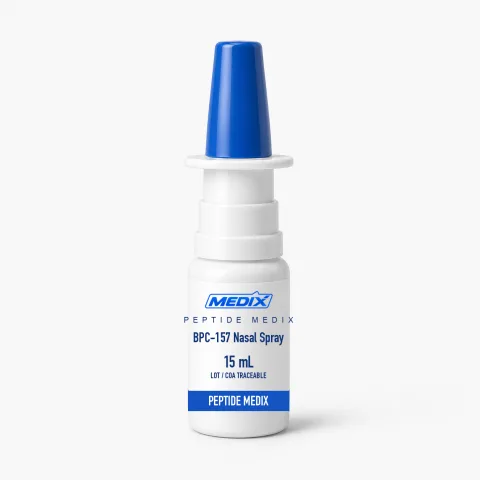
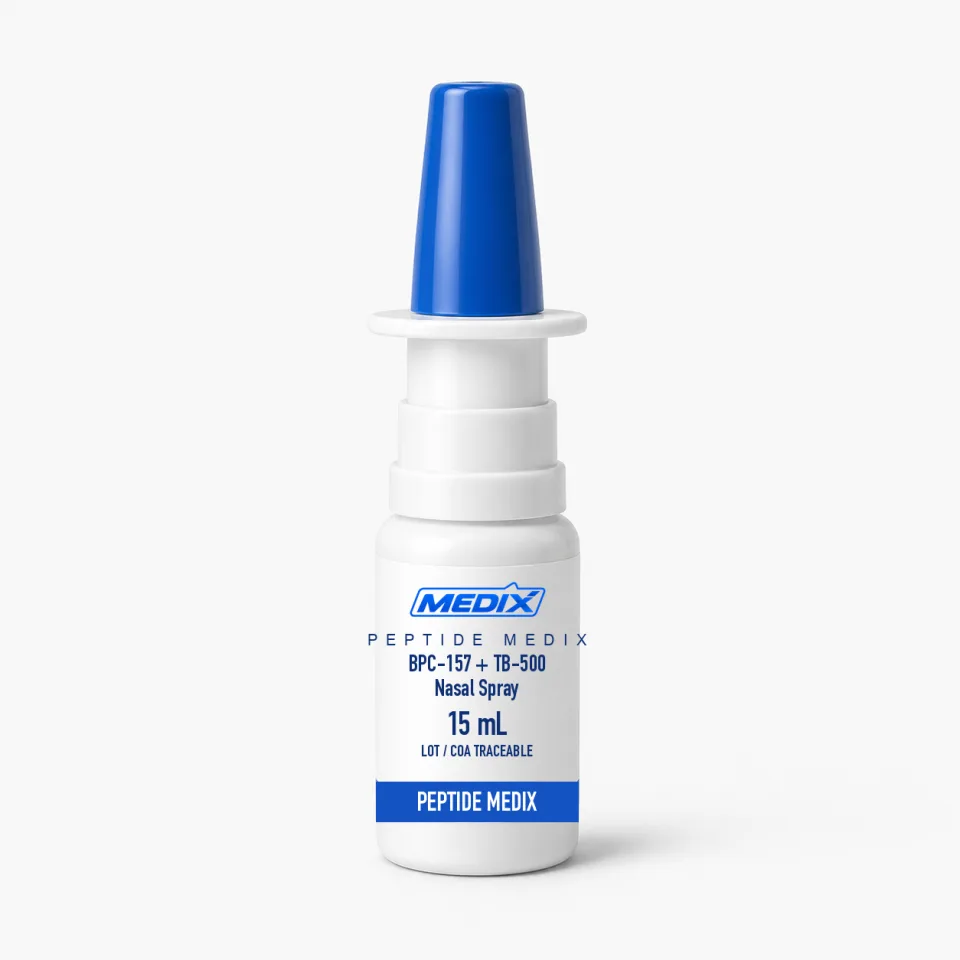
Pre-mixed BPC-157 and TB-500 solution in metered 15 mL and 30 mL pumps
- FormPre-mixed aqueous solution in an amber bottle with a metered nasal pump
- Research areasIntranasal peptide delivery, mucosal deposition, tendon and ligament repair models, cell migration, angiogenesis
Overview
This article combines the two peptides most often paired in soft-tissue repair research — BPC-157 and TB-500 — into a single ready-mixed aqueous solution, filled into an amber bottle with a metered nasal pump and offered in 15 mL and 30 mL sizes. Both actives are synthesised and purified separately to at least 99% by reversed-phase HPLC, then combined into one bulk solution, so the certificate of analysis reports each peptide on its own rather than describing the mixture as a whole.
BPC-157 is a fifteen-residue partial sequence of a protein identified in human gastric juice, notable among research peptides for its comparative stability in water. TB-500 is the acetylated seven-residue fragment corresponding to residues 17–23 of thymosin beta-4, the actin-binding domain of a 43-amino-acid G-actin sequestering protein. The two are studied together because they are described as acting through different routes: BPC-157 has been examined in relation to nitric oxide signalling and growth-factor receptor expression, while TB-500 work centres on actin dynamics and cell migration.
Specifications
Supply & purity
- Form
- Pre-mixed aqueous solution in an amber bottle with a metered nasal pump
- Available sizes
- 15 mL, 30 mL
Additional detail
- Components
- BPC-157 and TB-500 (thymosin beta-4 fragment 17–23)
- Fill note
- Both sizes are filled from the same bulk solution at the same nominal concentration; the peptide loading for your lot is printed on the label
- Purity input
- ≥99% by HPLC per component; lot-matched COA available
- BPC-157 CAS number
- 137525-51-0
- BPC-157 formula and mass
- C62H98N16O22, 1419.55 g/mol
- BPC-157 sequence
- Gly-Glu-Pro-Pro-Pro-Gly-Lys-Pro-Ala-Asp-Asp-Ala-Gly-Leu-Val
- TB-500 CAS number
- 885340-08-9
- TB-500 formula and mass
- C38H68N10O14, 889.02 g/mol
- TB-500 sequence
- Ac-Leu-Lys-Lys-Thr-Glu-Thr-Gln
- Vehicle
- Preserved aqueous vehicle suited to multi-actuation handling; clear and colourless when fresh
- Reconstitution
- None required — supplied ready to dispense
- Research areas
- Intranasal peptide delivery, mucosal deposition, tendon and ligament repair models, cell migration, angiogenesis
- Storage
- 2–8 °C upright, protected from light; do not freeze the filled bottle
Units and conversions
Because this is supplied at a stated strength, the question is rarely how much diluent to add — it is what that strength looks like in the units your method is written in. Convert mcg to mg, mL to µL and back with the unit converter.
Certificate of analysis
Every lot of BPC-157 + TB-500 Nasal Spray is released against a certificate of analysis: the batch-specific laboratory data for that lot, not a generic document for the compound. The lot number on the certificate matches the lot number printed on the label you receive — the vial label itself, where the product is vialled — so the record and the material it describes can always be reconciled.
Purity input: ≥99% by HPLC per component — the specification for this listing. The figure for the lot you receive is the one reported on that lot’s certificate.
No lot certificate is on display on this page at the moment. That is a publishing state and not a testing one: lots are released and documented as described above whether or not the document is posted here, and we will send what exists for the lot in stock, or for a lot already on your bench, by its number.
Certificates are available on request before you order as well as after, with no account and no charge. Request the certificate for this listing, read the testing and documentation policy in full, or see how to read a peptide COA.
Questions about BPC-157 + TB-500 Nasal Spray
What is the ratio of BPC-157 to TB-500 in the bottle?
The bulk solution is prepared at a fixed nominal ratio and the exact loading of each peptide is stated on the bottle label and repeated on the lot-matched certificate of analysis. Because both fills come from the same bulk, the 15 mL and 30 mL bottles are identical in concentration and differ only in volume.
Are these the same peptides as in your lyophilized vials?
Yes. The same ≥99% HPLC-purity BPC-157 and TB-500 are used, with the same CAS numbers, formulas and sequences. The only difference is presentation: this arrives pre-dissolved in a metered nasal pump instead of as a powder requiring reconstitution.
Do you provide a certificate of analysis?
Every bottle traces to a lot-matched COA covering both peptides used in the fill, with HPLC purity of ≥99% per component and mass-spectrometric identity confirmation. Each peptide is reported individually. Quote the lot number printed on the label when requesting the document.
How long does the solution stay good once opened?
That depends on your storage discipline and the study window you define. Cold, dark, upright storage slows hydrolysis and oxidation, but a solution is inherently less stable than a lyophilized cake. Studies extending over weeks should verify concentration analytically rather than relying on the label value.
Related