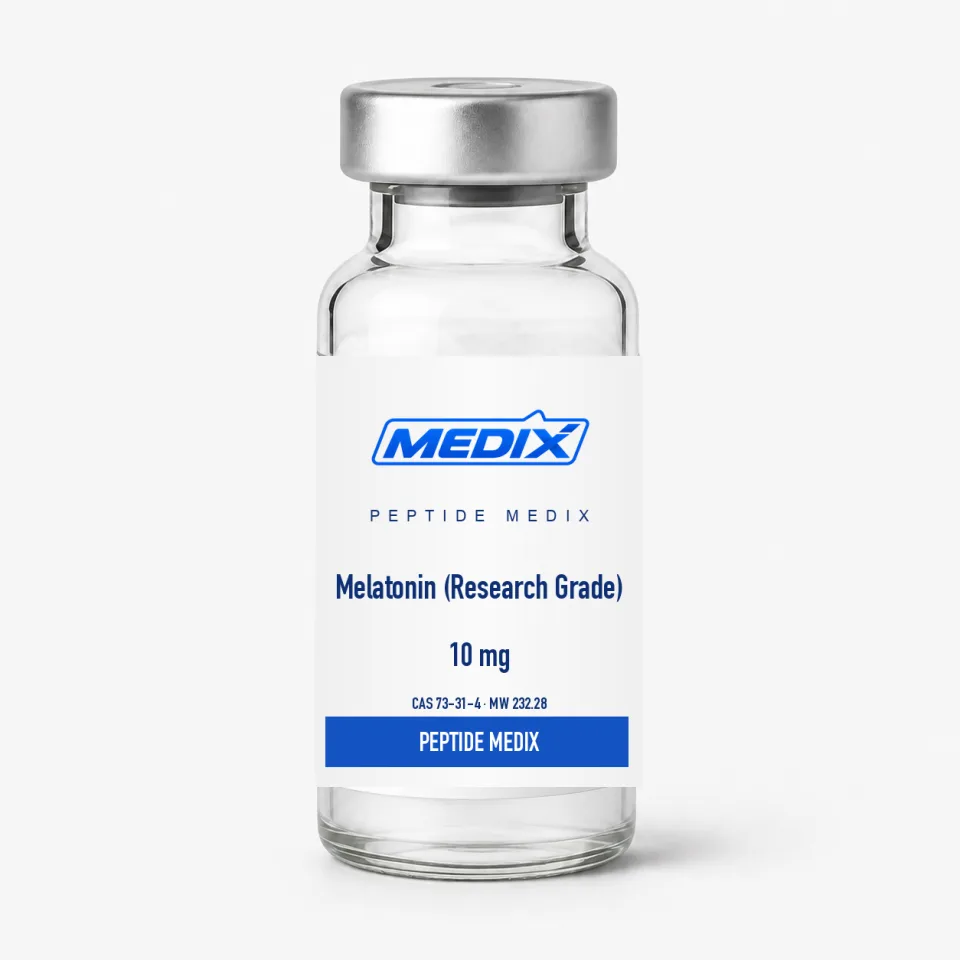
- ≥99% by HPLC
- Lot-matched certificate of analysis
- Ships next business day, tracked
Cognitive, Mood & Sleep Peptides
Melatonin (Research Grade)
N-acetyl-5-methoxytryptamine, research-grade vials in 10 mg and 50 mg
- FormCrystalline powder in a sealed glass vial
- Mol. weight232.28 g/mol
- Research areasCircadian rhythm and chronobiology, sleep-onset physiology, oxidative stress, mitochondrial function, seasonal and reproductive biology
Overview
Melatonin is N-acetyl-5-methoxytryptamine, an indoleamine produced in the pineal gland from tryptophan by way of serotonin, with the final two steps carried out by arylalkylamine N-acetyltransferase and acetylserotonin O-methyltransferase. Its synthesis is gated by the suprachiasmatic nucleus and suppressed by light reaching the retina, which is why circulating concentrations rise after dark and collapse at dawn. That tight coupling to the light–dark cycle has made the molecule one of the standard reference articles in chronobiology.
This listing is the small-molecule compound itself rather than a peptide, supplied as a research-grade powder in sealed vials at 10 mg and 50 mg. Melatonin acts at two G-protein-coupled receptors, MT1 and MT2, which couple through Gi to reduce cyclic AMP, and it also binds quinone reductase 2 (historically labelled MT3). Independently of receptors, the indole ring is a direct scavenger of reactive oxygen and nitrogen species, so the literature splits fairly cleanly into receptor-mediated chronobiological work and redox work.
Specifications
Identity
- CAS number
- 73-31-4
- Molecular formula
- C13H16N2O2
- Molecular weight
- 232.28 g/mol
Supply & purity
- Form
- Crystalline powder in a sealed glass vial
- Purity
- ≥99% by HPLC; lot-matched COA available
- Available sizes
- 10 mg, 50 mg
- Solubility
- Sparingly soluble in water; readily soluble in ethanol or DMSO for stock preparation
Additional detail
- Chemical name
- N-acetyl-5-methoxytryptamine
- Compound class
- Indoleamine; tryptophan-derived pineal hormone (small molecule, not a peptide)
- Biosynthetic origin
- Tryptophan to serotonin to N-acetylserotonin to melatonin, via AANAT and ASMT
- Molecular targets studied
- MT1 and MT2 G-protein-coupled receptors; quinone reductase 2 (MT3 site)
- Research areas
- Circadian rhythm and chronobiology, sleep-onset physiology, oxidative stress, mitochondrial function, seasonal and reproductive biology
- Storage (powder)
- −20 °C, sealed, desiccated and protected from light
- Storage (in solution)
- 2–8 °C in amber or foil-wrapped vessels; aliquot frozen stocks
Working out the concentration
Reconstitution is where the arithmetic lives. The same vial made up with 1 mL or with 3 mL of diluent gives three-fold different numbers, which is why a reconstitution volume calculator is more use here than a fixed table: enter the vial mass and your diluent volume and read the concentration back.
For work specified in µM or nM rather than mg/mL, feed 232.28 g/mol and your volume into the peptide molarity calculator.
Certificate of analysis
Every lot of Melatonin (Research Grade) is released against a certificate of analysis: the batch-specific laboratory data for that lot, not a generic document for the compound. The lot number on the certificate matches the lot number printed on the label you receive — the vial label itself, where the product is vialled — so the record and the material it describes can always be reconciled.
Purity: ≥99% by HPLC — the specification for this listing. The figure for the lot you receive is the one reported on that lot’s certificate.
No lot certificate is on display on this page at the moment. That is a publishing state and not a testing one: lots are released and documented as described above whether or not the document is posted here, and we will send what exists for the lot in stock, or for a lot already on your bench, by its number.
Certificates are available on request before you order as well as after, with no account and no charge. Request the certificate for this listing, read the testing and documentation policy in full, or see how to read a peptide COA.
Questions about Melatonin (Research Grade)
Is melatonin a peptide?
No. Melatonin is a small indoleamine derived from tryptophan, with a molecular weight of about 232 g/mol — roughly a tenth the size of most research peptides. It is catalogued alongside sleep-related peptides such as DSIP because of overlapping research areas, not because of any structural relationship.
What sizes and purity are available?
Vials are supplied at 10 mg and 50 mg of research-grade powder, tested to ≥99% purity by HPLC. Each lot carries a matched certificate of analysis covering purity and identity; quote the lot number printed on the vial when requesting the document.
How is it dissolved for laboratory work?
Melatonin is only sparingly soluble in water. The usual approach is a concentrated stock in ethanol or DMSO, diluted into aqueous buffer just before use, with the final solvent concentration kept low enough not to affect the assay system. Solubility should be verified for your specific buffer.
Why does it need protection from light?
The indole ring is photolabile and degrades measurably under normal laboratory lighting, and solutions oxidise faster than the dry powder. Sealed, cold, dark storage plus amber or foil-wrapped vessels for solutions is standard practice, and light exposure should be logged if quantitative accuracy matters.
Related