- Lot-matched certificate of analysis
- Ships next business day, tracked
Cortexin
Low-molecular-weight cortical polypeptide complex, 10 mg lyophilized vials
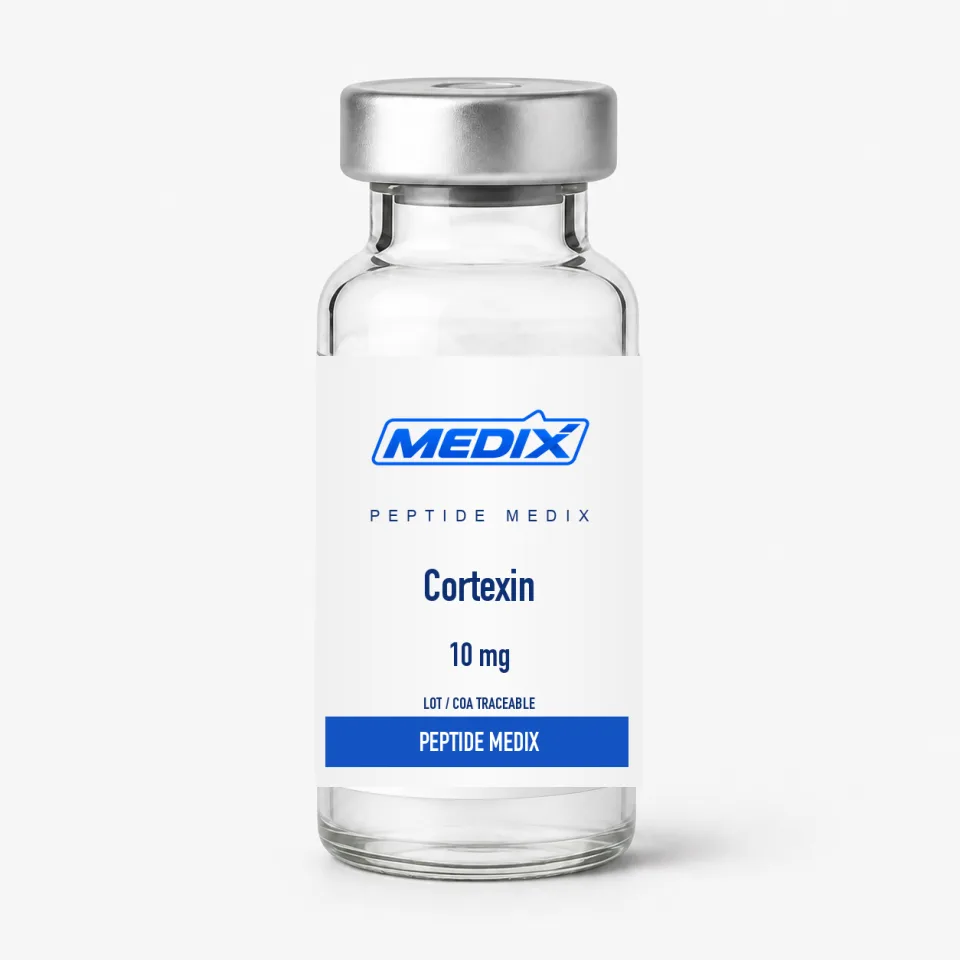
- FormLyophilized powder, sealed glass vial with flip-off seal
- Research areasNeurotrophic signalling, neuronal survival under stress, synaptic markers, cognition models
Overview
Cortexin is a polypeptide complex rather than a single defined molecule. It is prepared from mammalian cerebral cortex tissue and fractionated so that the finished material consists of water-soluble peptides below roughly 10 kilodaltons, together with free amino acids and trace elements. It belongs to the same family of Russian and Eastern European peptide preparations as Cerebrolysin, and the two are often discussed side by side in the neuropeptide literature.
Because the preparation is a mixture, its research profile is described in terms of fractions and activity rather than a sequence. Investigators study cortical peptide complexes for effects on neurotrophic signalling, neuronal survival under ischaemic or excitotoxic stress, synaptic marker expression and electrophysiological readouts in cultured neurons. Much of the published work sits in the Russian-language literature, and Western replication remains limited, which makes characterisation itself an open research question.
Specifications
Supply & purity
- Form
- Lyophilized powder, sealed glass vial with flip-off seal
- Available sizes
- 10 mg single vial; 10 mg × 10 vial pack
- Solubility
- Readily soluble in sterile or bacteriostatic water
Handling & storage
- Storage (lyophilized)
- 2–8 °C or below, protected from light and moisture
- Storage (reconstituted)
- 2–8 °C, protected from light; use within a short study window
Additional detail
- Product type
- Polypeptide complex (mixture), not a single-sequence peptide
- Composition
- Water-soluble cortical polypeptide fractions with free amino acids and trace elements
- Molecular weight range
- Peptide fractions below approximately 10 kDa
- Source material
- Mammalian cerebral cortex tissue, fractionated and purified
- Compound class
- Tissue-derived neuropeptide preparation
- Comparable preparations
- Cerebrolysin and other cortical or pineal polypeptide complexes
- Analytical documentation
- Identity and fraction-profile testing per lot; COA available
- Research areas
- Neurotrophic signalling, neuronal survival under stress, synaptic markers, cognition models
Working out the concentration
Reconstitution is where the arithmetic lives. The same vial made up with 1 mL or with 3 mL of diluent gives three-fold different numbers, which is why a reconstitution volume calculator is more use here than a fixed table: enter the vial mass and your diluent volume and read the concentration back.
Certificate of analysis
Every lot of Cortexin is released against its own lot documentation, and where the manufacturer issues a certificate of analysis for it, that certificate is the record for the lot rather than a generic document for the compound. The lot number on the certificate matches the lot number printed on the label you receive — the vial label itself, where the product is vialled — so the record and the material it describes can always be reconciled.
This listing carries no purity percentage, so none is claimed for it here. Where the manufacturer issues analytical documentation for a lot of this item, it is passed on unaltered — ask and we will send whatever exists.
No lot certificate is on display on this page at the moment. That is a publishing state and not a testing one: lots are released and documented as described above whether or not the document is posted here, and we will send what exists for the lot in stock, or for a lot already on your bench, by its number.
Certificates are available on request before you order as well as after, with no account and no charge. Request the certificate for this listing, read the testing and documentation policy in full, or see how to read a peptide COA.
Questions about Cortexin
Is Cortexin a single peptide?
No. It is a polypeptide complex, meaning a fractionated mixture of water-soluble peptides below roughly 10 kDa along with free amino acids and trace elements. There is no single CAS number, molecular formula or amino acid sequence to quote for it, and analysis is reported as a fraction profile.
How does it differ from Cerebrolysin?
Both are tissue-derived neuropeptide preparations with low-molecular-weight fractions, but they differ in source tissue, manufacturing process and presentation. Cerebrolysin is supplied as a solution in ampoules, while Cortexin is a lyophilized powder that the laboratory reconstitutes before use.
What documentation is supplied?
Each lot ships with identity and fraction-profile testing appropriate to a peptide complex, and a certificate of analysis is available. A single-peak HPLC purity percentage is not meaningful for a mixture, so the documentation describes composition and consistency instead.
How should it be stored?
Keep sealed vials refrigerated at 2–8 °C or colder, away from light and moisture. Once reconstituted, hold at 2–8 °C and use within a short window, since mixed peptide preparations are less stable in solution than purified single-sequence peptides.
Related