- Lot-matched certificate of analysis
- Ships next business day, tracked
Cerebrolysin Peptide
Porcine brain-derived low-molecular-weight peptide solution in sealed ampoules
- FormSterile aqueous solution in sealed glass ampoules (no lyophilized cake)
- Research areasNeurotrophic signaling, neurodegeneration models, cerebral ischemia, traumatic brain injury models
Overview
Cerebrolysin is not a single molecule. It is a standardized enzymatic hydrolysate prepared from purified porcine brain protein, consisting of free amino acids together with a fraction of low-molecular-weight biologically active peptides, conventionally described as under 10 kDa. That composition is why it is handled and specified quite differently from a synthetic research peptide: there is no single sequence, formula or HPLC purity figure to quote, and the meaningful specifications are concentration, volume, sterility and lot documentation.
The preparation has been studied for several decades, primarily in Europe and Asia, in models of neurodegeneration, cerebral ischemia and traumatic brain injury. The recurring scientific claim in that literature is neurotrophic-like activity, with reports comparing components of the hydrolysate to endogenous factors such as CNTF, GDNF and IGF family peptides. Because the material is a mixture, mechanistic interpretation is inherently harder than with a defined compound, and batch standardization is a central methodological concern.
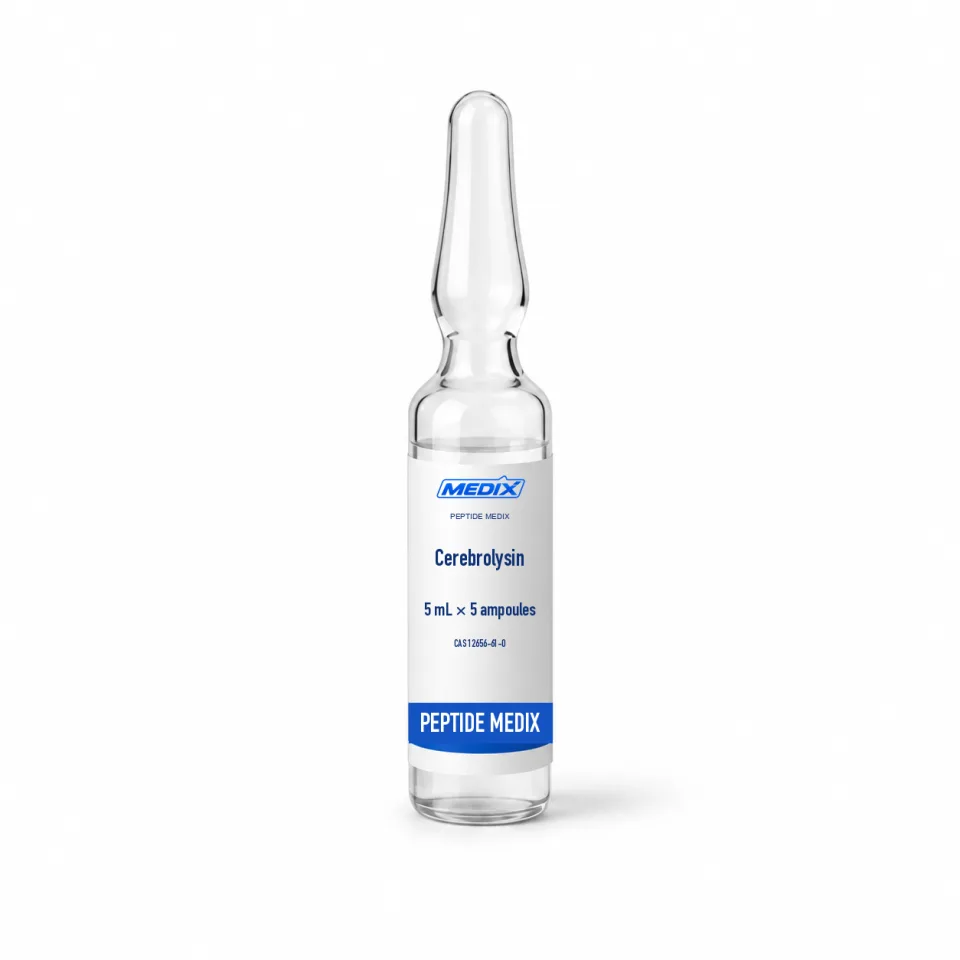
Peptide Medix supplies Cerebrolysin as a sterile aqueous solution in sealed glass ampoules, offered in 5 mL and 10 mL sizes in packs of five. It is intended for laboratory research applications only — comparative assay work, analytical characterization, and approved animal studies. It is not a drug, supplement or consumer product.
Specifications
Identity
- CAS number
- 12656-61-0
Supply & purity
- Form
- Sterile aqueous solution in sealed glass ampoules (no lyophilized cake)
- Available sizes
- 5 mL × 5 ampoules, 10 mL × 5 ampoules
Additional detail
- Composition
- Free amino acids plus low-molecular-weight peptides from enzymatic hydrolysis
- Peptide fraction
- Conventionally described as below 10 kDa
- Source material
- Purified porcine brain protein
- Documentation
- Lot-matched COA available; purity is reported as composition, not single-compound HPLC purity
- Compound class
- Brain-derived peptide hydrolysate (multi-component preparation)
- Research areas
- Neurotrophic signaling, neurodegeneration models, cerebral ischemia, traumatic brain injury models
- Storage
- Store below 25 °C, protected from light; do not freeze
- After opening
- Single-use ampoule; do not retain opened contents for later sessions
- Compatibility note
- Avoid mixing with strongly alkaline or high-ionic-strength solutions without compatibility testing
Working out the concentration
The vial sizes above — 5 mL × 5 ampoules, 10 mL × 5 ampoules — describe a mass of material, not a strength. Choose a diluent volume, work it out with the reconstitution calculator, and you have the concentration for your own vial of Cerebrolysin plus the volume that carries any mass you want to withdraw.
Certificate of analysis
Every lot of Cerebrolysin is released against its own lot documentation, and where the manufacturer issues a certificate of analysis for it, that certificate is the record for the lot rather than a generic document for the compound. The lot number on the certificate matches the lot number printed on the label you receive — the vial label itself, where the product is vialled — so the record and the material it describes can always be reconciled.
This listing carries no purity percentage, so none is claimed for it here. Where the manufacturer issues analytical documentation for a lot of this item, it is passed on unaltered — ask and we will send whatever exists.
No lot certificate is on display on this page at the moment. That is a publishing state and not a testing one: lots are released and documented as described above whether or not the document is posted here, and we will send what exists for the lot in stock, or for a lot already on your bench, by its number.
Certificates are available on request before you order as well as after, with no account and no charge. Request the certificate for this listing, read the testing and documentation policy in full, or see how to read a peptide COA.
Questions about Cerebrolysin
Why does Cerebrolysin have no purity percentage or sequence?
It is a peptide hydrolysate rather than a single synthetic compound, so there is no one sequence or molecular formula to report. The relevant specifications are peptide and amino acid composition, molecular weight distribution, volume and sterility, all documented in the lot paperwork.
Does it need to be reconstituted?
No. Cerebrolysin ships as a ready-to-use sterile aqueous solution in sealed ampoules, so no bacteriostatic water or reconstitution step is required. That also means it must not be frozen and should be protected from light in storage.
What sizes are available?
It is offered as a pack of five 5 mL ampoules and a pack of five 10 mL ampoules. Because composition varies between production lots, laboratories running comparative work generally order enough of one lot to complete the full study series.
What documentation is provided?
A lot-matched certificate of analysis is available on request. For a hydrolysate the COA reports compositional and quality parameters rather than the single-compound HPLC purity figure used for synthetic peptides, so read it against your assay requirements.
Where does the material come from?
The preparation is produced by controlled enzymatic hydrolysis of purified porcine brain protein. That animal-derived origin is one reason batch identity should be recorded alongside experimental data and why lots should not be mixed within a single study arm.
Related