- ≥99% by HPLC
- Lot-matched certificate of analysis
- Ships next business day, tracked
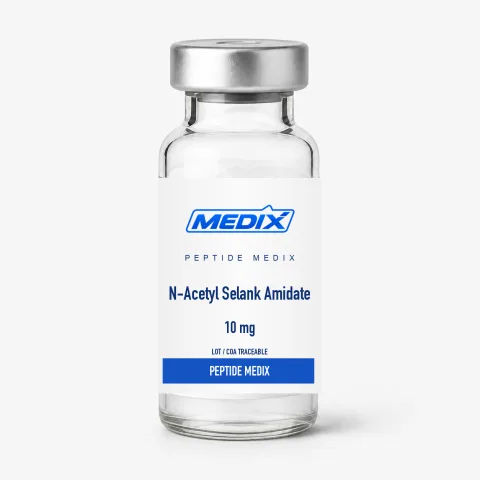
N-Acetyl Semax Amidate
Terminally protected Semax analog for extended-stability research
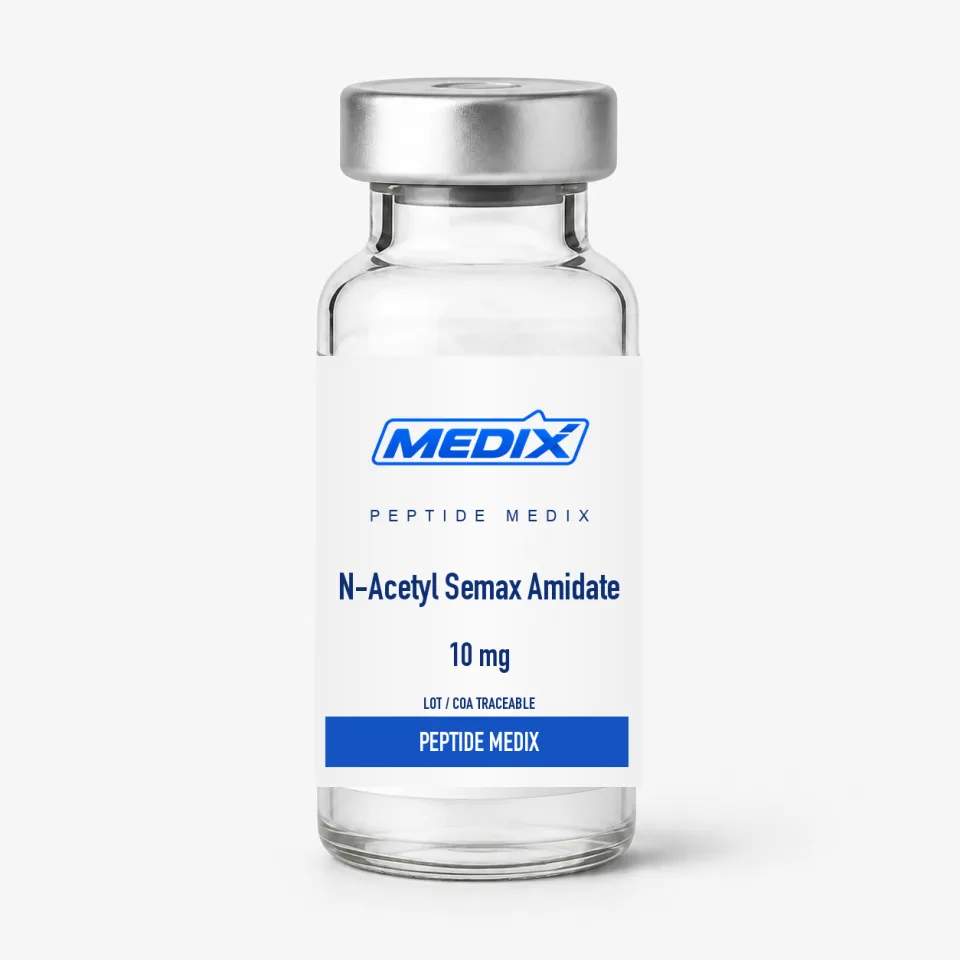
- FormLyophilized white powder in a sealed glass vial
- Research areasPeptide stability, neurotrophic factor expression, attention and memory models
Overview
N-Acetyl Semax Amidate, often abbreviated NA-Semax-Amidate or NASA, is a doubly protected derivative of Semax. Two chemical modifications are applied to the parent heptapeptide Met-Glu-His-Phe-Pro-Gly-Pro: an acetyl group caps the free N-terminus and the C-terminal carboxyl is converted to a primary amide. Both changes are standard peptide-chemistry strategies for blocking exopeptidase attack, and both remove a charged terminus, which also alters the molecule's overall polarity.
The design intent behind these modifications is stability rather than a new mechanism. Researchers who work with terminally protected analogs are typically comparing degradation kinetics, plasma and tissue residence, and mucosal permeability against the unmodified parent. In the Semax family this comparison is of particular interest because the parent peptide already carries a Pro-Gly-Pro tail added for the same reason, so the amidated acetylated version represents a second layer of protection.
Supplied here as a 10 mg lyophilized vial for laboratory use — stability studies, analytical method development, in vitro assays and approved animal research. Each batch is HPLC-purified with a lot-matched certificate of analysis available. This is a research chemical: not a drug, not a supplement.
Specifications
Identity
- Amino acid sequence
- Ac-Met-Glu-His-Phe-Pro-Gly-Pro-NH2
- Peptide class
- Terminally protected synthetic ACTH(4-10) analog
Supply & purity
- Form
- Lyophilized white powder in a sealed glass vial
- Purity
- ≥99% by HPLC; lot-matched COA available
- Solubility
- Soluble in bacteriostatic water and sterile water
Handling & storage
- Storage (lyophilized)
- −20 °C, protected from light and moisture
- Storage (reconstituted)
- 2–8 °C; aliquot to avoid freeze-thaw cycles
Additional detail
- Available size
- 10 mg
- Parent peptide
- Semax — ACTH(4-10) analog, CAS 80714-61-0
- Modifications
- N-terminal acetyl cap; C-terminal primary amide
- Research areas
- Peptide stability, neurotrophic factor expression, attention and memory models
- Synthesis
- Solid-phase peptide synthesis with preparative HPLC purification
Working out the concentration
Reconstitution is where the arithmetic lives. The same vial made up with 1 mL or with 3 mL of diluent gives three-fold different numbers, which is why a reconstitution volume calculator is more use here than a fixed table: enter the vial mass and your diluent volume and read the concentration back.
Certificate of analysis
Every lot of N-Acetyl Semax Amidate is released against a certificate of analysis: the batch-specific laboratory data for that lot, not a generic document for the compound. The lot number on the certificate matches the lot number printed on the label you receive — the vial label itself, where the product is vialled — so the record and the material it describes can always be reconciled.
Purity: ≥99% by HPLC — the specification for this listing. The figure for the lot you receive is the one reported on that lot’s certificate.
No lot certificate is on display on this page at the moment. That is a publishing state and not a testing one: lots are released and documented as described above whether or not the document is posted here, and we will send what exists for the lot in stock, or for a lot already on your bench, by its number.
Certificates are available on request before you order as well as after, with no account and no charge. Request the certificate for this listing, read the testing and documentation policy in full, or see how to read a peptide COA.
Questions about N-Acetyl Semax Amidate
How does this differ from standard Semax?
The backbone sequence is identical. This version adds an acetyl group at the N-terminus and converts the C-terminal acid to an amide. Both modifications block exopeptidase cleavage and remove a charged terminus, so the analog is studied primarily for stability and permeability characteristics rather than a different mechanism.
Is a certificate of analysis provided?
Yes. Every lot is HPLC-tested for purity and mass-spec confirmed for identity, with a lot-matched COA available on request. For modified analogs the observed mass is especially useful, since it confirms both the acetylation and the amidation are present.
What size is available?
This item ships as a single 10 mg lyophilized vial. That quantity suits comparative stability panels and in vitro assay series where the unmodified parent peptide is run alongside as a control.
How should it be stored after reconstitution?
Keep the solution at 2–8 °C, protected from light, and use it within your planned study window. Aliquot into single-use portions rather than repeatedly freezing and thawing a single vial, which degrades peptides regardless of terminal protection.
Which solvent is appropriate?
Bacteriostatic water is the standard benchtop choice, with sterile water used when a preservative-free solution is required. Add solvent slowly to the vial wall and allow the powder to dissolve without agitation. Concentrations are determined by your own experimental design.
Related