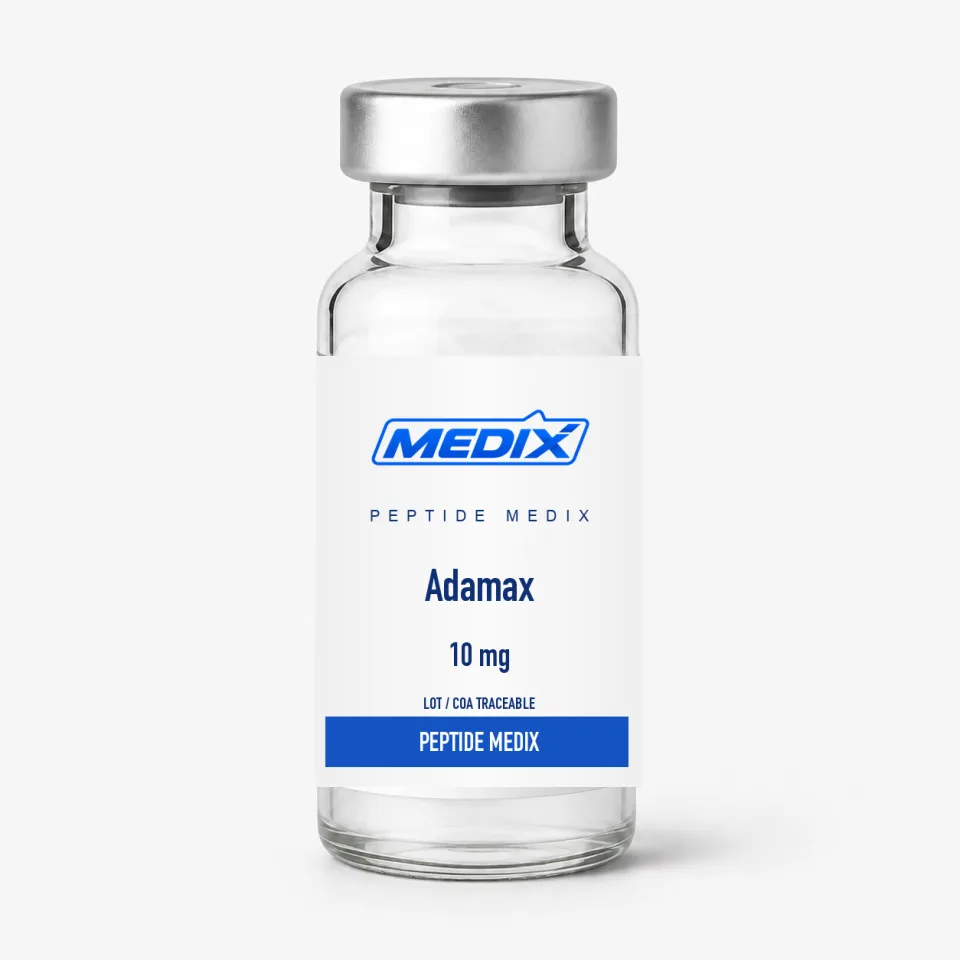
- ≥99% by HPLC
- Lot-matched certificate of analysis
- Ships next business day, tracked
Adamax Peptide
Adamantane-modified Semax-family analog for neurotrophic signaling research
- FormLyophilized powder in a sealed glass vial
- Research areasNeurotrophic signaling assays, BDNF/TrkB-associated markers, comparative analog panels
Overview
Adamax is a synthetic research compound described in supplier documentation as a structural analog within the Semax family, carrying an adamantane modification. Adamantane is a rigid, highly lipophilic cage hydrocarbon used across medicinal chemistry to increase metabolic stability and lipid partitioning; attaching it to a short neuropeptide backbone is the same tactic applied to P-21, another adamantylated research compound in the cognitive category.
Compared with the peptides it is grouped with, Adamax has a thin independent literature. Most of what circulates about it extrapolates from the Semax/ACTH(4-10) family and from what adamantane conjugation generally does to a small molecule. Laboratories that work with it are typically running comparative characterization: confirming identity analytically, measuring solubility and stability behavior, and placing it beside better-documented analogs in the same assay panel rather than assuming an established profile.
Specifications
Supply & purity
- Form
- Lyophilized powder in a sealed glass vial
- Purity
- ≥99% by HPLC; lot-matched COA available
- Solubility
- Reduced aqueous solubility expected from the adamantane group; a co-solvent step is commonly used
Handling & storage
- Storage (lyophilized)
- −20 °C, protected from light and moisture
Additional detail
- Available size
- 10 mg
- Compound class
- Adamantane-modified synthetic peptide analog
- Family
- Described within the Semax / ACTH(4-10) analog research family
- Research areas
- Neurotrophic signaling assays, BDNF/TrkB-associated markers, comparative analog panels
- Synthesis
- Solid-phase peptide synthesis with preparative HPLC purification
- Storage (in solution)
- 2–8 °C short term; aliquot and freeze for longer storage
- Shipping
- Ships from a United States facility; stable at ambient temperature in transit
Working out the concentration
The vial sizes above — 10 mg — describe a mass of material, not a strength. Choose a diluent volume, work it out with the reconstitution calculator, and you have the concentration for your own vial of Adamax plus the volume that carries any mass you want to withdraw.
Certificate of analysis
Every lot of Adamax is released against a certificate of analysis: the batch-specific laboratory data for that lot, not a generic document for the compound. The lot number on the certificate matches the lot number printed on the label you receive — the vial label itself, where the product is vialled — so the record and the material it describes can always be reconciled.
Purity: ≥99% by HPLC — the specification for this listing. The figure for the lot you receive is the one reported on that lot’s certificate.
No lot certificate is on display on this page at the moment. That is a publishing state and not a testing one: lots are released and documented as described above whether or not the document is posted here, and we will send what exists for the lot in stock, or for a lot already on your bench, by its number.
Certificates are available on request before you order as well as after, with no account and no charge. Request the certificate for this listing, read the testing and documentation policy in full, or see how to read a peptide COA.
Questions about Adamax
What exactly is Adamax?
It is a synthetic research compound described as an adamantane-modified analog within the Semax peptide family. Independent structural literature is limited, so the lot certificate of analysis, which reports HPLC purity and mass-spec identity, is the most reliable record of what is in your vial.
Why is an adamantane group added?
Adamantane is a rigid, highly lipophilic cage hydrocarbon widely used in medicinal chemistry to slow metabolic clearance and improve lipid partitioning. In peptide analog design it serves the same purpose as acetylation or amidation: making a short, fragile sequence more durable.
Is a certificate of analysis provided?
Yes. Each lot is analyzed by reversed-phase HPLC for purity and by mass spectrometry for identity, with a lot-matched COA available on request. For a compound with limited published characterization, that documentation should be reviewed before any assay work begins.
How should Adamax be dissolved?
The adamantane group reduces aqueous solubility relative to standard research peptides. Most laboratories dissolve it first in a compatible organic co-solvent to make a concentrated stock, then dilute into buffer immediately before use and check for precipitation at the working concentration.
Related