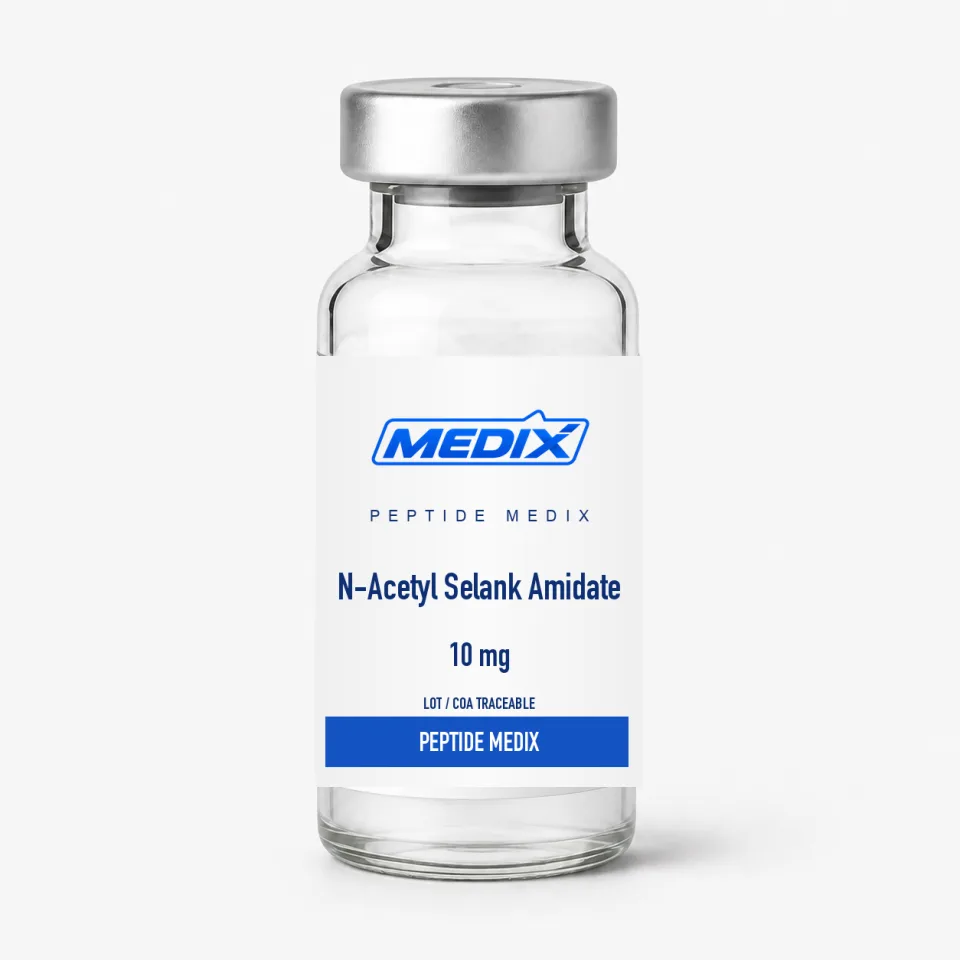
- ≥99% by HPLC
- Lot-matched certificate of analysis
- Ships next business day, tracked
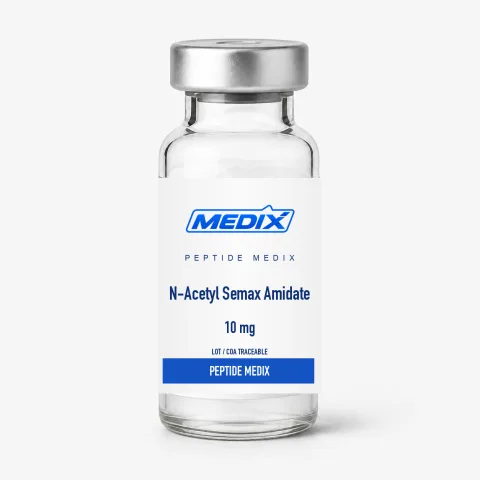
N-Acetyl Selank Amidate
Terminally protected Selank analog for stability and behavioral research
- FormLyophilized white powder in a sealed glass vial
- Research areasPeptide stability, anxiety-like behavior models, GABAergic markers, cytokine expression
Overview
N-Acetyl Selank Amidate is a chemically protected version of Selank, the tuftsin-derived heptapeptide Thr-Lys-Pro-Arg-Pro-Gly-Pro. An acetyl group caps the N-terminus and the C-terminal carboxyl is converted to a primary amide, giving the sequence Ac-Thr-Lys-Pro-Arg-Pro-Gly-Pro-NH2. Neither change alters the residue order; both are conventional strategies for shielding a peptide from the aminopeptidases and carboxypeptidases that act at free termini.
Peptide Medix supplies the compound as a 10 mg lyophilized vial for in vitro assays, analytical development and approved animal research. Each lot is purified by preparative HPLC, checked for identity by mass spectrometry, and accompanied by a lot-matched certificate of analysis on request. The material ships from a United States facility. It is not a drug, supplement or consumer product.
Specifications
Identity
- Amino acid sequence
- Ac-Thr-Lys-Pro-Arg-Pro-Gly-Pro-NH2
- Peptide class
- Terminally protected synthetic tuftsin analog
Supply & purity
- Form
- Lyophilized white powder in a sealed glass vial
- Purity
- ≥99% by HPLC; lot-matched COA available
- Solubility
- Freely soluble in bacteriostatic water and sterile water
Handling & storage
- Storage (lyophilized)
- −20 °C, protected from light and moisture
- Storage (reconstituted)
- 2–8 °C; aliquot to avoid repeated freeze-thaw
Additional detail
- Available size
- 10 mg
- Parent peptide
- Selank — tuftsin analog, CAS 129954-34-3
- Modifications
- N-terminal acetyl cap; C-terminal primary amide
- Research areas
- Peptide stability, anxiety-like behavior models, GABAergic markers, cytokine expression
- Synthesis
- Solid-phase peptide synthesis with preparative HPLC purification
Working out the concentration
Because N-Acetyl Selank Amidate arrives dry, its concentration is a decision rather than a specification. Run the numbers through the reconstitution calculator — vial mass in, diluent volume in, mg/mL and mass per syringe unit out.
Certificate of analysis
Every lot of N-Acetyl Selank Amidate is released against a certificate of analysis: the batch-specific laboratory data for that lot, not a generic document for the compound. The lot number on the certificate matches the lot number printed on the label you receive — the vial label itself, where the product is vialled — so the record and the material it describes can always be reconciled.
Purity: ≥99% by HPLC — the specification for this listing. The figure for the lot you receive is the one reported on that lot’s certificate.
No lot certificate is on display on this page at the moment. That is a publishing state and not a testing one: lots are released and documented as described above whether or not the document is posted here, and we will send what exists for the lot in stock, or for a lot already on your bench, by its number.
Certificates are available on request before you order as well as after, with no account and no charge. Request the certificate for this listing, read the testing and documentation policy in full, or see how to read a peptide COA.
Questions about N-Acetyl Selank Amidate
What is the difference between this and regular Selank?
The amino acid sequence is the same. This analog adds an N-terminal acetyl group and a C-terminal amide, both of which block exopeptidase cleavage and neutralize the terminal charges. It is studied mainly for stability and permeability comparisons rather than for a distinct mechanism of action.
Is the peptide third-party tested?
Yes. Each lot is analyzed by reversed-phase HPLC for purity and by mass spectrometry for identity, with a lot-matched certificate of analysis available on request. The observed mass also verifies that both terminal modifications are present on the finished material.
What quantity is supplied?
This product ships as one 10 mg lyophilized vial. That amount typically covers a comparative assay series in which the protected analog and the unmodified parent peptide are run side by side under identical conditions.
How long is the reconstituted solution usable?
Keep it at 2–8 °C, protected from light, and use it within the window your protocol defines. Terminal protection slows enzymatic degradation but does not make a peptide indefinitely stable in aqueous solution, so aliquoting and cold storage still matter.
Which solvent should be used?
Bacteriostatic water is standard for benchtop reconstitution; sterile water is used when a preservative-free preparation is needed. Add solvent slowly and let the powder dissolve without agitation. Working concentrations depend entirely on your assay design.
Related