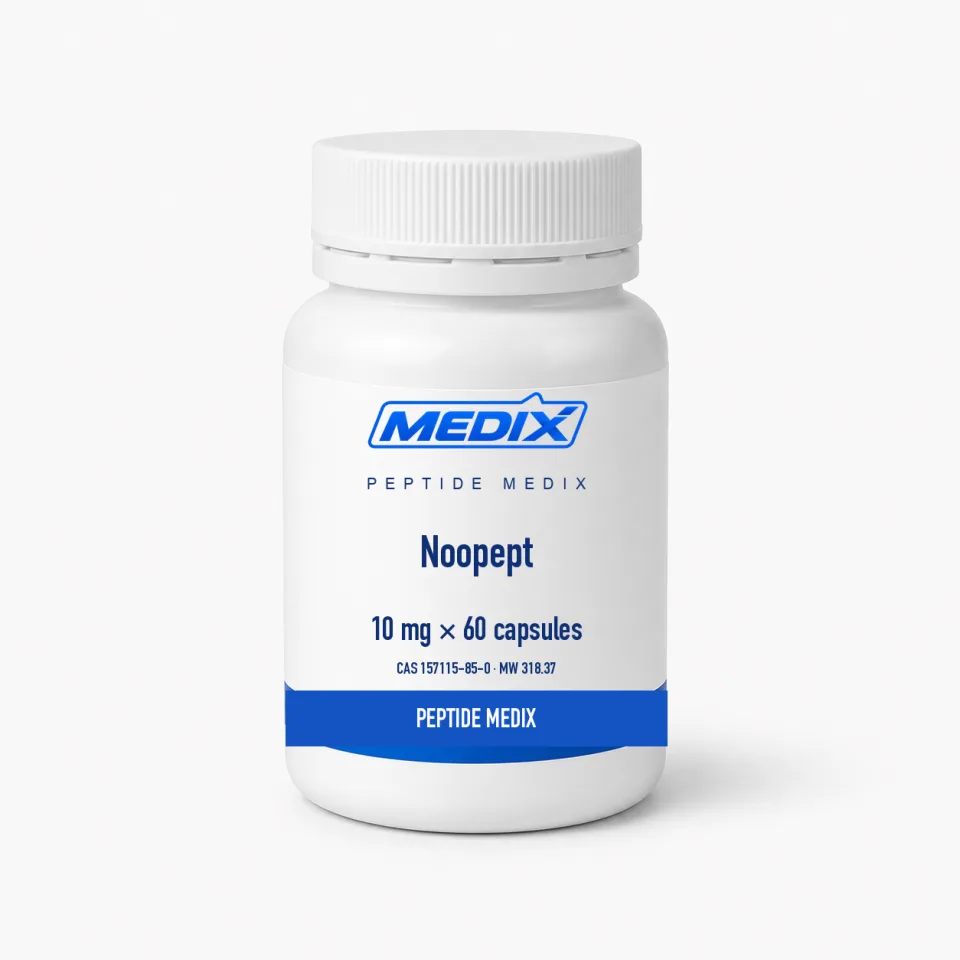
- ≥98% by HPLC
- Lot-matched certificate of analysis
- Ships next business day, tracked
Noopept
N-phenylacetyl-L-prolylglycine ethyl ester, a dipeptide-derived nootropic compound
- FormOral capsules in a sealed bottle with desiccant
- Mol. weight318.37 g/mol
- Research areasNGF and BDNF mRNA expression, hippocampal memory paradigms, anxiolytic and neuroprotective animal models
Overview
Noopept is the common name for N-phenylacetyl-L-prolylglycine ethyl ester, a synthetic compound built on a proline–glycine dipeptide backbone with a phenylacetyl group at the N-terminus and an ethyl ester at the C-terminus. Its formula is C17H22N2O4 and its molecular weight 318.37 g/mol, making it far smaller than the peptide nootropics it is usually compared with, such as Semax and Selank. It was developed at the Zakusov Institute of Pharmacology in Moscow as a dipeptide analogue of the racetam scaffold.
Laboratory interest centres on reports of nerve growth factor and BDNF mRNA changes in rodent hippocampus, on anxiolytic and neuroprotective endpoints in animal models, and on comparisons with piracetam-family compounds. We supply Noopept as finished capsules in a sealed bottle at two research strengths, HPLC tested with a lot-matched Certificate of Analysis available.
Specifications
Identity
- CAS number
- 157115-85-0
- Molecular formula
- C17H22N2O4
- Molecular weight
- 318.37 g/mol
Supply & purity
- Form
- Oral capsules in a sealed bottle with desiccant
- Purity
- ≥98% by HPLC; lot-matched COA available
- Available sizes
- 10 mg × 60 capsules, 30 mg × 60 capsules
Additional detail
- Chemical name
- Ethyl N-phenylacetyl-L-prolylglycinate
- Also known as
- Noopept, GVS-111, omberacetam
- Compound class
- Dipeptide-derived nootropic (proline-glycine backbone, N-phenylacetylated, C-terminal ethyl ester)
- Principal metabolite
- Cycloprolylglycine (cyclo-Pro-Gly), an endogenous cyclic dipeptide
- Research areas
- NGF and BDNF mRNA expression, hippocampal memory paradigms, anxiolytic and neuroprotective animal models
- Regulatory status
- Not approved in the United States; does not meet the statutory definition of a dietary ingredient
- Reconstitution
- None required — supplied in finished capsule form
- Storage
- Room temperature in the sealed bottle, protected from light, heat and humidity
Units and conversions
Capsule and troche strengths are stated per unit, so the figure a method needs is usually a conversion rather than a dilution. The mcg to mg converter handles the milligram-to-microgram step, and the millilitre arithmetic if you are working from a solution format instead.
Certificate of analysis
Every lot of Noopept is released against a certificate of analysis: the batch-specific laboratory data for that lot, not a generic document for the compound. The lot number on the certificate matches the lot number printed on the label you receive — the vial label itself, where the product is vialled — so the record and the material it describes can always be reconciled.
Purity: ≥98% by HPLC — the specification for this listing. The figure for the lot you receive is the one reported on that lot’s certificate.
No lot certificate is on display on this page at the moment. That is a publishing state and not a testing one: lots are released and documented as described above whether or not the document is posted here, and we will send what exists for the lot in stock, or for a lot already on your bench, by its number.
Certificates are available on request before you order as well as after, with no account and no charge. Request the certificate for this listing, read the testing and documentation policy in full, or see how to read a peptide COA.
Questions about Noopept
What is Noopept?
Noopept is N-phenylacetyl-L-prolylglycine ethyl ester, a synthetic compound built on a proline-glycine dipeptide backbone. Developed in Russia as a dipeptide analogue of the racetam scaffold, it is used in laboratory research on neurotrophin expression, memory paradigms and neuroprotection models.
Is Noopept a peptide?
Only in part. It contains a proline-glycine dipeptide core, but the N-terminal phenylacetyl group and C-terminal ethyl ester make it behave as a small molecule rather than a conventional peptide. At 318.37 g/mol it is much smaller than peptide nootropics such as Semax or Selank.
How is purity verified?
Every lot is tested by HPLC for purity of at least 98% and checked for identity against the expected 318.37 g/mol mass. The lot-matched Certificate of Analysis is available on this product page before purchase and documents the full analytical results.
What sizes are available?
Noopept is supplied as 10 mg × 60 capsules and 30 mg × 60 capsules in sealed bottles with desiccant. Two strengths in the same capsule count make concentration comparisons straightforward without weighing bulk powder in the laboratory.
Related