- Purity (raw material): ≥99% by HPLC
- Lot-matched certificate of analysis
- Ships next business day, tracked
Cognitive, Mood & Sleep Peptides
Glutathione Nasal Spray
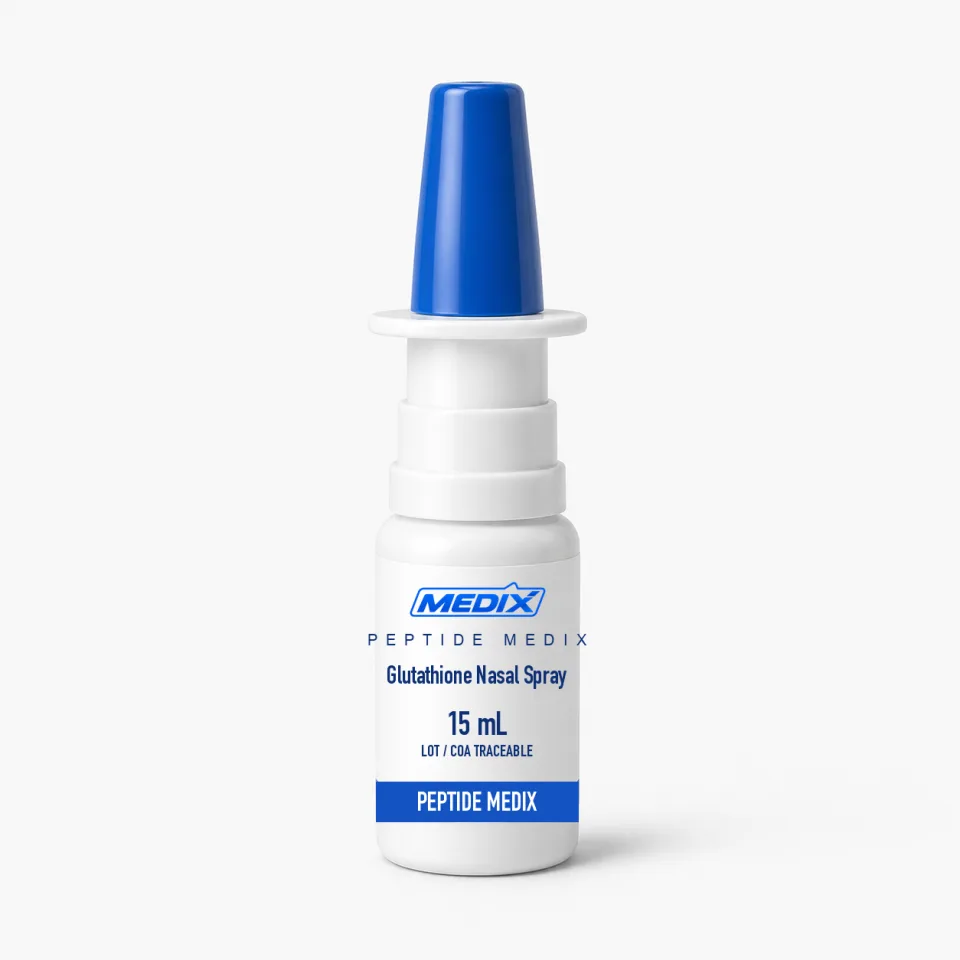
Pre-mixed reduced L-glutathione solution in a 15 mL or 30 mL metered pump bottle
- FormPre-mixed aqueous solution in a bottle with a metered spray pump
- Mol. weight307.32 g/mol
- Research areasRedox homeostasis, glutathione peroxidase and S-transferase activity, oxidative stress models, intranasal and mucosal delivery
Overview
Glutathione Nasal Spray supplies reduced L-glutathione (GSH) as a ready-to-use aqueous research solution in a 15 mL or 30 mL bottle fitted with a metered pump. Glutathione is a gamma-linked tripeptide — gamma-L-glutamyl-L-cysteinyl-glycine, CAS 70-18-8 — and the most abundant low-molecular-weight thiol in mammalian cells. Its unusual gamma-peptide bond between glutamate and cysteine makes it resistant to ordinary aminopeptidases, and the free cysteinyl thiol is the group that carries out its redox chemistry.
In cells, GSH is the reducing substrate for glutathione peroxidases, the conjugating partner for glutathione S-transferases in phase II detoxification, and the buffer that keeps protein thiols reduced. Oxidation converts two molecules of GSH into the disulfide dimer GSSG, and the GSH/GSSG ratio is one of the standard indices of cellular redox state. That chemistry is also why formulation matters: thiols oxidise on standing, particularly when warm, alkaline or exposed to air and trace metals.
This format exists so that laboratories comparing delivery routes do not have to weigh and reconstitute lyophilized powder before each session. The solution is supplied pre-mixed, with the concentration printed on the bottle label and restated on the lot-matched Certificate of Analysis. The glutathione input is third-party HPLC tested to ≥99% purity.
Specifications
Identity
- CAS number
- 70-18-8
- Molecular formula
- C10H17N3O6S
- Molecular weight
- 307.32 g/mol
- Peptide class
- Non-ribosomal gamma-linked tripeptide
Supply & purity
- Form
- Pre-mixed aqueous solution in a bottle with a metered spray pump
- Available sizes
- 15 mL, 30 mL
Additional detail
- Concentration
- Fill strength printed on the bottle label and restated on the lot-matched COA
- Active compound
- Reduced L-glutathione (GSH)
- Purity (raw material)
- ≥99% by HPLC; lot-matched COA available
- Structure
- gamma-L-Glutamyl-L-cysteinyl-glycine, reduced form
- Reactive group
- Free cysteinyl thiol (−SH); oxidises to the GSSG disulfide dimer
- Research areas
- Redox homeostasis, glutathione peroxidase and S-transferase activity, oxidative stress models, intranasal and mucosal delivery
- Reconstitution
- None required — supplied pre-mixed and ready to dispense
- Storage
- 2–8 °C, upright, protected from light; do not freeze the filled bottle
- Stability note
- Thiol solutions oxidise on standing and faster when warm or alkaline — keep cold and use within the study window
Units and conversions
Because this is supplied at a stated strength, the question is rarely how much diluent to add — it is what that strength looks like in the units your method is written in. Convert mcg to mg, mL to µL and back with the unit converter.
Certificate of analysis
Every lot of Glutathione Nasal Spray is released against a certificate of analysis: the batch-specific laboratory data for that lot, not a generic document for the compound. The lot number on the certificate matches the lot number printed on the label you receive — the vial label itself, where the product is vialled — so the record and the material it describes can always be reconciled.
Purity (raw material): ≥99% by HPLC — the specification for this listing. The figure for the lot you receive is the one reported on that lot’s certificate.
No lot certificate is on display on this page at the moment. That is a publishing state and not a testing one: lots are released and documented as described above whether or not the document is posted here, and we will send what exists for the lot in stock, or for a lot already on your bench, by its number.
Certificates are available on request before you order as well as after, with no account and no charge. Request the certificate for this listing, read the testing and documentation policy in full, or see how to read a peptide COA.
Questions about Glutathione Nasal Spray
What concentration is the spray?
The fill strength is printed on the bottle label and restated on the lot-matched Certificate of Analysis for the batch you receive, so per-actuation calculations can be checked against a documented value rather than an assumed one. Both 15 mL and 30 mL bottles are offered.
Is the glutathione third-party tested?
Yes. The reduced L-glutathione input is analysed by an independent laboratory using HPLC to confirm ≥99% purity with identity testing, and a lot-matched COA covering your batch is available. Match the lot number on the bottle to the COA before recording results.
Does it need reconstitution?
No. It ships pre-mixed as an aqueous solution, so there is no weighing, solvent addition or filtration step. That is the main reason laboratories choose the spray format when they want to remove reconstitution variability from a route-comparison experiment.
How is this different from the glutathione vial?
The molecule is identical; the format is not. The vial is lyophilized powder in 600 mg and 1500 mg sizes that must be reconstituted, while the spray is a pre-mixed solution in a metered pump bottle. Powder is the more stable long-term form for the same reason solutions oxidise.
Why does storage matter so much for glutathione?
Its free cysteinyl thiol is the reactive group, and thiols oxidise to the GSSG disulfide on exposure to air, warmth, alkaline pH or trace metals. Cold, dark, upright storage and a short in-use window keep the reduced fraction closer to the labelled value.
Is glutathione a peptide?
Yes, but an unusual one. It is a tripeptide joined through a gamma-carboxyl linkage between glutamate and cysteine rather than the standard alpha-peptide bond, which is why it resists most aminopeptidases. Its formula is C10H17N3O6S and its mass 307.32 g/mol.
Related