- Purity (raw material): ≥99% by HPLC
- Lot-matched certificate of analysis
- Ships next business day, tracked
Cognitive, Mood & Sleep Peptides
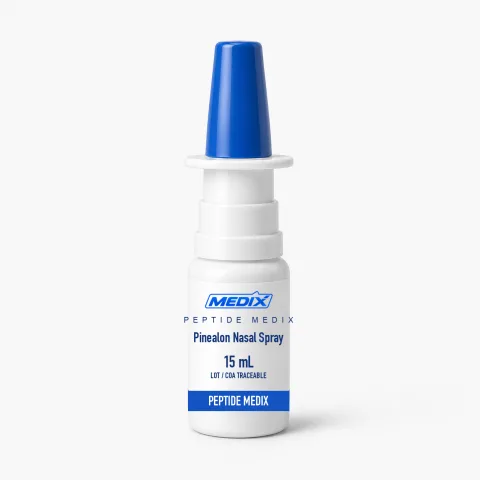
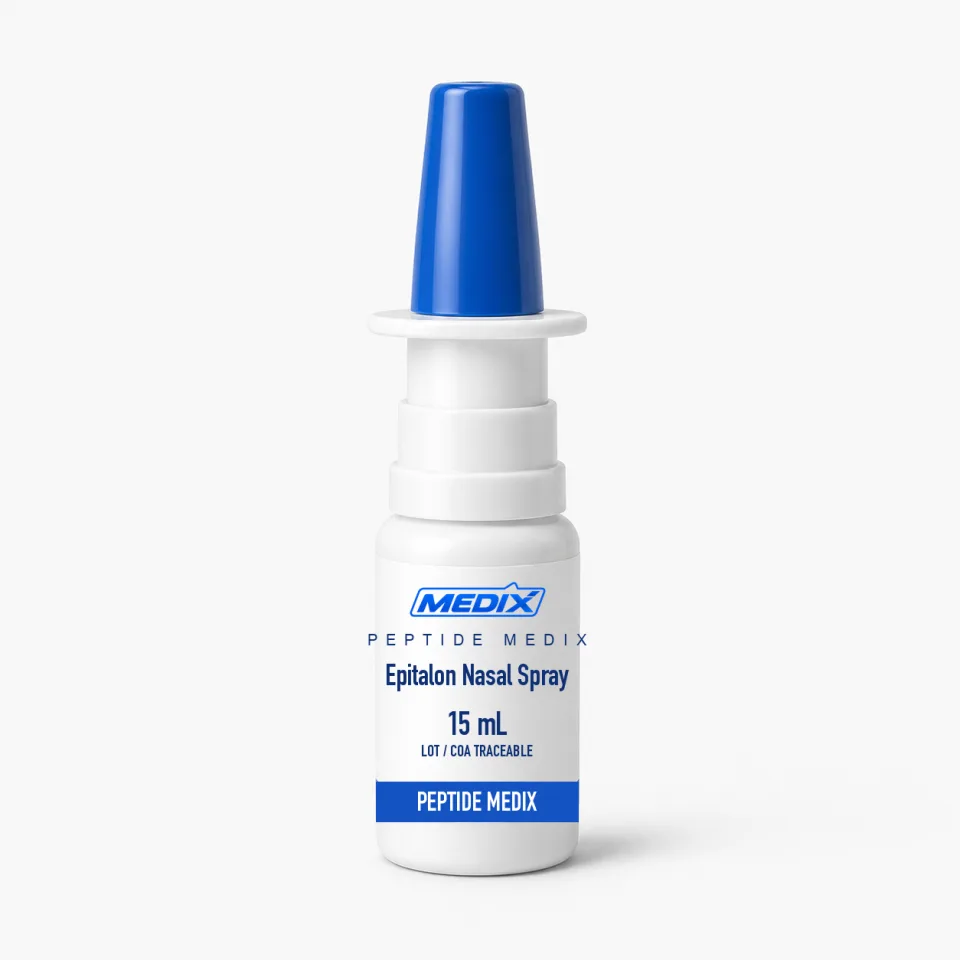
Epitalon Nasal Spray
Pre-mixed Ala-Glu-Asp-Gly tetrapeptide solution in a metered spray bottle
- FormPre-mixed aqueous solution in a bottle with metered spray pump
- Mol. weight390.35 g/mol
- Research areasTelomerase activity, circadian and pineal signalling, cellular senescence, intranasal delivery models
Overview
This is the intranasal format of epitalon, the synthetic tetrapeptide Ala-Glu-Asp-Gly developed by Vladimir Khavinson's group as a short analogue of the pineal preparation epithalamin. The molecule is identical to the material in our lyophilized vials — CAS 307297-39-8, formula C14H22N4O9, molecular weight 390.35 g/mol — but it arrives already dissolved in an aqueous vehicle inside a bottle fitted with a metered spray pump, so no weighing, reconstitution or solvent handling is required.
The format exists because delivery route is itself a research variable. Studies that compare intranasal with parenteral administration of small peptides are a recognised branch of the literature, motivated by reports of nose-to-brain transport along olfactory and trigeminal pathways for compounds of low molecular weight. Epitalon's very small size and high water solubility make it a convenient probe molecule for that kind of route-comparison work, alongside the telomerase, circadian and senescence questions the peptide is usually associated with.
The peptide raw material is third-party tested at ≥99% purity by HPLC with a lot-matched Certificate of Analysis available before purchase. The finished solution is filled into 15 mL and 30 mL bottles, with total peptide content and per-actuation delivery printed on each label.
Specifications
Identity
- CAS number
- 307297-39-8
- Molecular formula
- C14H22N4O9
- Molecular weight
- 390.35 g/mol
- Amino acid sequence
- H-Ala-Glu-Asp-Gly-OH
- Peptide class
- Synthetic bioregulator tetrapeptide
Supply & purity
- Form
- Pre-mixed aqueous solution in a bottle with metered spray pump
- Available sizes
- 15 mL, 30 mL
Additional detail
- Concentration
- Total peptide content and mg per actuation are printed on the bottle label
- Metered delivery
- Approximately 0.1 mL per actuation from the pump
- Purity (raw material)
- ≥99% by HPLC; lot-matched COA available
- Active peptide
- Epitalon (epithalon, AEDG peptide)
- Vehicle
- Aqueous solution with a preservative system suitable for a multi-actuation bottle
- Research areas
- Telomerase activity, circadian and pineal signalling, cellular senescence, intranasal delivery models
- Reconstitution
- None required — supplied pre-mixed and ready to dispense
- Storage
- 2–8 °C, upright, protected from light; do not freeze the filled bottle
Units and conversions
This is a pre-mixed presentation: the strength is fixed at fill, and the only arithmetic between the label and the bench is a change of units. The peptide unit converter moves between mg, mcg, mL and µL without the decimal-point slip that costs a whole run.
Certificate of analysis
Every lot of Epitalon Nasal Spray is released against a certificate of analysis: the batch-specific laboratory data for that lot, not a generic document for the compound. The lot number on the certificate matches the lot number printed on the label you receive — the vial label itself, where the product is vialled — so the record and the material it describes can always be reconciled.
Purity (raw material): ≥99% by HPLC — the specification for this listing. The figure for the lot you receive is the one reported on that lot’s certificate.
No lot certificate is on display on this page at the moment. That is a publishing state and not a testing one: lots are released and documented as described above whether or not the document is posted here, and we will send what exists for the lot in stock, or for a lot already on your bench, by its number.
Certificates are available on request before you order as well as after, with no account and no charge. Request the certificate for this listing, read the testing and documentation policy in full, or see how to read a peptide COA.
Questions about Epitalon Nasal Spray
How does this differ from epitalon vials?
The molecule is identical — Ala-Glu-Asp-Gly, 390.35 g/mol. The difference is presentation: this is a pre-mixed aqueous solution in a metered spray bottle rather than a lyophilized powder requiring reconstitution, which makes it the practical choice for intranasal route studies.
How much peptide does each bottle contain?
Total peptide content and the amount delivered per actuation are printed on each bottle label alongside the lot number, and both figures are documented on the lot-matched Certificate of Analysis. The bottles are supplied in 15 mL and 30 mL fills.
How is purity verified?
The epitalon raw material used to prepare the solution is third-party tested by reverse-phase HPLC at ≥99% purity, with mass-spectrometric identity confirmation against the expected 390.35 g/mol mass. The lot-matched COA is available on this page before you order.
Does it need refrigeration?
Yes. Because the peptide is already in solution, store the bottle at 2–8 °C, upright and protected from light, and do not freeze it. Freezing a filled spray bottle can damage the pump mechanism and promote precipitation on thawing.
Why are small peptides studied intranasally?
Compounds below roughly 1000 g/mol are the group most examined for nose-to-brain transport along olfactory and trigeminal routes. At 390.35 g/mol epitalon sits well within that range, which is why it appears in delivery-route comparison work as well as in its own literature.
Related