- Purity (raw material): ≥99% by HPLC for the Dihexa input
- Lot-matched certificate of analysis
- Ships next business day, tracked
Cognitive, Mood & Sleep Peptides
Dihexa Nasal Spray
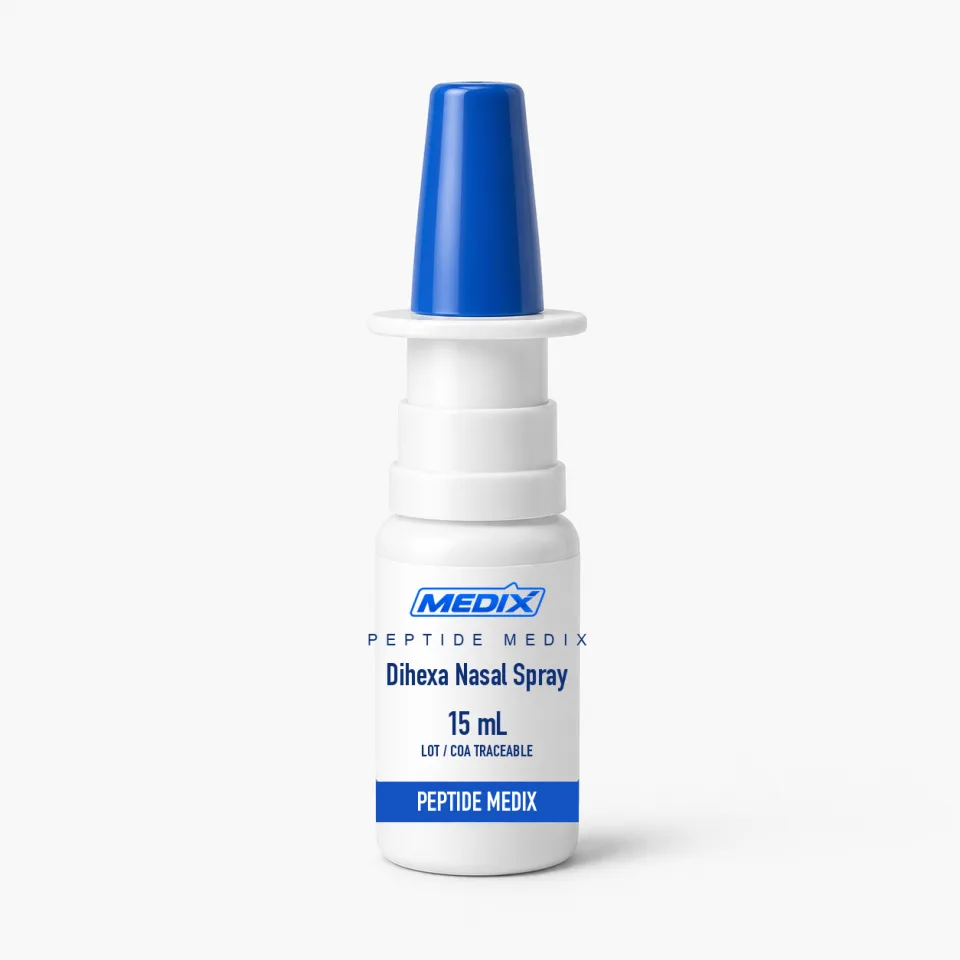
Pre-mixed intranasal Dihexa solution in a metered 15 mL or 30 mL pump bottle
- FormPre-mixed solution in a bottle with a metered nasal spray pump
- Mol. weight439.55 g/mol
Overview
This is Dihexa supplied as a ready-to-dispense intranasal solution rather than a lyophilized vial. Dihexa is an angiotensin IV-derived peptidomimetic — N-hexanoic-Tyr-Ile-(6)-aminohexanoic amide — studied for its reported potentiation of hepatocyte growth factor signalling at the c-Met receptor, and for effects on dendritic spine density in hippocampal culture models. The molecule in this bottle is the same compound as our lyophilized Dihexa: CAS 1401708-83-5, formula C24H37N3O4, molecular weight 439.55 g/mol.
The formulation exists because Dihexa is deliberately lipophilic and poorly water-soluble. A nasal research solution therefore uses a co-solvent system to hold the compound in solution and a metered pump to deliver a repeatable volume per actuation. Intranasal delivery is of interest to neuroscience laboratories because olfactory and trigeminal routes have been described as a way of reaching the central nervous system while bypassing first-pass metabolism — a question that is itself an active research topic rather than a settled fact.
Specifications
Identity
- CAS number
- 1401708-83-5
- Molecular formula
- C24H37N3O4
- Molecular weight
- 439.55 g/mol
Supply & purity
- Form
- Pre-mixed solution in a bottle with a metered nasal spray pump
- Available sizes
- 15 mL, 30 mL
Additional detail
- Metered delivery
- Standard nasal pump, approximately 0.1 mL per actuation
- Concentration
- Printed on the lot label
- Purity (raw material)
- ≥99% by HPLC for the Dihexa input; lot-matched COA available
- Chemical name
- N-hexanoic-Tyr-Ile-(6)-aminohexanoic amide
- Compound class
- Angiotensin IV-derived peptidomimetic with lipophilic termini
- Primary research target
- HGF / c-Met receptor signalling
- Vehicle
- Aqueous co-solvent system; Dihexa is not freely water-soluble on its own
- Storage
- 2–8 °C, upright and protected from light; do not freeze the filled bottle
Units and conversions
Dihexa Nasal Spray arrives already made up, so there is no diluent volume to choose and no reconstitution step. What is left is unit work — percent to mg/mL, milligrams to micrograms, millilitres to microlitres — and the mcg to mg converter does all three.
Certificate of analysis
Every lot of Dihexa Nasal Spray is released against a certificate of analysis: the batch-specific laboratory data for that lot, not a generic document for the compound. The lot number on the certificate matches the lot number printed on the label you receive — the vial label itself, where the product is vialled — so the record and the material it describes can always be reconciled.
Purity (raw material): ≥99% by HPLC for the Dihexa input — the specification for this listing. The figure for the lot you receive is the one reported on that lot’s certificate.
No lot certificate is on display on this page at the moment. That is a publishing state and not a testing one: lots are released and documented as described above whether or not the document is posted here, and we will send what exists for the lot in stock, or for a lot already on your bench, by its number.
Certificates are available on request before you order as well as after, with no account and no charge. Request the certificate for this listing, read the testing and documentation policy in full, or see how to read a peptide COA.
Questions about Dihexa Nasal Spray
How does this differ from Dihexa in a vial?
The compound is identical. The spray is supplied pre-dissolved in a co-solvent vehicle at a fixed concentration with a metered pump, so there is no reconstitution step. The lyophilized vial gives you freedom to choose concentration and solvent; the spray gives you repeatability.
What concentration is the solution?
The concentration for your bottle is printed on the lot label rather than fixed across all lots. Paired with the pump's approximate 0.1 mL per actuation, that value is what you use to calculate delivered amount per spray in a protocol.
Why does Dihexa need a co-solvent?
Dihexa carries a hexanoic chain and an aminohexanoic amide that make it markedly lipophilic and poorly soluble in plain water. A co-solvent system is required to keep it in solution at a usable concentration in an aqueous spray.
What purity documentation do you provide?
The Dihexa used to prepare each batch is purified to ≥99% by HPLC and has a lot-matched certificate of analysis covering purity and identity. Quote the lot number on the bottle and the COA will be sent to you.
How should the bottle be stored?
Refrigerate at 2–8 °C, keep it upright and protected from light, and do not freeze it. Note the date of first opening on the label and keep the in-use period short, since peptides in solution degrade faster than powder.
Related