- Purity (raw material): ≥99% by HPLC
- Lot-matched certificate of analysis
- Ships next business day, tracked
Cognitive, Mood & Sleep Peptides
Selank Nasal Spray
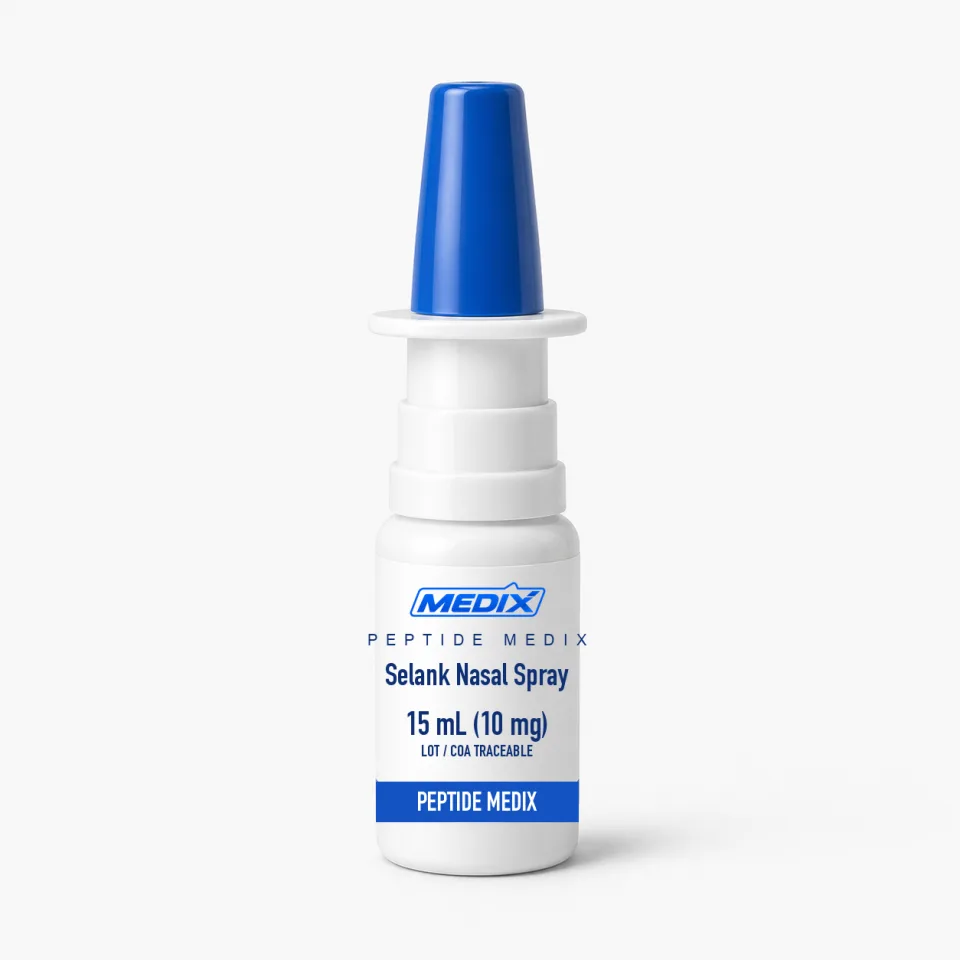
Pre-mixed Selank tuftsin-analogue research solution in a 15 mL spray bottle
- FormPre-mixed aqueous solution, 15 mL bottle with metered spray pump
- Mol. weight751.89 g/mol
- Research areasGABAergic transmission, anxiolytic-type behavioural models, enkephalin-degrading enzyme activity, immune and stress-related gene expression
Overview
Selank Nasal Spray supplies the synthetic heptapeptide Selank (CAS 129954-34-3, Thr-Lys-Pro-Arg-Pro-Gly-Pro) as a pre-mixed aqueous solution in a 15 mL bottle fitted with a metered pump. Selank is built from tuftsin — the endogenous tetrapeptide Thr-Lys-Pro-Arg released from the heavy chain of immunoglobulin G — extended at the C-terminus with Pro-Gly-Pro. The proline-rich tail slows exopeptidase cleavage substantially, converting a fragment with a very short plasma life into a stable, synthetically tractable research peptide.
Two strengths share the same 15 mL bottle: a 10 mg fill at roughly 0.67 mg/mL and a 20 mg fill at roughly 1.33 mg/mL. Because the solution ships pre-formulated, laboratories running mucosal-delivery or format-comparison studies can work from a documented concentration without reconstituting powder first, which removes weighing and dilution error from the protocol.
Specifications
Identity
- CAS number
- 129954-34-3
- Molecular formula
- C33H57N11O9
- Molecular weight
- 751.89 g/mol
- Amino acid sequence
- Thr-Lys-Pro-Arg-Pro-Gly-Pro
- Peptide class
- Synthetic tuftsin (Thr-Lys-Pro-Arg) analogue, heptapeptide
Supply & purity
- Form
- Pre-mixed aqueous solution, 15 mL bottle with metered spray pump
- Available sizes
- 15 mL (10 mg total), 15 mL (20 mg total)
Additional detail
- Concentration
- Approximately 0.67 mg/mL (10 mg fill) or 1.33 mg/mL (20 mg fill)
- Purity (raw material)
- ≥99% by HPLC; lot-matched COA available
- Amino acid count
- 7 residues
- Research areas
- GABAergic transmission, anxiolytic-type behavioural models, enkephalin-degrading enzyme activity, immune and stress-related gene expression
- Reconstitution
- None required — supplied pre-mixed and ready to dispense
- Storage
- 2–8 °C, upright, protected from light; do not freeze the filled bottle
Units and conversions
Because this is supplied at a stated strength, the question is rarely how much diluent to add — it is what that strength looks like in the units your method is written in. Convert mcg to mg, mL to µL and back with the unit converter.
Certificate of analysis
Every lot of Selank Nasal Spray is released against a certificate of analysis: the batch-specific laboratory data for that lot, not a generic document for the compound. The lot number on the certificate matches the lot number printed on the label you receive — the vial label itself, where the product is vialled — so the record and the material it describes can always be reconciled.
Purity (raw material): ≥99% by HPLC — the specification for this listing. The figure for the lot you receive is the one reported on that lot’s certificate.
No lot certificate is on display on this page at the moment. That is a publishing state and not a testing one: lots are released and documented as described above whether or not the document is posted here, and we will send what exists for the lot in stock, or for a lot already on your bench, by its number.
Certificates are available on request before you order as well as after, with no account and no charge. Request the certificate for this listing, read the testing and documentation policy in full, or see how to read a peptide COA.
Questions about Selank Nasal Spray
How much Selank does each bottle contain?
Both variants use the same 15 mL bottle: a 10 mg total fill at roughly 0.67 mg/mL, or a 20 mg total fill at roughly 1.33 mg/mL. The concentration is printed on the label and restated on the lot-matched Certificate of Analysis supplied with the batch.
Is the peptide third-party tested and is a COA available?
Yes. The Selank used in this formulation is third-party analysed by HPLC to ≥99% purity with mass-spectrometry identity confirmation, and a lot-matched Certificate of Analysis is available. Match the lot on the bottle to the COA before recording any results.
What is Selank chemically?
A synthetic heptapeptide, Thr-Lys-Pro-Arg-Pro-Gly-Pro, CAS 129954-34-3, formula C33H57N11O9, molecular weight 751.89 g/mol. It is the immunomodulatory tetrapeptide tuftsin extended with Pro-Gly-Pro, a modification that markedly slows enzymatic degradation.
How does Selank differ from Semax in research use?
Both are Pro-Gly-Pro-stabilised heptapeptides from Russian peptide chemistry, but their literatures diverge. Semax work centres on BDNF, neurotrophins and attention models; Selank work centres on GABAergic transmission, enkephalinase inhibition and stress-response endpoints.
Does it require reconstitution?
No. The spray ships pre-mixed at a stated concentration, so there is no weighing, solvent addition or filtration step. That is the practical difference from the lyophilized Selank vial and the reason laboratories choose it for format-comparison work.
How should the bottle be stored?
Refrigerate at 2–8 °C, upright and protected from light, and do not freeze the filled bottle. Solution-phase peptide is less stable than powder, so keep the in-use window short and note the first-open date alongside the lot number on the label.
Related