- Lot-matched certificate of analysis
- Ships next business day, tracked
Cognitive, Mood & Sleep Peptides
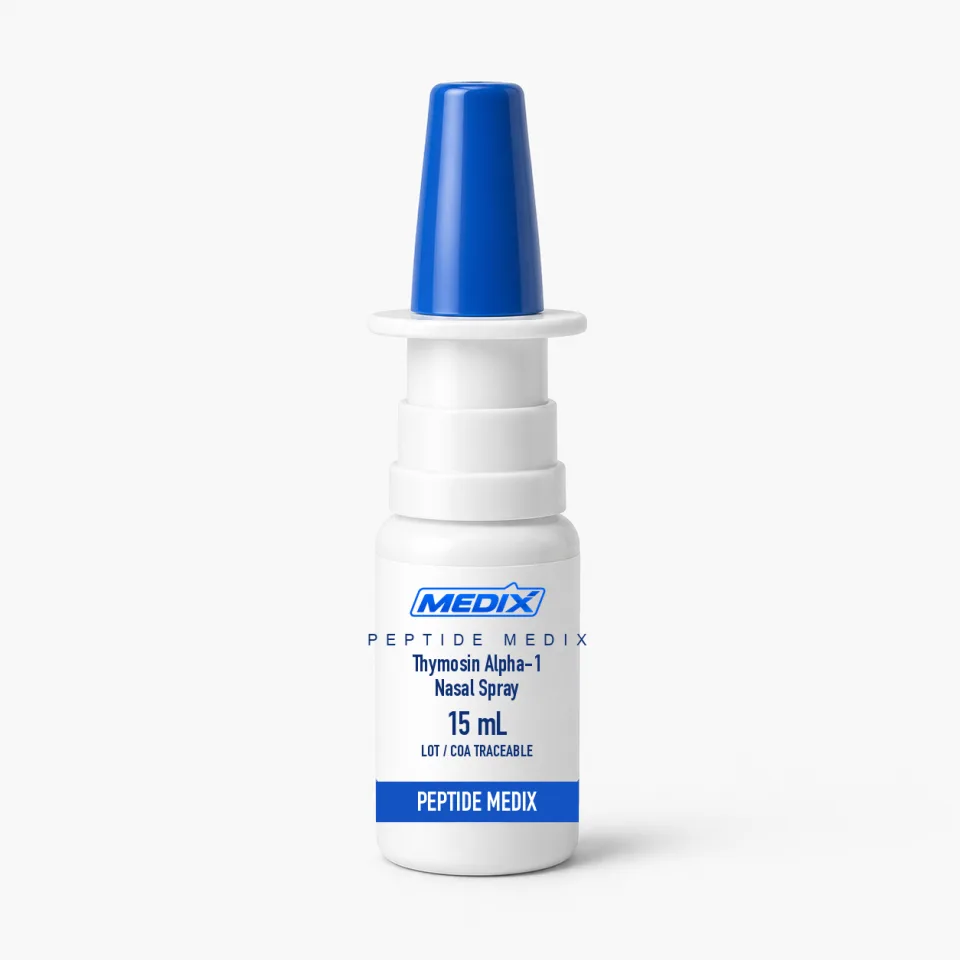
Thymosin Alpha-1 Nasal Spray
Pre-mixed thymic peptide solution in 15 mL and 30 mL metered nasal pumps
- FormPre-mixed aqueous solution in an amber bottle fitted with a metered nasal pump
- Research areasIntranasal peptide delivery, nasal mucosal absorption, T cell maturation, Toll-like receptor signalling, antiviral and adjuvant models
Overview
Thymosin Alpha-1 Nasal Spray supplies the same 28-residue thymic peptide as our lyophilized vial, already dissolved in a preserved aqueous vehicle and packaged in an amber bottle with a metered nasal pump. Thymosin alpha-1 is the N-terminally acetylated 1–28 fragment of prothymosin alpha, a peptide first isolated from thymic tissue and studied for decades as a modulator of T cell maturation and innate immune signalling.
The spray format exists because the molecule itself is difficult to work with in powder form at small scale: at roughly 3.1 kDa it is highly hydrophilic, strongly charged and easy to lose to static and vial walls when weighing sub-milligram amounts. Supplying it pre-mixed removes the reconstitution step entirely and gives every actuation the same nominal peptide loading, which makes the format useful for mucosal-delivery, nasal-deposition and solution-stability work where a consistent starting concentration matters more than a bespoke dilution.
Specifications
Identity
- Amino acid sequence
- Ac-Ser-Asp-Ala-Ala-Val-Asp-Thr-Ser-Ser-Glu-Ile-Thr-Thr-Lys-Asp-Leu-Lys-Glu-Lys-Lys-Glu-Val-Val-Glu-Glu-Ala-Glu-Asn
- Chain length
- 28 amino acids, N-terminally acetylated
- Peptide class
- Thymic immunomodulatory peptide
Supply & purity
- Form
- Pre-mixed aqueous solution in an amber bottle fitted with a metered nasal pump
- Available sizes
- 15 mL, 30 mL
Additional detail
- Fill note
- Both sizes are filled from the same bulk solution; the 30 mL bottle holds twice the volume at the same nominal concentration, and the peptide loading for your lot is printed on the label
- Active component
- Thymosin alpha-1, ≥99% by HPLC; lot-matched COA available
- CAS number (active)
- 62304-98-7
- Molecular formula (active)
- C129H215N33O55
- Molecular weight (active)
- 3108.30 g/mol
- Parent protein
- Prothymosin alpha (residues 1–28)
- Vehicle
- Preserved aqueous vehicle suitable for multi-actuation handling; clear and colourless when fresh
- Reconstitution
- None required — supplied ready to dispense
- Research areas
- Intranasal peptide delivery, nasal mucosal absorption, T cell maturation, Toll-like receptor signalling, antiviral and adjuvant models
- Storage
- 2–8 °C upright, protected from light; do not freeze the filled bottle
Units and conversions
Thymosin Alpha-1 Nasal Spray arrives already made up, so there is no diluent volume to choose and no reconstitution step. What is left is unit work — percent to mg/mL, milligrams to micrograms, millilitres to microlitres — and the mcg to mg converter does all three.
Certificate of analysis
Every lot of Thymosin Alpha-1 Nasal Spray is released against its own lot documentation, and where the manufacturer issues a certificate of analysis for it, that certificate is the record for the lot rather than a generic document for the compound. The lot number on the certificate matches the lot number printed on the label you receive — the vial label itself, where the product is vialled — so the record and the material it describes can always be reconciled.
This listing carries no purity percentage, so none is claimed for it here. Where the manufacturer issues analytical documentation for a lot of this item, it is passed on unaltered — ask and we will send whatever exists.
No lot certificate is on display on this page at the moment. That is a publishing state and not a testing one: lots are released and documented as described above whether or not the document is posted here, and we will send what exists for the lot in stock, or for a lot already on your bench, by its number.
Certificates are available on request before you order as well as after, with no account and no charge. Request the certificate for this listing, read the testing and documentation policy in full, or see how to read a peptide COA.
Questions about Thymosin Alpha-1 Nasal Spray
How does the nasal spray differ from the lyophilized vial?
The molecule is identical — the same acetylated 28-residue peptide at ≥99% HPLC purity. The difference is format: the spray arrives already dissolved in a preserved aqueous vehicle with a metered pump, so there is no weighing, reconstitution or powder transfer, and every actuation carries the same nominal loading.
What purity is the peptide used in the spray?
The bulk peptide is tested at ≥99% by HPLC before formulation, and a lot-matched certificate of analysis is available on request. The COA covers the peptide input; the label states the nominal peptide loading for your specific fill lot.
What is the difference between the 15 mL and 30 mL bottles?
Volume only. Both are filled from the same bulk solution at the same nominal concentration, so the 30 mL bottle simply provides twice the working material. Choosing the larger fill reduces the number of lot changes across a longer study.
Does the bottle need refrigeration?
Yes. Keep it upright at 2–8 °C and protected from light. Peptides in solution degrade faster than lyophilized powder, and refrigeration slows deamidation and oxidation. Do not freeze the filled bottle — the glass and pump assembly are not designed for freeze–thaw.
Can the solution be diluted or transferred for assay work?
Researchers commonly draw an aliquot into a separate vessel for analytical work rather than dispensing through the pump. If you dilute, record the diluent, buffer pH and final concentration, since solution-phase stability for this peptide is pH- and temperature-dependent.
Related