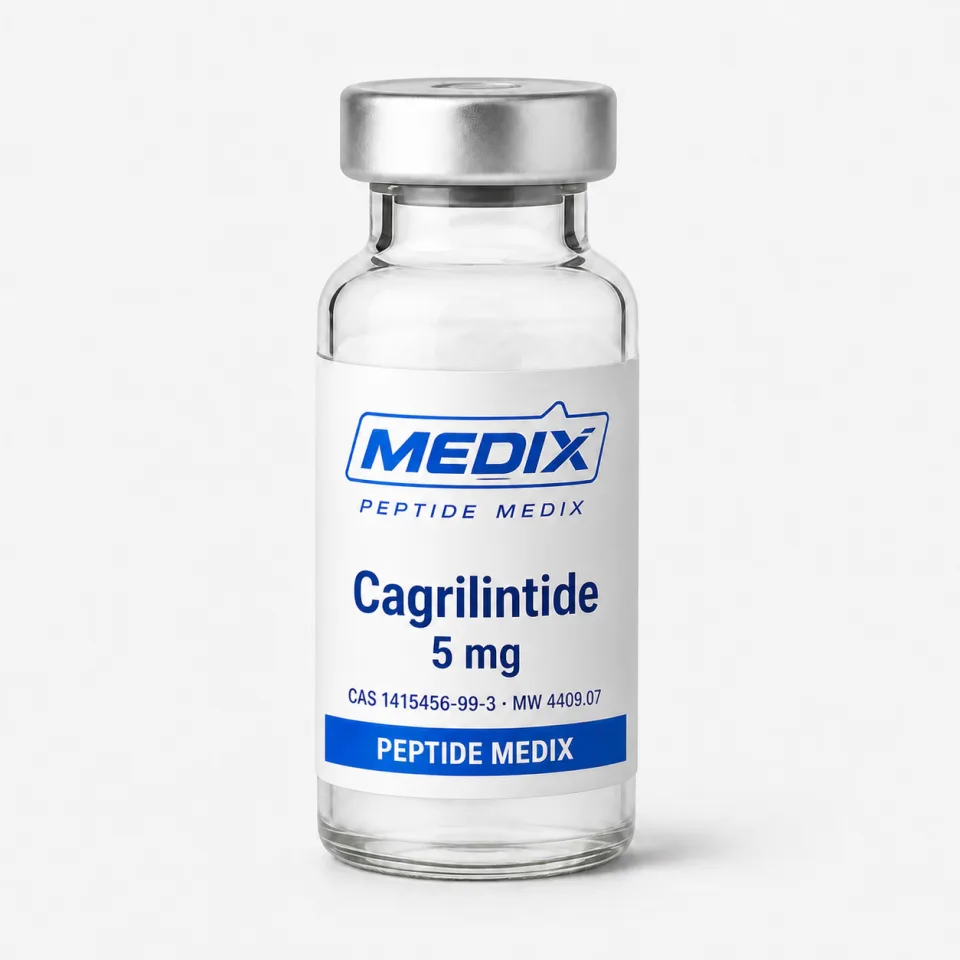
- ≥99% by HPLC
- Lot-matched certificate of analysis
- Ships next business day, tracked
Cagrilintide Peptide
Long-acting acylated amylin analog for receptor and metabolic research
- FormLyophilized powder, sealed glass vial with flip-off seal
- Mol. weight4409.07 g/mol
- Research areasSatiation signaling, gastric emptying, amylin-incretin combination models
Overview
Cagrilintide is a synthetic, long-acting analog of human amylin — the 37-residue beta-cell hormone co-secreted with insulin that acts at amylin and calcitonin receptor complexes to influence satiation and gastric emptying. Native human amylin is notoriously difficult to work with because it aggregates into amyloid fibrils, so the analog carries sequence substitutions that suppress fibril formation together with a lipid side chain that extends circulating half-life through reversible albumin binding.
Those two properties make cagrilintide a practical tool where native amylin is not. Laboratories use it to interrogate the calcitonin receptor and its receptor-activity-modifying-protein partners, the AMY1 to AMY3 complexes, and to study satiation pathways in the area postrema and hypothalamus. It is also the standard research comparator for combination work with GLP-1 agonists, since amylin and incretin signaling engage partly separate circuits.
Specifications
Identity
- CAS number
- 1415456-99-3
- Molecular formula
- C194H309N55O59S2
- Molecular weight
- 4409.07 g/mol
- Peptide class
- Acylated long-acting amylin (islet amyloid polypeptide) analog
Supply & purity
- Form
- Lyophilized powder, sealed glass vial with flip-off seal
- Purity
- ≥99% by HPLC; lot-matched COA available
- Available sizes
- 5 mg, 10 mg
- Solubility
- Bacteriostatic water; dilute buffers used where assay pH matters
Handling & storage
- Storage (lyophilized)
- −20 °C, sealed and protected from light and moisture
- Storage (reconstituted)
- 2–8 °C, protected from light; use within the study window
Additional detail
- Receptor targets studied
- Calcitonin receptor and AMY1–AMY3 amylin receptor complexes
- Structural notes
- Amylin-based backbone with anti-fibrillation substitutions, intramolecular disulfide and a lipid side chain
- Research areas
- Satiation signaling, gastric emptying, amylin-incretin combination models
Working out the concentration
The vial sizes above — 5 mg, 10 mg — describe a mass of material, not a strength. Choose a diluent volume, work it out with the reconstitution calculator, and you have the concentration for your own vial of Cagrilintide plus the volume that carries any mass you want to withdraw.
If the protocol asks for a molar concentration, the molar concentration calculator converts between 4409.07 g/mol, the mass you weigh out and the volume you dissolve it in.
Certificate of analysis
Every lot of Cagrilintide is released against a certificate of analysis: the batch-specific laboratory data for that lot, not a generic document for the compound. The lot number on the certificate matches the lot number printed on the label you receive — the vial label itself, where the product is vialled — so the record and the material it describes can always be reconciled.
Purity: ≥99% by HPLC — the specification for this listing. The figure for the lot you receive is the one reported on that lot’s certificate.
No lot certificate is on display on this page at the moment. That is a publishing state and not a testing one: lots are released and documented as described above whether or not the document is posted here, and we will send what exists for the lot in stock, or for a lot already on your bench, by its number.
Certificates are available on request before you order as well as after, with no account and no charge. Request the certificate for this listing, read the testing and documentation policy in full, or see how to read a peptide COA.
Questions about Cagrilintide
Why use cagrilintide instead of native human amylin?
Human amylin aggregates readily into amyloid fibrils, which makes solutions unstable and results hard to reproduce. Cagrilintide carries anti-fibrillation substitutions and a lipid side chain, so it stays soluble longer and gives a more workable tool for receptor and satiation studies.
What purity and documentation do you supply?
Each lot is tested by HPLC to at least 99% purity with identity confirmed by mass spectrometry, and a lot-matched certificate of analysis is available. The COA is tied to the vial number shipped, so purity data stays traceable to your material.
Which receptors does it act on?
Published cell work describes activity at the calcitonin receptor and at the amylin receptor complexes AMY1 to AMY3, formed when the calcitonin receptor pairs with receptor-activity-modifying proteins. Selectivity across those complexes is itself an active research question.
How is it stored and handled?
Store the sealed lyophilized vial at −20 °C, protected from light and moisture. Once reconstituted, keep it at 2–8 °C and use within your documented study window. Swirl rather than shake and minimize air-liquid interfaces to limit aggregation.
Is it studied together with GLP-1 agonists?
Yes. Because amylin and incretin pathways engage partly separate circuits, laboratories frequently run cagrilintide alongside semaglutide or a triple agonist to ask whether the two signals combine additively in cell and rodent metabolic models.
Related