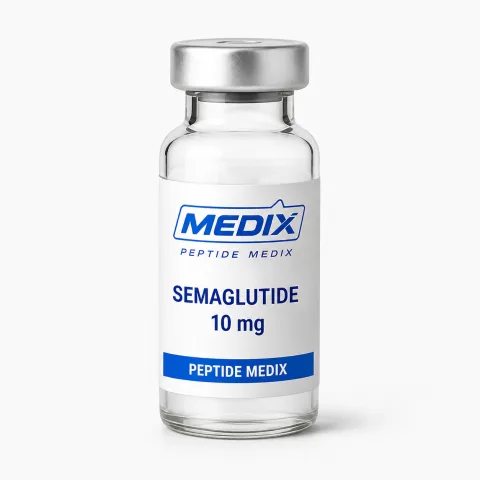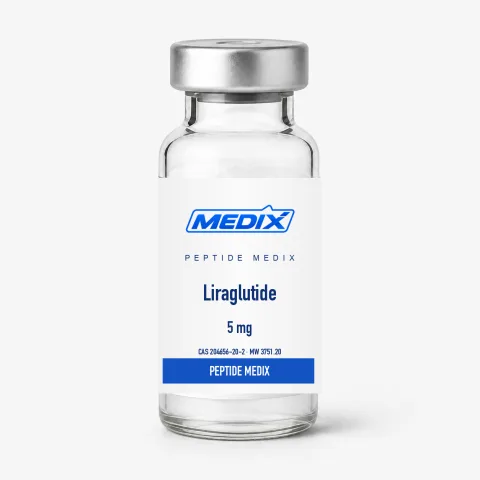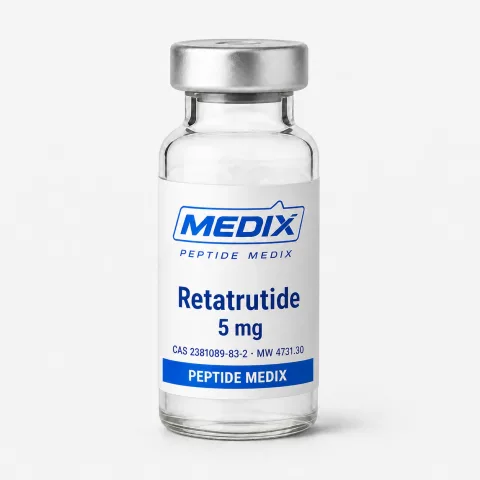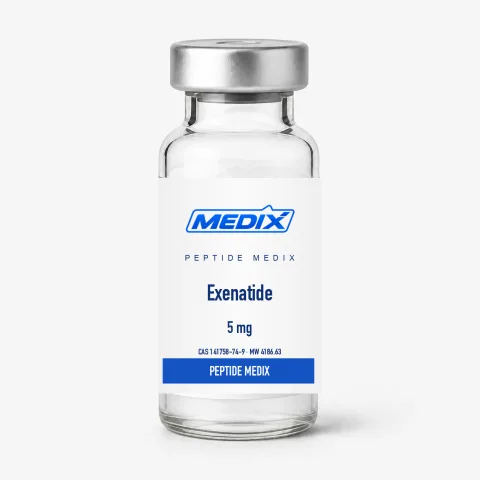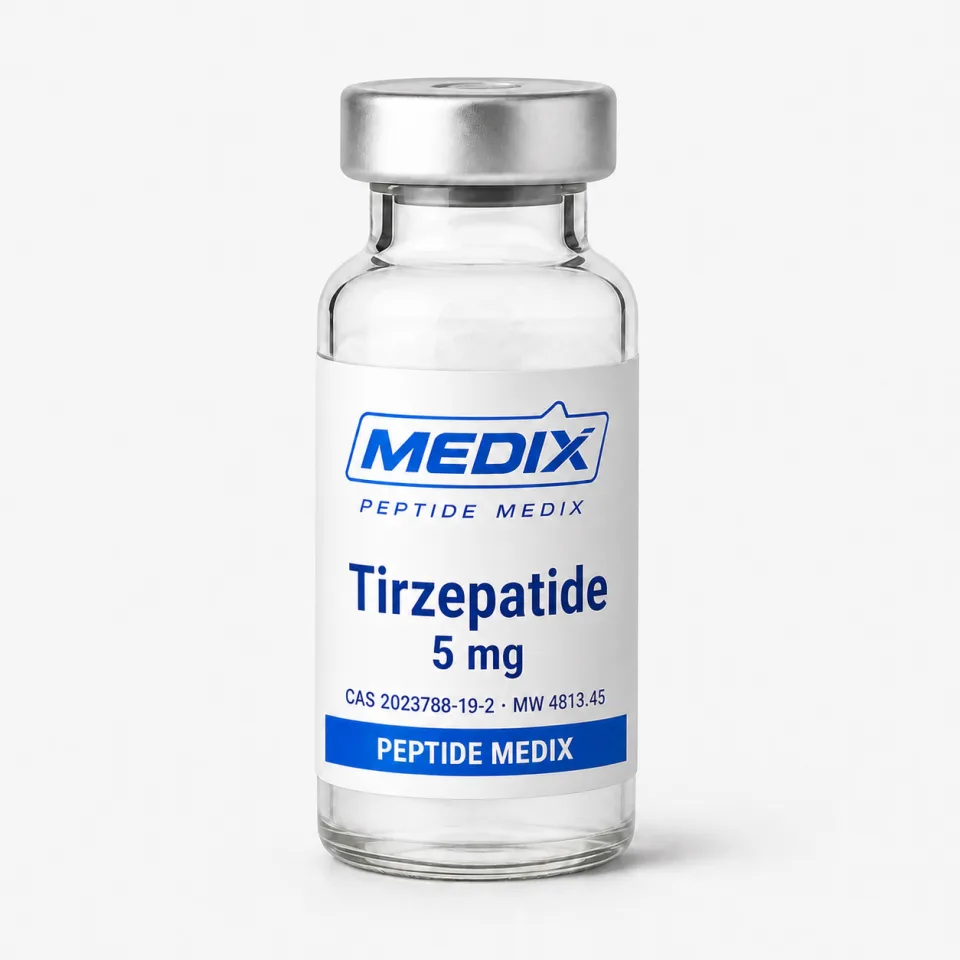
- ≥99% by HPLC
- Lot-matched certificate of analysis
- Ships next business day, tracked
Tirzepatide Peptide
39-residue dual GIP and GLP-1 receptor agonist peptide, research grade
- FormLyophilized powder, sealed glass vial with flip-off seal
- Mol. weight4813.45 g/mol
- Research areasIncretin receptor crosstalk, insulin secretion, adipose and energy-balance models
Overview
Tirzepatide is a synthetic 39-amino-acid peptide built on a glucose-dependent insulinotropic polypeptide (GIP) backbone and engineered to act at two incretin receptors at once. Alpha-aminoisobutyric acid substitutions block dipeptidyl peptidase-4 cleavage, while a lysine residue carries a gamma-glutamyl and AEEA spacer linked to a C20 fatty diacid, giving the reversible albumin binding that underlies its long circulating persistence in published pharmacokinetic studies. The C-terminus is amidated.
That dual-agonist architecture is what makes tirzepatide interesting as a laboratory tool. Rather than probing GLP-1 signaling in isolation, investigators use it to study how simultaneous GIP and GLP-1 receptor engagement changes cyclic-AMP kinetics, receptor trafficking and beta-arrestin recruitment, and how biased signaling at the GLP-1 receptor differs from balanced agonists. It appears constantly as a comparator in papers characterizing newer dual and triple agonists.
Specifications
Identity
- CAS number
- 2023788-19-2
- Molecular formula
- C225H348N48O68
- Molecular weight
- 4813.45 g/mol
- Peptide class
- Acylated dual GIP/GLP-1 receptor agonist (twincretin)
Supply & purity
- Form
- Lyophilized powder, sealed glass vial with flip-off seal
- Purity
- ≥99% by HPLC; lot-matched COA available
- Available sizes
- 5 mg, 10 mg, 15 mg, 20 mg, 30 mg, 60 mg, 100 mg
- Solubility
- Bacteriostatic water; also soluble in dilute alkaline or phosphate buffers
Handling & storage
- Storage (lyophilized)
- −20 °C, sealed and protected from light and moisture
- Storage (reconstituted)
- 2–8 °C, protected from light; use within the study window
Additional detail
- Backbone length
- 39 amino acids, GIP-based sequence
- Key modifications
- Aib substitutions, Lys20 conjugated to gamma-Glu-(AEEA)2-C20 diacid, C-terminal amide
- Research areas
- Incretin receptor crosstalk, insulin secretion, adipose and energy-balance models
Working out the concentration
Reconstitution is where the arithmetic lives. The same vial made up with 1 mL or with 3 mL of diluent gives three-fold different numbers, which is why a reconstitution volume calculator is more use here than a fixed table: enter the vial mass and your diluent volume and read the concentration back.
If the protocol asks for a molar concentration, the molar concentration calculator converts between 4813.45 g/mol, the mass you weigh out and the volume you dissolve it in.
Certificate of analysis
Every lot of Tirzepatide is released against a certificate of analysis: the batch-specific laboratory data for that lot, not a generic document for the compound. The lot number on the certificate matches the lot number printed on the label you receive — the vial label itself, where the product is vialled — so the record and the material it describes can always be reconciled.
Purity: ≥99% by HPLC — the specification for this listing. The figure for the lot you receive is the one reported on that lot’s certificate.
No lot certificate is on display on this page at the moment. That is a publishing state and not a testing one: lots are released and documented as described above whether or not the document is posted here, and we will send what exists for the lot in stock, or for a lot already on your bench, by its number.
Certificates are available on request before you order as well as after, with no account and no charge. Request the certificate for this listing, read the testing and documentation policy in full, or see how to read a peptide COA.
Questions about Tirzepatide
What makes tirzepatide different from semaglutide?
Semaglutide is a GLP-1 receptor agonist analog. Tirzepatide is built on a GIP backbone and activates both the GIP and GLP-1 receptors, so laboratories use it to study how combined incretin receptor engagement changes signaling compared with single-receptor agonism.
What purity and documentation do you provide?
Each lot is HPLC tested to at least 99% purity with identity confirmed by mass spectrometry, and a lot-matched certificate of analysis is available. The COA corresponds to the specific vial number shipped so results stay traceable to your order.
How is it stored before and after reconstitution?
Keep the sealed lyophilized vial at −20 °C away from light and moisture. After reconstitution, refrigerate at 2–8 °C, protect from light and use within your documented study window. Aliquot so the stock is not repeatedly frozen and thawed.
Is the peptide supplied sterile and ready to use?
It is supplied as a lyophilized powder in a sealed vial, not as a ready-made solution. The receiving laboratory performs reconstitution under its own aseptic practices and validates the resulting solution for whatever assay or model is planned.
Related