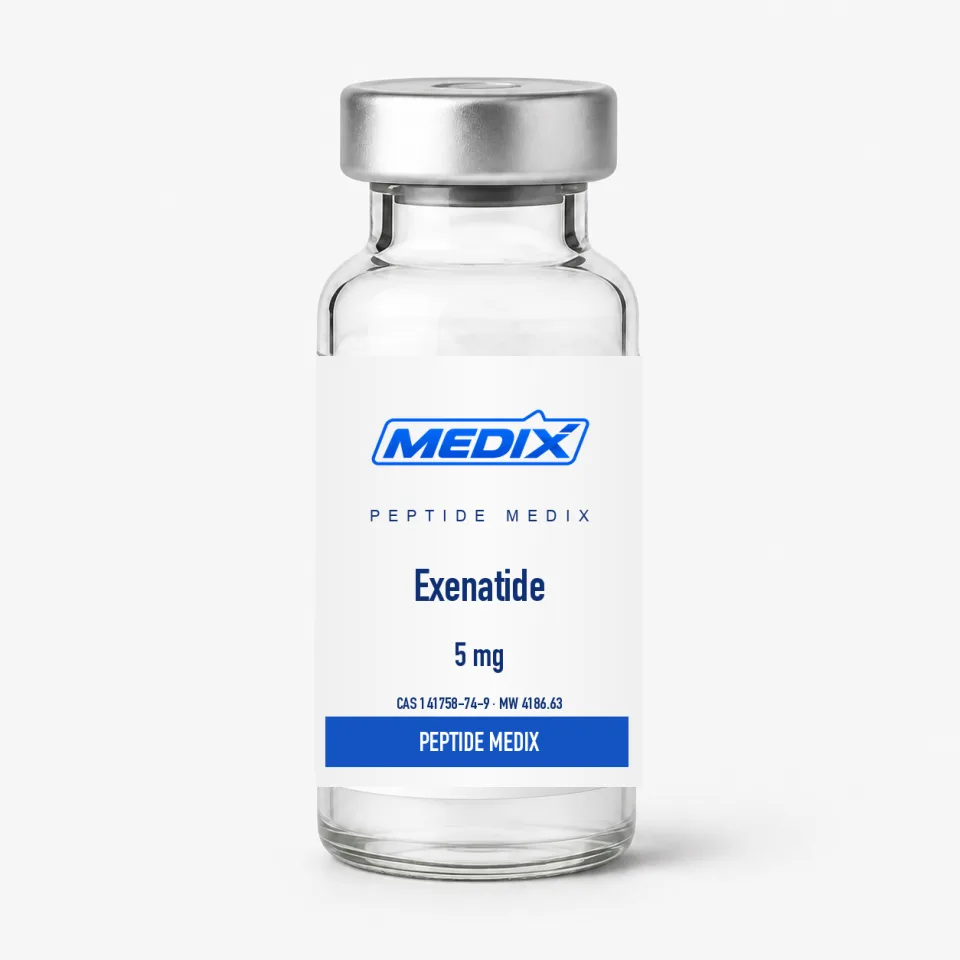
- ≥99% by HPLC
- Lot-matched certificate of analysis
- Ships next business day, tracked
Exenatide
Synthetic exendin-4, a 39-residue GLP-1 receptor agonist peptide
- FormLyophilized white to off-white powder, sealed glass vial
- Mol. weight4186.63 g/mol
- Research areasGLP-1 receptor pharmacology, islet beta-cell biology, gastric emptying, neuroprotection models
Overview
Exenatide is the synthetic form of exendin-4, a 39-amino-acid peptide originally isolated from the salivary secretions of the Gila monster, Heloderma suspectum. It shares roughly half its sequence with mammalian GLP-1 but replaces the alanine at position two with glycine, which makes it markedly resistant to cleavage by dipeptidyl peptidase-4. That single substitution is why exendin-4 remains active far longer than native GLP-1 and why it became the reference agonist in incretin pharmacology.
In the laboratory, exenatide is the workhorse tool for probing the GLP-1 receptor. It is used to build agonist concentration-response curves, to validate receptor expression in transfected cell lines and primary islets, and as the positive control against which newer analogs such as semaglutide, liraglutide and the multi-agonists are benchmarked. The truncated fragment exendin(9-39) serves as the matching antagonist, and the two are frequently used as a pair.
Specifications
Identity
- CAS number
- 141758-74-9
- Molecular formula
- C184H282N50O60S
- Molecular weight
- 4186.63 g/mol
- Amino acid sequence
- His-Gly-Glu-Gly-Thr-Phe-Thr-Ser-Asp-Leu-Ser-Lys-Gln-Met-Glu-Glu-Glu-Ala-Val-Arg-Leu-Phe-Ile-Glu-Trp-Leu-Lys-Asn-Gly-Gly-Pro-Ser-Ser-Gly-Ala-Pro-Pro-Pro-Ser-NH2
- Chain length
- 39 amino acids, C-terminal amide
- Peptide class
- GLP-1 receptor agonist (incretin mimetic), non-acylated
Supply & purity
- Form
- Lyophilized white to off-white powder, sealed glass vial
- Purity
- ≥99% by HPLC; lot-matched COA available
- Available sizes
- 5 mg, 10 mg
Handling & storage
- Storage (lyophilized)
- −20 °C, sealed and protected from light and moisture
- Storage (reconstituted)
- 2–8 °C, protected from light; use within the study window
Additional detail
- Molecular target
- GLP-1 receptor, a class B G-protein-coupled receptor
- Research areas
- GLP-1 receptor pharmacology, islet beta-cell biology, gastric emptying, neuroprotection models
Working out the concentration
The vial sizes above — 5 mg, 10 mg — describe a mass of material, not a strength. Choose a diluent volume, work it out with the reconstitution calculator, and you have the concentration for your own vial of Exenatide plus the volume that carries any mass you want to withdraw.
Certificate of analysis
Every lot of Exenatide is released against a certificate of analysis: the batch-specific laboratory data for that lot, not a generic document for the compound. The lot number on the certificate matches the lot number printed on the label you receive — the vial label itself, where the product is vialled — so the record and the material it describes can always be reconciled.
Purity: ≥99% by HPLC — the specification for this listing. The figure for the lot you receive is the one reported on that lot’s certificate.
No lot certificate is on display on this page at the moment. That is a publishing state and not a testing one: lots are released and documented as described above whether or not the document is posted here, and we will send what exists for the lot in stock, or for a lot already on your bench, by its number.
Certificates are available on request before you order as well as after, with no account and no charge. Request the certificate for this listing, read the testing and documentation policy in full, or see how to read a peptide COA.
Questions about Exenatide
How does exenatide differ from native GLP-1?
Exendin-4 shares about 53% sequence identity with GLP-1 but carries glycine rather than alanine at position two. That substitution blocks dipeptidyl peptidase-4 cleavage, so the peptide stays intact far longer in biological matrices, which is why it is favoured over native GLP-1 in time-course experiments.
Where does the exendin-4 sequence come from?
It was originally identified in the salivary secretion of the Gila monster, Heloderma suspectum. The material supplied here is fully synthetic, produced by solid-phase peptide synthesis and purified by preparative HPLC, with no animal-derived starting material involved.
What purity and documentation do you supply?
Each lot is tested by HPLC to at least 99% purity with identity confirmed by mass spectrometry, and a lot-matched certificate of analysis is available. The COA references the vial number shipped so purity data remains traceable to your specific material.
Is there a matching antagonist?
Yes. The truncated fragment exendin(9-39) binds the GLP-1 receptor without activating it and is the conventional antagonist control. Running agonist and antagonist together is the standard way to confirm that an observed effect is genuinely GLP-1 receptor mediated.
How is it stored and handled?
Keep the sealed lyophilized vial at −20 °C, protected from light and moisture. Reconstituted solutions are held at 2–8 °C for short windows or aliquoted and frozen for longer holds. Avoid shaking, and use low-binding plasticware at dilute concentrations.
Related