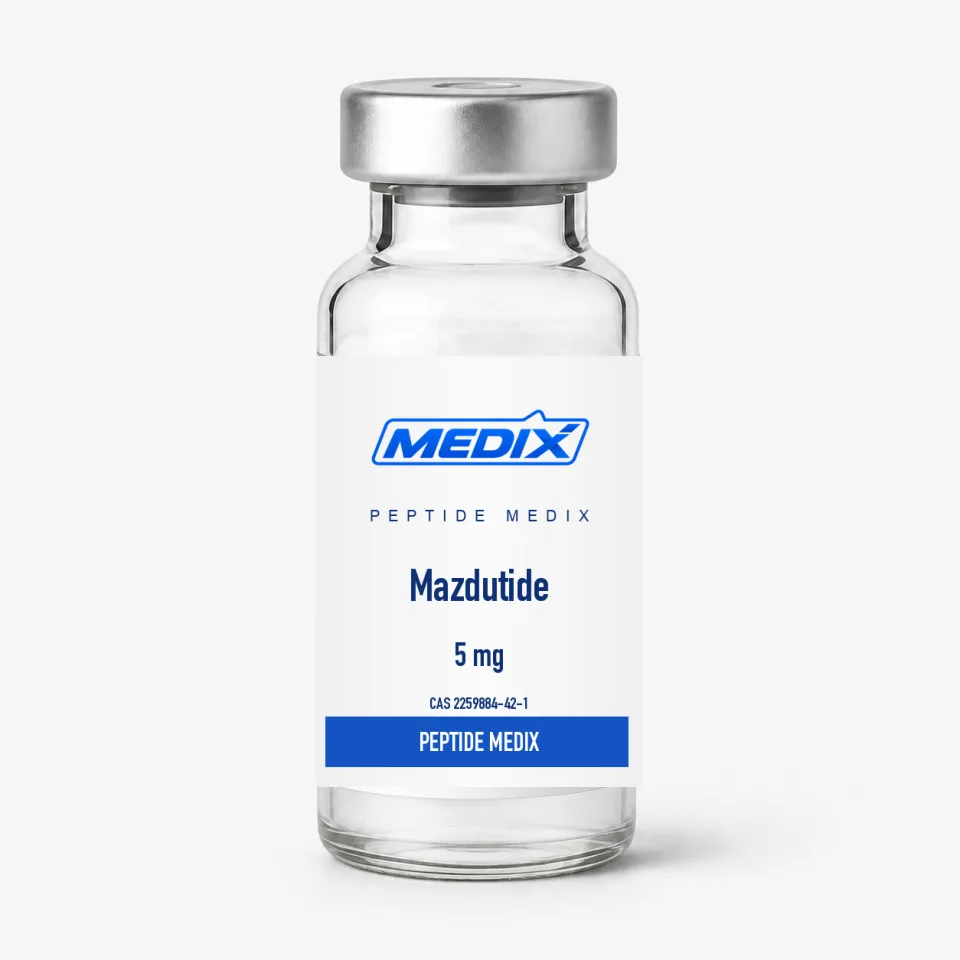
- ≥99% by HPLC
- Lot-matched certificate of analysis
- Ships next business day, tracked
Mazdutide Peptide
Oxyntomodulin-based dual GLP-1 and glucagon receptor agonist peptide
- FormLyophilized powder, sealed glass vial with flip-off seal
- Research areasEnergy expenditure, hepatic substrate handling, incretin-glucagon receptor balance
Overview
Its interest as a research tool comes from that natural template. Where survodutide and retatrutide are engineered scaffolds, mazdutide follows the receptor balance nature already built into oxyntomodulin, which makes it useful for asking whether an oxyntomodulin-like ratio behaves differently from a designed one. Investigators use it in cyclic-AMP potency panels, hepatocyte and adipocyte assays, and rodent energy-balance work where glucagon-driven expenditure and GLP-1-driven intake reduction are measured together.
Oxyntomodulin, the template, is a 37-residue proglucagon product: the full glucagon sequence extended at the C-terminus by an eight-residue basic tail. It activates both the glucagon and the GLP-1 receptors natively but is cleared within minutes, and mazdutide is the stabilised version of that arrangement, with protease-resistant substitutions and a lipid side chain for reversible albumin binding, catalogued under CAS 2259884-42-1 and appearing in the literature as IBI362 and LY3305677. Searching all three identifiers is worth doing when assembling references, since the development codes dominate the earlier papers. Vials are offered at 5 mg, 10 mg and 20 mg, reconstituted in bacteriostatic water or in dilute alkaline or phosphate buffers, with the lyophilized cake at −20 °C and solutions at 2–8 °C.
Specifications
Identity
- CAS number
- 2259884-42-1
- Peptide class
- Acylated oxyntomodulin analog; dual GLP-1 / glucagon receptor agonist
Supply & purity
- Form
- Lyophilized powder, sealed glass vial with flip-off seal
- Purity
- ≥99% by HPLC; lot-matched COA available
- Available sizes
- 5 mg, 10 mg, 20 mg
- Solubility
- Bacteriostatic water; dilute alkaline or phosphate buffers also used
Handling & storage
- Storage (lyophilized)
- −20 °C, sealed and protected from light and moisture
- Storage (reconstituted)
- 2–8 °C, protected from light; use within the study window
Additional detail
- Also cited as
- IBI362 and LY3305677 in the research literature
- Structural notes
- Proglucagon-family backbone with protease-resistant substitutions and a lipid side chain for albumin binding
- Research areas
- Energy expenditure, hepatic substrate handling, incretin-glucagon receptor balance
Working out the concentration
Mazdutide ships as a lyophilized powder, so nothing on this page can state a concentration: the figure you work with is the one you create when you add diluent. Put the vial mass and the volume you intend to use into the peptide reconstitution calculator and it returns mg/mL, mcg/mL and the mass sitting at each mark on a U-100 syringe.
Certificate of analysis
Every lot of Mazdutide is released against a certificate of analysis: the batch-specific laboratory data for that lot, not a generic document for the compound. The lot number on the certificate matches the lot number printed on the label you receive — the vial label itself, where the product is vialled — so the record and the material it describes can always be reconciled.
Purity: ≥99% by HPLC — the specification for this listing. The figure for the lot you receive is the one reported on that lot’s certificate.
No lot certificate is on display on this page at the moment. That is a publishing state and not a testing one: lots are released and documented as described above whether or not the document is posted here, and we will send what exists for the lot in stock, or for a lot already on your bench, by its number.
Certificates are available on request before you order as well as after, with no account and no charge. Request the certificate for this listing, read the testing and documentation policy in full, or see how to read a peptide COA.
Questions about Mazdutide
What is mazdutide based on?
It is an analog of oxyntomodulin, a naturally occurring proglucagon-derived peptide that activates both the GLP-1 and glucagon receptors. Stabilizing substitutions and a fatty-acid side chain give it a working duration native oxyntomodulin does not have.
Is it the same compound as IBI362 or LY3305677?
Yes. Mazdutide appears under both development codes in the pharmacology literature. Searching all three names is useful when assembling references, since older papers often use only the code.
How does it compare with survodutide?
Both engage the glucagon and GLP-1 receptors, but they come from different design lineages and differ in receptor potency ratio. Laboratories often run them side by side precisely to test whether that ratio changes the metabolic phenotype observed.
What purity and documentation are supplied?
Each lot is HPLC tested to at least 99% purity with mass-spectrometric identity confirmation, and a lot-matched certificate of analysis is available. The COA is tied to the vial number shipped so data remains traceable to that material.
How should the vial be stored?
Store the sealed lyophilized vial at −20 °C, protected from light and moisture. After reconstitution, keep the solution at 2–8 °C, protect it from light and use it within your documented study window. Aliquot to avoid freeze-thaw cycling.
Related