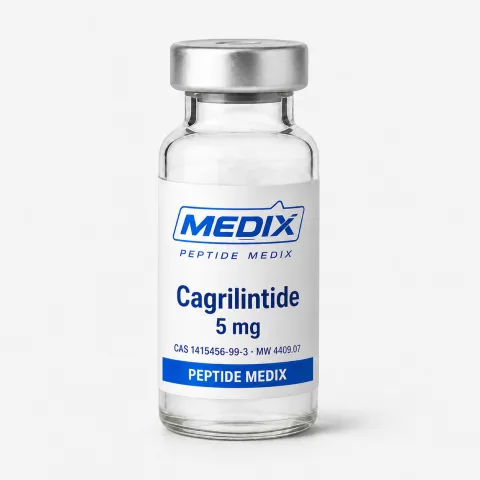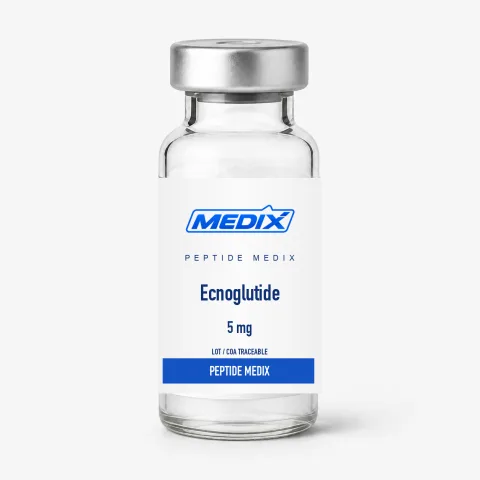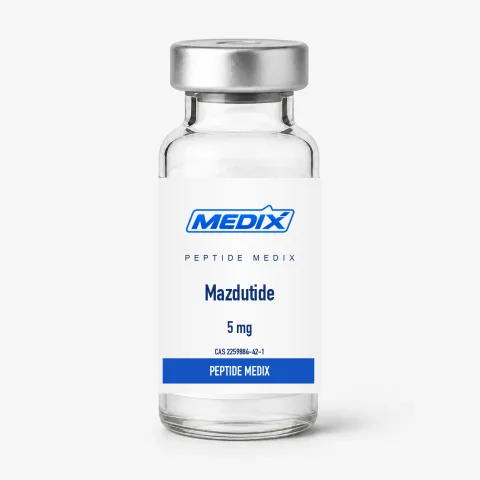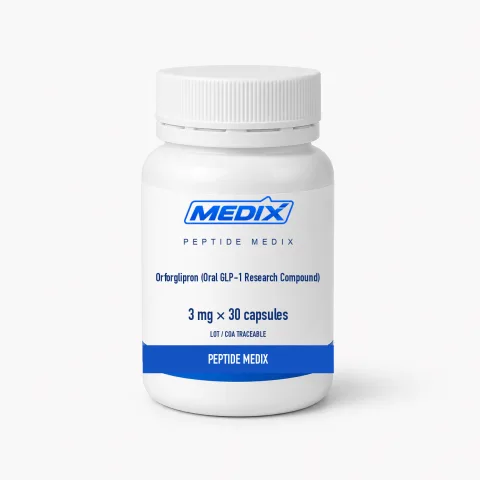
- ≥99% by HPLC
- Lot-matched certificate of analysis
- Ships next business day, tracked
Liraglutide Peptide
Palmitoylated 31-residue GLP-1 receptor agonist analog, research grade
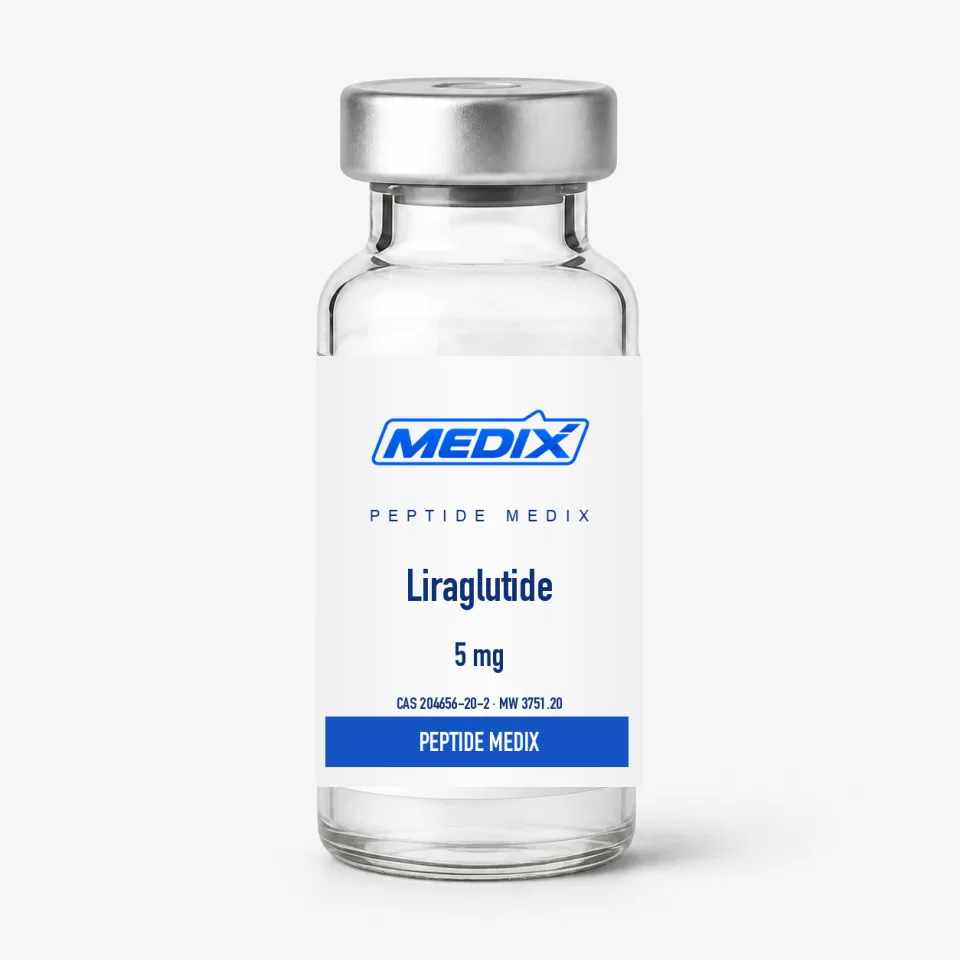
- FormLyophilized powder, sealed glass vial with flip-off seal
- Mol. weight3751.20 g/mol
- Research areasGLP-1 receptor signaling, insulin secretion, appetite and gastric-emptying models
Overview
Historically it is the molecule that proved lipidation could turn a fragile incretin into a durable tool compound, and it remains a common reference in that literature. Laboratories use liraglutide as a benchmark GLP-1 receptor agonist in cyclic-AMP and beta-arrestin assays, in islet and beta-cell secretion studies, and in rodent food-intake models, particularly when the goal is to compare an older single-agonist reference against newer diacid-acylated or multi-receptor peptides.
Structurally liraglutide is the GLP-1(7-37) backbone with two changes. Lysine 34 is replaced by arginine, leaving a single lysine in the chain, and that remaining Lys26 carries a gamma-glutamyl spacer bearing a C16 palmitoyl group. The substitution matters as much as the acylation, since it directs the fatty acid to one site rather than two. The acyl chain drives reversible albumin binding and also self-association into oligomers, behaviour that has made the molecule a standard model system in biophysical studies of lipidated peptides. It reconstitutes in bacteriostatic water but dissolves more slowly than unmodified peptides, so solvent is added down the wall and given time. Vials are 5 mg and 10 mg at 3751.20 g/mol.
Specifications
Identity
- CAS number
- 204656-20-2
- Molecular formula
- C172H265N43O51
- Molecular weight
- 3751.20 g/mol
- Amino acid sequence
- His-Ala-Glu-Gly-Thr-Phe-Thr-Ser-Asp-Val-Ser-Ser-Tyr-Leu-Glu-Gly-Gln-Ala-Ala-Lys(gamma-Glu-palmitoyl)-Glu-Phe-Ile-Ala-Trp-Leu-Val-Arg-Gly-Arg-Gly
- Peptide class
- Acylated GLP-1 receptor agonist analog (incretin mimetic)
Supply & purity
- Form
- Lyophilized powder, sealed glass vial with flip-off seal
- Purity
- ≥99% by HPLC; lot-matched COA available
- Available sizes
- 5 mg, 10 mg
Handling & storage
- Storage (lyophilized)
- −20 °C, sealed and protected from light and moisture
- Storage (reconstituted)
- 2–8 °C, protected from light; use within the study window
Additional detail
- Backbone length
- 31 amino acids, based on GLP-1(7-37)
- Research areas
- GLP-1 receptor signaling, insulin secretion, appetite and gastric-emptying models
Working out the concentration
Because Liraglutide arrives dry, its concentration is a decision rather than a specification. Run the numbers through the reconstitution calculator — vial mass in, diluent volume in, mg/mL and mass per syringe unit out.
Certificate of analysis
Every lot of Liraglutide is released against a certificate of analysis: the batch-specific laboratory data for that lot, not a generic document for the compound. The lot number on the certificate matches the lot number printed on the label you receive — the vial label itself, where the product is vialled — so the record and the material it describes can always be reconciled.
Purity: ≥99% by HPLC — the specification for this listing. The figure for the lot you receive is the one reported on that lot’s certificate.
No lot certificate is on display on this page at the moment. That is a publishing state and not a testing one: lots are released and documented as described above whether or not the document is posted here, and we will send what exists for the lot in stock, or for a lot already on your bench, by its number.
Certificates are available on request before you order as well as after, with no account and no charge. Request the certificate for this listing, read the testing and documentation policy in full, or see how to read a peptide COA.
Questions about Liraglutide
How does liraglutide differ from semaglutide?
Both are acylated GLP-1 receptor agonist analogs, but liraglutide carries a C16 palmitoyl chain and no Aib substitution, giving a shorter circulating persistence. Semaglutide adds Aib at position 2 and a C18 diacid, which markedly extends its half-life in published pharmacokinetic work.
Why is liraglutide still used in research?
It is one of the most thoroughly characterized GLP-1 agonists available, so it makes a dependable reference arm. Its self-association behavior also makes it a useful model system for biophysical studies of lipidated peptides.
What purity and documentation do you provide?
Each lot is HPLC tested to at least 99% purity with identity confirmed by mass spectrometry. A lot-matched certificate of analysis is available and corresponds to the vial number shipped, so results can be traced to the exact material used.
Does it dissolve easily?
It reconstitutes in bacteriostatic water, though the palmitoyl chain makes it slower to clear than unmodified peptides. Add solvent gently down the wall, swirl and allow time; some laboratories use a mildly alkaline buffer to aid dissolution before adjusting to assay conditions.
How should the vial be stored?
Keep the sealed lyophilized vial at −20 °C, protected from light and moisture. After reconstitution, store at 2–8 °C, protect from light and use within your documented study window. Aliquot so the stock avoids repeated freeze-thaw cycles.
Related