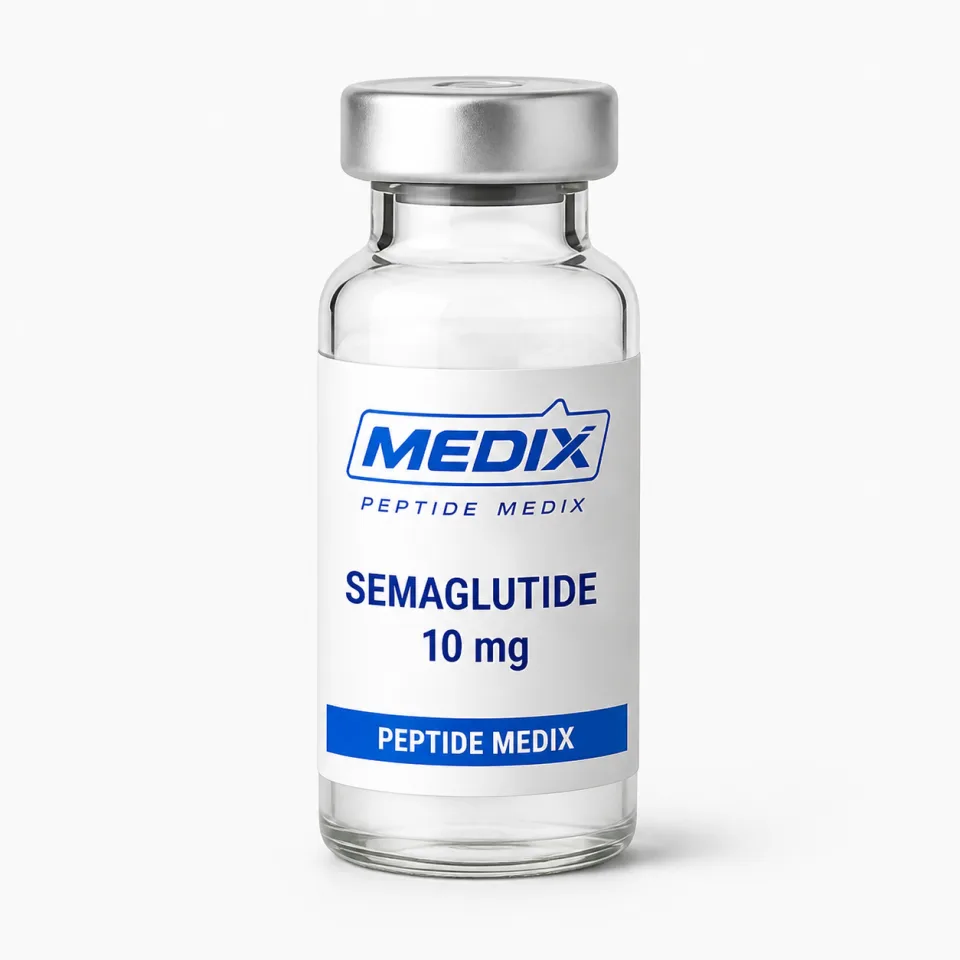
- ≥99% by HPLC
- Lot-matched certificate of analysis
- Ships next business day, tracked
Semaglutide Peptide
Acylated 31-residue GLP-1 receptor agonist analog, research grade
- FormLyophilized powder, sealed glass vial with flip-off seal
- Mol. weight4113.58 g/mol
- Research areasGLP-1 receptor pharmacology, incretin signaling, appetite and glucose-handling models
Overview
Semaglutide is a synthetic 31-residue analog of glucagon-like peptide-1 (GLP-1), the incretin hormone released from intestinal L-cells after nutrient intake. Two engineering changes distinguish it from native GLP-1: an alpha-aminoisobutyric acid substitution near the N-terminus, which sharply reduces cleavage by dipeptidyl peptidase-4, and a lysine-linked gamma-glutamyl spacer carrying a C18 fatty diacid, which promotes reversible albumin binding. Together these modifications extend circulating persistence from minutes to days in published pharmacokinetic work.
Because of that stability, semaglutide has become one of the most widely referenced tool compounds in incretin biology. Laboratory groups use it to probe GLP-1 receptor binding kinetics, cyclic-AMP accumulation and beta-arrestin recruitment in receptor-transfected cell lines, and downstream signaling in islet, hypothalamic and vagal-afferent preparations. It is also a common positive control when novel GLP-1, dual and triple agonists are characterized side by side.
Specifications
Identity
- CAS number
- 910463-68-2
- Molecular formula
- C187H291N45O59
- Molecular weight
- 4113.58 g/mol
- Peptide class
- Acylated GLP-1 receptor agonist analog (incretin mimetic)
Supply & purity
- Form
- Lyophilized powder, sealed glass vial with flip-off seal
- Purity
- ≥99% by HPLC; lot-matched COA available
- Available sizes
- 2 mg, 5 mg, 10 mg, 15 mg, 20 mg, 30 mg, 50 mg
- Solubility
- Bacteriostatic water; also soluble in dilute alkaline or phosphate buffers
Handling & storage
- Storage (lyophilized)
- −20 °C, sealed and protected from light and moisture
- Storage (reconstituted)
- 2–8 °C, protected from light; use within the study window
Additional detail
- Backbone length
- 31 amino acids
- Key modifications
- Aib at position 2; Lys26 conjugated to gamma-Glu-(AEEA)2-C18 diacid
- Research areas
- GLP-1 receptor pharmacology, incretin signaling, appetite and glucose-handling models
Working out the concentration
Semaglutide ships as a lyophilized powder, so nothing on this page can state a concentration: the figure you work with is the one you create when you add diluent. Put the vial mass and the volume you intend to use into the peptide reconstitution calculator and it returns mg/mL, mcg/mL and the mass sitting at each mark on a U-100 syringe.
If the protocol asks for a molar concentration, the molar concentration calculator converts between 4113.58 g/mol, the mass you weigh out and the volume you dissolve it in.
Certificate of analysis
Every lot of Semaglutide is released against a certificate of analysis: the batch-specific laboratory data for that lot, not a generic document for the compound. The lot number on the certificate matches the lot number printed on the label you receive — the vial label itself, where the product is vialled — so the record and the material it describes can always be reconciled.
Purity: ≥99% by HPLC — the specification for this listing. The figure for the lot you receive is the one reported on that lot’s certificate.
No lot certificate is on display on this page at the moment. That is a publishing state and not a testing one: lots are released and documented as described above whether or not the document is posted here, and we will send what exists for the lot in stock, or for a lot already on your bench, by its number.
Certificates are available on request before you order as well as after, with no account and no charge. Request the certificate for this listing, read the testing and documentation policy in full, or see how to read a peptide COA.
Questions about Semaglutide
What purity is your semaglutide and can I see a COA?
Every lot is tested by HPLC to at least 99% purity, with identity confirmed by mass spectrometry. A lot-matched certificate of analysis is available on request and is tied to the exact vial number you receive, so results can be traced to your shipment.
What sizes are available?
Semaglutide is offered in 5 mg, 10 mg, 20 mg, 30 mg and 50 mg lyophilized vials. Larger sizes lower the cost per milligram, which suits longer assay programs; smaller vials limit how long a reconstituted stock sits in the refrigerator.
How should the vial be stored?
Store the sealed lyophilized vial at −20 °C, protected from light and moisture. Once reconstituted, keep the solution at 2–8 °C and use it within your documented study window. Prepare single-use aliquots so the stock is not repeatedly frozen and thawed.
How does semaglutide differ from tirzepatide or retatrutide?
Semaglutide is a single-receptor GLP-1 agonist analog. Tirzepatide engages both GIP and GLP-1 receptors, and retatrutide adds glucagon receptor activity. Laboratories often run all three side by side to compare receptor selectivity and downstream signaling.
What solvent is used for reconstitution?
Bacteriostatic water is the usual choice in research settings; dilute alkaline or phosphate buffers are also used when a specific assay pH is required. Add solvent slowly and swirl rather than shake, then confirm the solution is clear before use.
Related