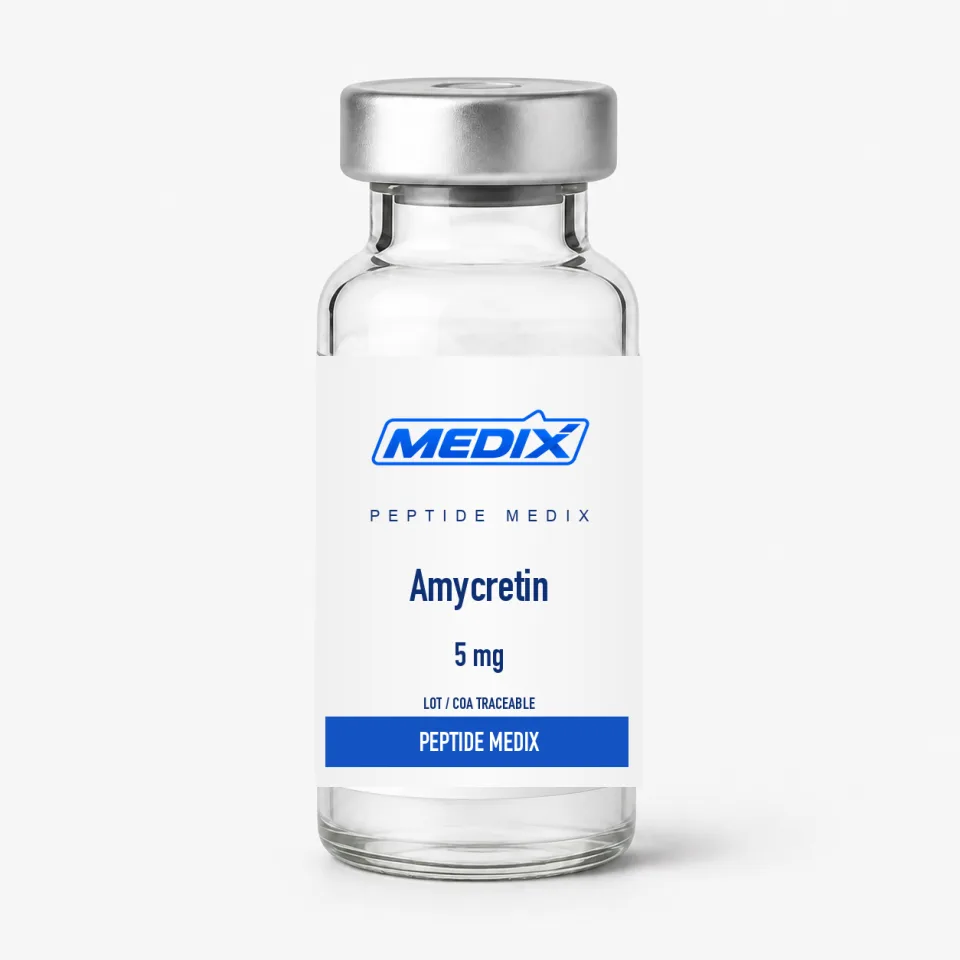
- ≥99% by HPLC
- Lot-matched certificate of analysis
- Ships next business day, tracked
Amycretin
Investigational unimolecular GLP-1 and amylin receptor co-agonist peptide
- FormLyophilized powder, sealed glass vial with flip-off seal
Overview
Amycretin is an investigational peptide designed as a unimolecular co-agonist: a single molecule that engages both the GLP-1 receptor and the amylin receptor complex. The two pathways have historically been targeted separately — incretin agonists such as semaglutide on one side, amylin analogues such as cagrilintide on the other — and combination approaches have generally meant co-administering two peptides. Amycretin represents the alternative strategy of building both activities into one acylated peptide backbone.
Pharmacologically, the amylin arm is unusual in that its receptor is not a single gene product: amylin receptors are heterodimers of the calcitonin receptor with one of three receptor activity-modifying proteins, RAMP1, RAMP2 or RAMP3, producing the AMY1, AMY2 and AMY3 subtypes. Which of them a co-agonist engages, and in what proportion, has to be resolved in cells expressing defined RAMP combinations rather than inferred from a binding figure, and that is a large part of why the compound is of interest at the bench. Structural detail is deliberately absent from the specification list because the public literature does not yet fix it to a verifiable standard. Vials are 5 mg and 10 mg, swirled rather than vortexed on reconstitution.
Specifications
Identity
- Peptide class
- Acylated unimolecular GLP-1 receptor and amylin receptor co-agonist
Supply & purity
- Form
- Lyophilized powder, sealed glass vial with flip-off seal
- Purity
- ≥99% by HPLC; lot-matched COA available
- Available sizes
- 5 mg, 10 mg
- Solubility
- Bacteriostatic water; gentle swirling, no vortexing
Handling & storage
- Storage (lyophilized)
- −20 °C, sealed and protected from light and moisture
- Storage (reconstituted)
- 2–8 °C, protected from light, used within the study window
Additional detail
- Molecular targets
- GLP-1 receptor; calcitonin receptor with RAMP subunits (amylin receptor complex)
- Design rationale
- Two appetite-regulating pathways engaged by one peptide rather than two co-administered agents
- Regulatory status
- Investigational; not approved for any indication in any jurisdiction
- Documentation
- Third-party HPLC purity and identity report per lot
Working out the concentration
The vial sizes above — 5 mg, 10 mg — describe a mass of material, not a strength. Choose a diluent volume, work it out with the reconstitution calculator, and you have the concentration for your own vial of Amycretin plus the volume that carries any mass you want to withdraw.
Certificate of analysis
Every lot of Amycretin is released against a certificate of analysis: the batch-specific laboratory data for that lot, not a generic document for the compound. The lot number on the certificate matches the lot number printed on the label you receive — the vial label itself, where the product is vialled — so the record and the material it describes can always be reconciled.
Purity: ≥99% by HPLC — the specification for this listing. The figure for the lot you receive is the one reported on that lot’s certificate.
No lot certificate is on display on this page at the moment. That is a publishing state and not a testing one: lots are released and documented as described above whether or not the document is posted here, and we will send what exists for the lot in stock, or for a lot already on your bench, by its number.
Certificates are available on request before you order as well as after, with no account and no charge. Request the certificate for this listing, read the testing and documentation policy in full, or see how to read a peptide COA.
Questions about Amycretin
What makes amycretin different from semaglutide or tirzepatide?
Semaglutide is a GLP-1 receptor agonist and tirzepatide is a dual GIP/GLP-1 agonist. Amycretin's second arm is amylin rather than another incretin: it engages the calcitonin receptor–RAMP complexes that mediate amylin signalling, alongside the GLP-1 receptor, within a single molecule.
Is amycretin an approved medicine?
No. Amycretin is an investigational compound in early-phase development. It is not approved by the FDA, EMA or any other regulator for any indication, and it is offered here strictly as a research chemical for laboratory use.
Why does the specification list omit a molecular formula?
We publish only values we can state with confidence. Full structural details for amycretin are not established in the public literature to the standard we require, so we list class, targets and status rather than printing a formula or sequence we cannot verify.
What documentation comes with each lot?
Every lot is third-party tested by HPLC for purity and identity, with a lot-matched certificate of analysis available on request. Retain the COA with your study records so the material characterised can be traced to the data generated from it.
How is it prepared for laboratory work?
The lyophilized powder is reconstituted with bacteriostatic water added slowly against the vial wall and swirled gently rather than shaken. Solutions are held at 2–8 °C and protected from light. We provide no dosing, administration or protocol guidance of any kind.
Related