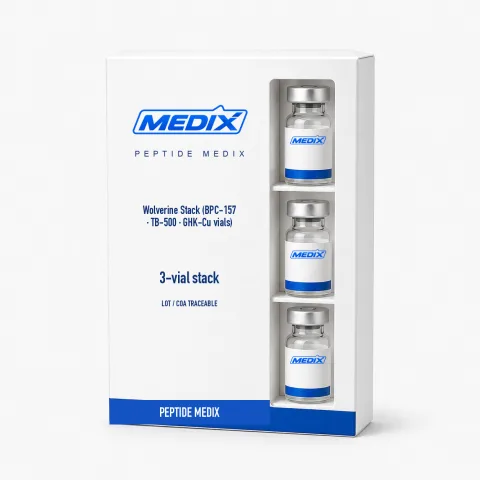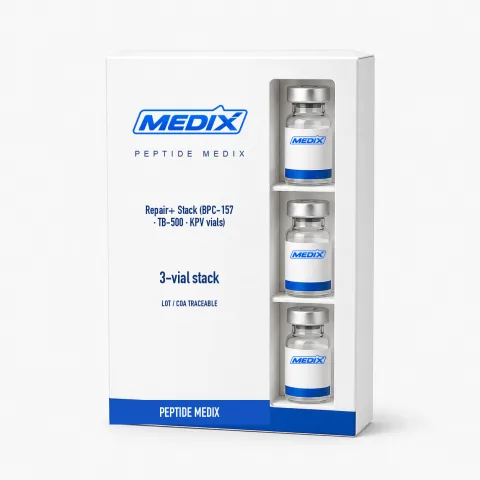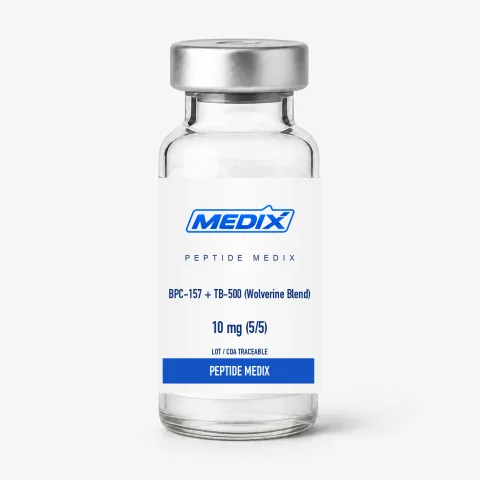
- ≥99% by HPLC per component
- Lot-matched certificate of analysis
- Ships next business day, tracked
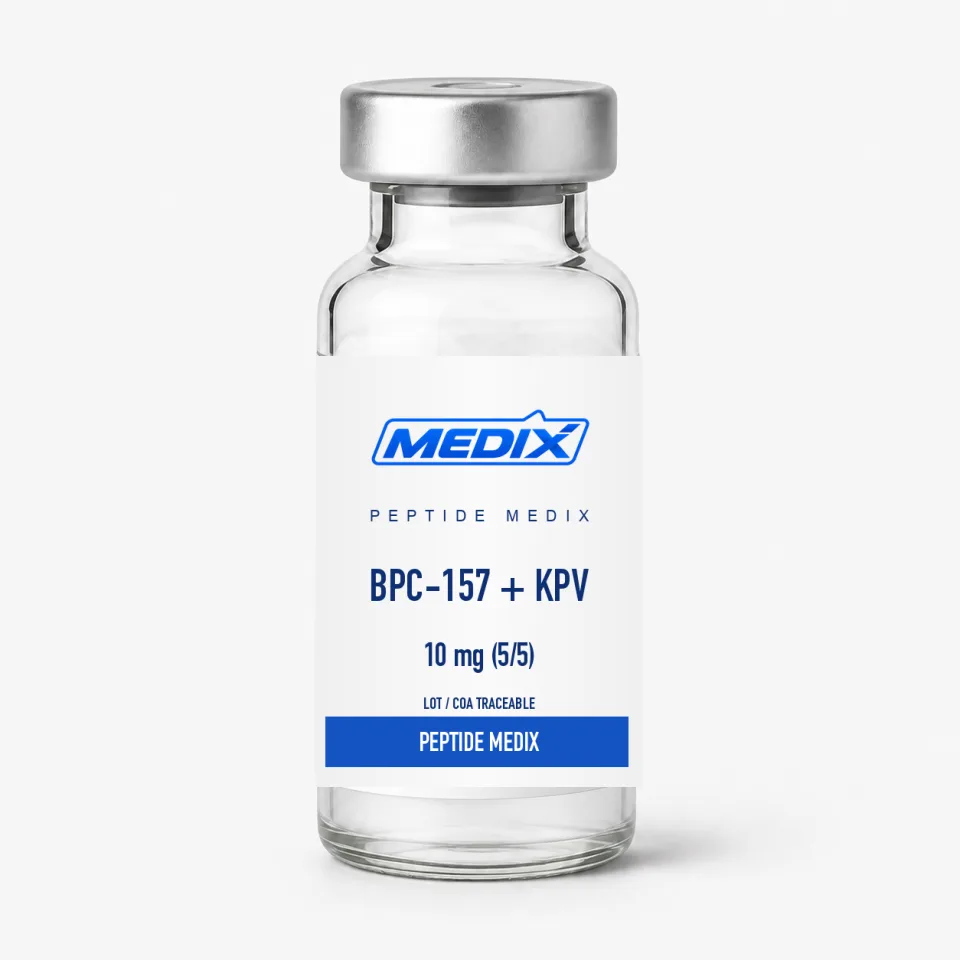
BPC-157 + KPV
Co-formulated repair and inflammatory-signalling blend in one lyophilized vial
- FormLyophilized powder, sealed glass vial with crimped stopper
- Research areasGastrointestinal mucosal models, inflammatory signalling, tissue repair, NF-kappa B pathway activity
Overview
This blend puts two short peptides into a single lyophilized vial at a 1:1 mass ratio: BPC-157, the fifteen-residue gastric pentadecapeptide derived from body protection compound, and KPV, the three-residue C-terminal fragment of alpha-melanocyte-stimulating hormone. The 10 mg vial contains 5 mg of each; the 20 mg vial contains 10 mg of each.
A 1:1 mass ratio is not a 1:1 molar ratio here, and the gap is wide: BPC-157 has a molecular weight of 1419.55 g/mol against 342.43 g/mol for KPV, so an equal-mass fill supplies roughly four times as many KPV molecules as BPC-157 molecules. Any design reporting concentrations in molar terms needs that conversion made explicitly. The two sequences also come from unrelated origins. BPC-157 derives from body protection compound, characterised in gastric juice; KPV is the C-terminal tripeptide of alpha-melanocyte-stimulating hormone, a fragment examined in the literature for its activity in NF-kappa B-driven inflammatory signalling. Both dissolve readily in bacteriostatic or sterile water, and the vial holds the two peptides alone, with no diluent, carrier or preservative.
Specifications
Supply & purity
- Form
- Lyophilized powder, sealed glass vial with crimped stopper
- Purity
- ≥99% by HPLC per component; lot-matched COA available
- Available sizes
- 10 mg total (5 mg BPC-157 / 5 mg KPV); 20 mg total (10 mg / 10 mg)
- Solubility
- Both peptides dissolve readily in bacteriostatic or sterile water
Handling & storage
- Storage (lyophilized)
- −20 °C, sealed and protected from light and moisture
- Storage (reconstituted)
- 2–8 °C, protected from light, used within the study window
Additional detail
- Product type
- Co-formulated two-peptide blend, single vial
- Blend ratio
- 1:1 by mass
- BPC-157
- CAS 137525-51-0 · C62H98N16O22 · 1419.55 g/mol
- BPC-157 sequence
- Gly-Glu-Pro-Pro-Pro-Gly-Lys-Pro-Ala-Asp-Asp-Ala-Gly-Leu-Val
- KPV
- CAS 67727-97-3 · C16H30N4O4 · 342.43 g/mol
- KPV sequence
- Lys-Pro-Val (alpha-MSH 11–13 C-terminal fragment)
- Research areas
- Gastrointestinal mucosal models, inflammatory signalling, tissue repair, NF-kappa B pathway activity
Working out the concentration
Reconstitution is where the arithmetic lives. The same vial made up with 1 mL or with 3 mL of diluent gives three-fold different numbers, which is why a reconstitution volume calculator is more use here than a fixed table: enter the vial mass and your diluent volume and read the concentration back.
Certificate of analysis
Every lot of BPC-157 + KPV is released against a certificate of analysis: the batch-specific laboratory data for that lot, not a generic document for the compound. The lot number on the certificate matches the lot number printed on the label you receive — the vial label itself, where the product is vialled — so the record and the material it describes can always be reconciled.
Purity: ≥99% by HPLC per component — the specification for this listing. The figure for the lot you receive is the one reported on that lot’s certificate.
No lot certificate is on display on this page at the moment. That is a publishing state and not a testing one: lots are released and documented as described above whether or not the document is posted here, and we will send what exists for the lot in stock, or for a lot already on your bench, by its number.
Certificates are available on request before you order as well as after, with no account and no charge. Request the certificate for this listing, read the testing and documentation policy in full, or see how to read a peptide COA.
Questions about BPC-157 + KPV
What is in the BPC-157 + KPV vial?
One lyophilized vial containing both peptides at a 1:1 mass ratio. The 10 mg option holds 5 mg of BPC-157 and 5 mg of KPV; the 20 mg option holds 10 mg of each. There is no diluent, carrier or preservative in the vial — only the two peptides.
How does the blend differ from buying the peptides separately?
A blend fixes the ratio at manufacture and needs one reconstitution, which simplifies preparation and reduces vial-to-vial handling. Separate vials let a researcher set any ratio and run single-peptide control arms. Studies designed to attribute an effect to one component usually need the separate vials as well.
Is a certificate of analysis available?
Yes. Each component is assayed by HPLC to a ≥99% purity specification with mass-spectrometric identity confirmation, and the finished blend lot carries a matched certificate of analysis covering both peptides. Current lot COAs can be requested before ordering.
What solvent is used to reconstitute it?
Both peptides are freely water-soluble, so bacteriostatic water is the usual choice for multi-draw preparations and sterile water for single-use ones. Add the diluent slowly against the vial wall and swirl rather than shake; the solution should be clear and colourless with no visible particulates.
How long does the reconstituted blend last?
Kept at 2–8 °C, protected from light and drawn with aseptic technique, reconstituted short peptides are typically used within a few weeks in laboratory practice. Define the study window in the protocol, avoid repeated warming, and discard any preparation that becomes cloudy or shows particulates.
Related