- ≥99% by HPLC per component
- Lot-matched certificate of analysis
- Ships next business day, tracked
TB-500 + GHK-Cu Peptide Blend
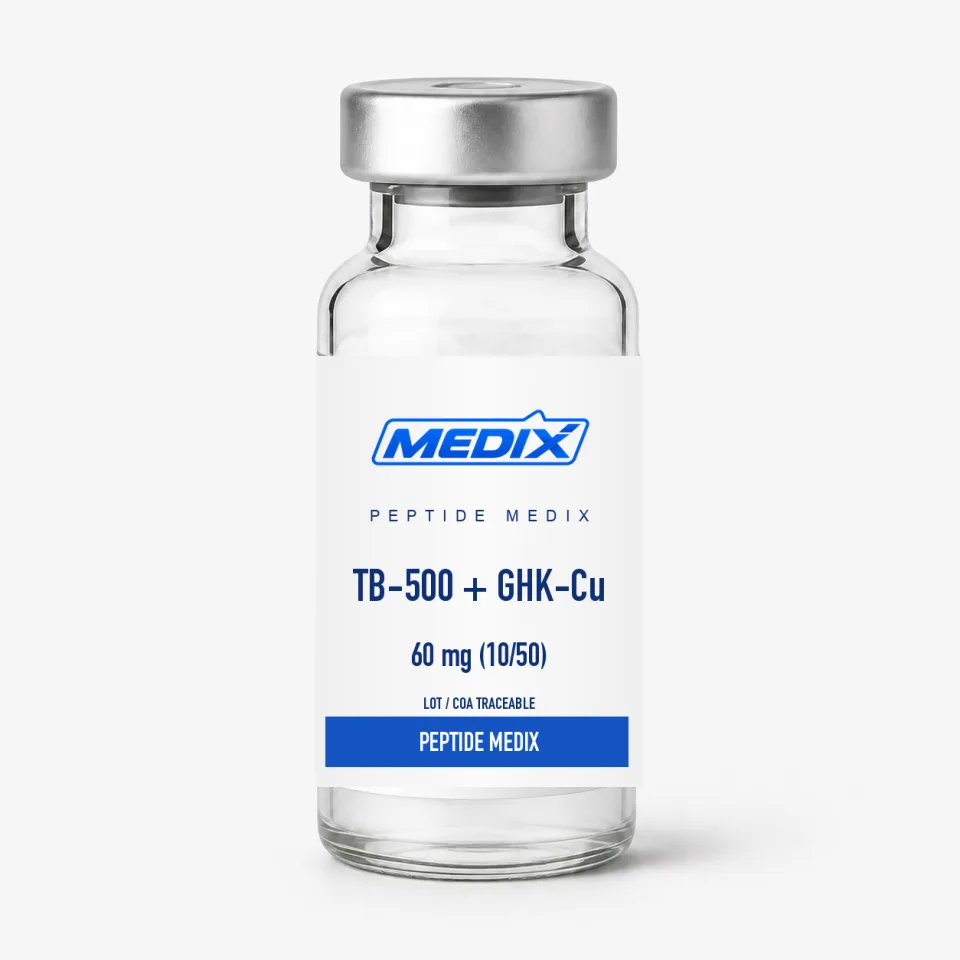
Co-lyophilized 10 mg TB-500 with 50 mg GHK-Cu in one research vial
- FormCo-lyophilized blue powder blend, sealed glass vial with crimped stopper
- Research areasCell migration, wound closure, angiogenesis, collagen and glycosaminoglycan synthesis, dermal and follicle models
Overview
This vial pairs two peptides that approach tissue remodelling from opposite ends of the process. TB-500 is the acetylated seven-residue fragment corresponding to residues 17–23 of thymosin beta-4, the actin-binding domain of a 43-amino-acid G-actin sequestering protein, and it is studied chiefly for cell migration and wound-closure endpoints. GHK-Cu is the copper(II) complex of the tripeptide glycyl-L-histidyl-L-lysine, isolated from human plasma in the 1970s, and its literature centres on extracellular matrix synthesis, collagen and glycosaminoglycan production and copper-dependent enzyme chemistry.
The vial is filled at 60 mg total: 10 mg of TB-500 and 50 mg of GHK-Cu. The asymmetric ratio reflects how the two are used rather than any claim about relative strength — GHK-Cu is conventionally handled at much higher masses than short synthetic fragments in matrix and dermal models. Each peptide is synthesised and purified to at least 99% by reversed-phase HPLC before combination, so the lot-matched certificate of analysis reports them individually rather than characterising the mixture as one entity.
Specifications
Identity
- Peptide class
- Actin-binding thymosin fragment combined with a copper-binding matrix tripeptide
Supply & purity
- Form
- Co-lyophilized blue powder blend, sealed glass vial with crimped stopper
- Purity
- ≥99% by HPLC per component; lot-matched COA available
- Available sizes
- 60 mg total — 10 mg TB-500 / 50 mg GHK-Cu
- Solubility
- Bacteriostatic or sterile water; avoid chelating buffers that strip copper
Handling & storage
- Storage (lyophilized)
- −20 °C, sealed and protected from light and moisture
- Storage (reconstituted)
- 2–8 °C, protected from light, used within the study window
Additional detail
- Components
- TB-500 (thymosin beta-4 fragment 17–23) and GHK-Cu (copper tripeptide-1)
- Blend ratio
- 1:5 TB-500 to GHK-Cu by mass
- TB-500 CAS number
- 885340-08-9
- TB-500 formula and mass
- C38H68N10O14, 889.02 g/mol
- TB-500 sequence
- Ac-Leu-Lys-Lys-Thr-Glu-Thr-Gln
- GHK-Cu CAS number
- 89030-95-5
- GHK-Cu formula and mass
- C14H24N6O4·Cu, 403.93 g/mol
- GHK-Cu sequence
- Gly-His-Lys, complexed with copper(II)
- Colour
- Blue in powder and in solution — an indicator of copper coordination
- Research areas
- Cell migration, wound closure, angiogenesis, collagen and glycosaminoglycan synthesis, dermal and follicle models
Working out the concentration
Because TB-500 + GHK-Cu arrives dry, its concentration is a decision rather than a specification. Run the numbers through the reconstitution calculator — vial mass in, diluent volume in, mg/mL and mass per syringe unit out.
Certificate of analysis
Every lot of TB-500 + GHK-Cu is released against a certificate of analysis: the batch-specific laboratory data for that lot, not a generic document for the compound. The lot number on the certificate matches the lot number printed on the label you receive — the vial label itself, where the product is vialled — so the record and the material it describes can always be reconciled.
Purity: ≥99% by HPLC per component — the specification for this listing. The figure for the lot you receive is the one reported on that lot’s certificate.
No lot certificate is on display on this page at the moment. That is a publishing state and not a testing one: lots are released and documented as described above whether or not the document is posted here, and we will send what exists for the lot in stock, or for a lot already on your bench, by its number.
Certificates are available on request before you order as well as after, with no account and no charge. Request the certificate for this listing, read the testing and documentation policy in full, or see how to read a peptide COA.
Questions about TB-500 + GHK-Cu
How much of each peptide is in the vial?
The 60 mg fill contains 10 mg of TB-500 and 50 mg of GHK-Cu, a 1:5 ratio by mass. The exact loading is stated on the label and repeated on the lot-matched certificate of analysis, which reports each peptide separately rather than characterising the blend as one substance.
Why is the powder blue?
GHK-Cu is a copper(II) complex, and coordinated copper gives both the lyophilized cake and the reconstituted solution a clear blue colour. It is a useful in-process check: intact blue indicates the complex is intact, while fading or greening suggests the copper coordination has been disturbed.
What should I reconstitute it with?
Bacteriostatic water is the usual choice for multi-draw preparations and sterile water where a single-use solution is wanted. Avoid EDTA-containing buffers, strong reducing agents and chelator-heavy media, because those can strip copper from the GHK-Cu component and change what you are actually testing.
Do you provide a certificate of analysis?
Yes. Every vial traces to a lot-matched COA covering both components, with HPLC purity of at least 99% per peptide and mass-spectrometric identity confirmation. Quote the lot number printed on the vial when requesting the document.
Why combine these two rather than run them separately?
Because they act at different points of the remodelling process — cytoskeletal migration versus matrix biosynthesis — investigators often want both present at a fixed ratio. A co-lyophilized vial removes a second reconstitution step, an extra septum puncture and one more source of pipetting variance between study arms.
Is this suitable for human or cosmetic use?
No. Both peptides are supplied as research chemicals in a laboratory vial format. This blend is not a drug, cosmetic or supplement, it has no approval for any indication under any circumstances.
Related