- ≥99% by HPLC per vial
- Lot-matched certificate of analysis
- Ships next business day, tracked
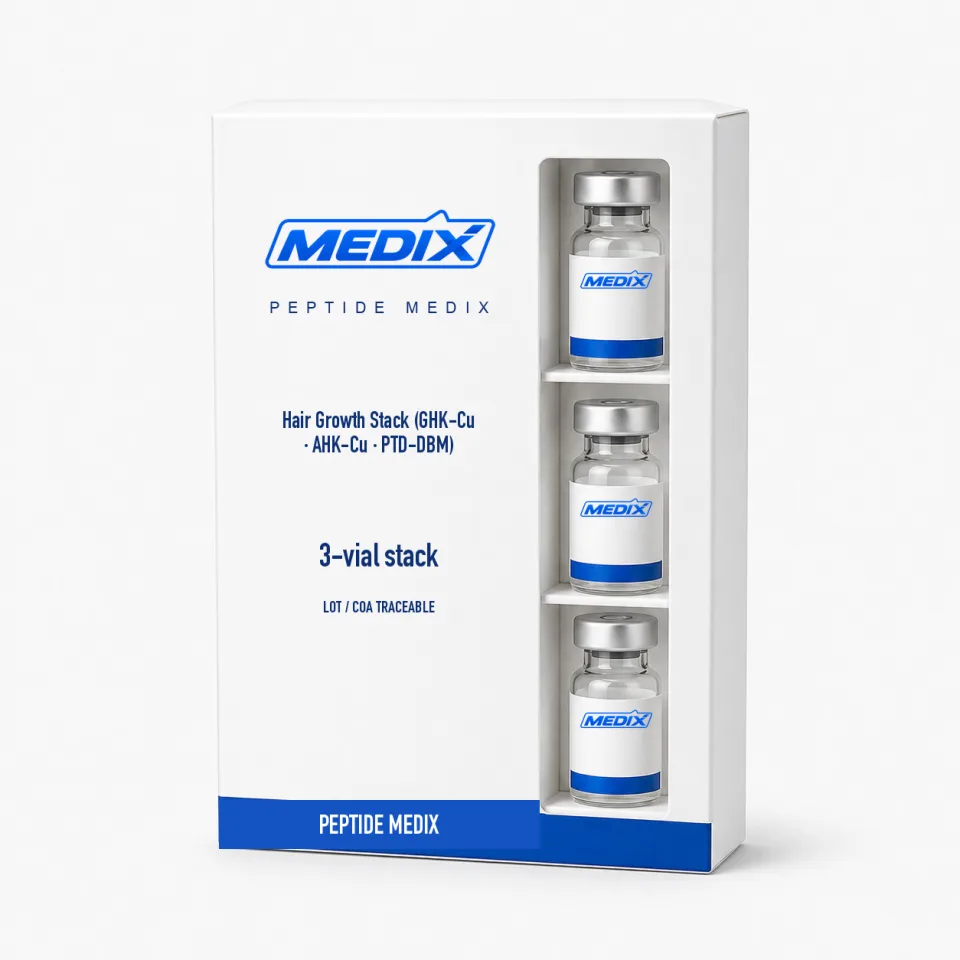
Hair Growth Stack (GHK-Cu · AHK-Cu · PTD-DBM)
Three separately sealed vials: GHK-Cu, AHK-Cu and PTD-DBM for follicle research
- FormLyophilized powder in each vial, individually stoppered and crimped
- Research areasDermal papilla cell cultures, hair follicle cycling, angiogenic signalling, matrix synthesis, topical formulation science
Overview
This stack gathers the three peptides that appear most often in follicle and dermal papilla research and ships them as separate sealed vials rather than as one co-formulated blend. Two are copper-binding tripeptides — GHK-Cu, the glycyl-histidyl-lysyl copper(II) complex characterised by Pickart, and AHK-Cu, its alanine-substituted analogue known cosmetically as copper tripeptide-3. The third, PTD-DBM, is a cell-permeable fusion peptide that blocks the CXXC5–Dishevelled interaction in Wnt/beta-catenin signalling.
Keeping the vials separate matters here more than in most stacks. The copper peptides are strongly coloured, water-soluble and sensitive to acidic conditions that dissociate the copper ion, while PTD-DBM is a much larger construct with different solubility behaviour and a different research question attached to it. Supplying them separately lets a laboratory set each concentration independently, run single-peptide control arms, and leave two vials sealed at −20 °C while the third is in use.
Specifications
Supply & purity
- Form
- Lyophilized powder in each vial, individually stoppered and crimped
- Purity
- ≥99% by HPLC per vial; a separate lot-matched COA for each
Handling & storage
- Storage (lyophilized)
- −20 °C, sealed and protected from light and moisture
- Storage (reconstituted)
- 2–8 °C, protected from light; aliquot to avoid freeze–thaw
Additional detail
- Product type
- Multi-vial research stack — three separately sealed vials
- Kit contents
- One GHK-Cu vial, one AHK-Cu vial, one PTD-DBM vial
- GHK-Cu
- CAS 89030-95-5 · C14H24N6O4·Cu · 403.93 g/mol · blue powder
- AHK-Cu
- CAS 1245800-58-7 · C15H26N6O4·Cu · ≈417.96 g/mol as the copper complex
- PTD-DBM
- Cell-permeable fusion peptide: protein transduction domain joined to the Dishevelled-binding motif of CXXC5
- Sequences
- GHK-Cu: Gly-His-Lys with coordinated Cu(II); AHK-Cu: Ala-His-Lys with coordinated Cu(II)
- Molecular targets
- Copper-dependent matrix signalling (GHK-Cu, AHK-Cu); CXXC5–Dishevelled interaction in Wnt/beta-catenin signalling (PTD-DBM)
- Research areas
- Dermal papilla cell cultures, hair follicle cycling, angiogenic signalling, matrix synthesis, topical formulation science
- Reconstitution
- Each vial prepared separately in bacteriostatic or sterile water; avoid acidic media with the copper peptides
Working out the concentration
A lyophilized vial carries a mass on the label and no concentration anywhere, so the first calculation of any protocol is the reconstitution one. The peptide concentration calculator converts vial mass plus diluent volume into mg/mL, and back into the draw volume for a given mass.
Certificate of analysis
Every lot of Hair Growth Stack (GHK-Cu · AHK-Cu · PTD-DBM) is released against a certificate of analysis: the batch-specific laboratory data for that lot, not a generic document for the compound. The lot number on the certificate matches the lot number printed on the label you receive — the vial label itself, where the product is vialled — so the record and the material it describes can always be reconciled.
Purity: ≥99% by HPLC per vial — the specification for this listing. The figure for the lot you receive is the one reported on that lot’s certificate.
No lot certificate is on display on this page at the moment. That is a publishing state and not a testing one: lots are released and documented as described above whether or not the document is posted here, and we will send what exists for the lot in stock, or for a lot already on your bench, by its number.
Certificates are available on request before you order as well as after, with no account and no charge. Request the certificate for this listing, read the testing and documentation policy in full, or see how to read a peptide COA.
Questions about Hair Growth Stack (GHK-Cu · AHK-Cu · PTD-DBM)
Why are the peptides supplied separately instead of blended?
Separate vials let a laboratory choose each concentration independently, run single-peptide control arms and handle the copper complexes under the pH conditions they need. A shared formulation would fix the ratio at manufacture and make it impossible to attribute an observed effect to one component.
How do GHK-Cu and AHK-Cu differ?
They are near-identical tripeptides: AHK substitutes alanine for glycine at the first position, so both retain the histidine and lysine residues that coordinate copper(II). Published work reports overlapping activity, with AHK-Cu studied more narrowly in dermal papilla and hair-follicle assays and GHK-Cu across a broader dermal literature.
What is PTD-DBM and why is it in a hair stack?
PTD-DBM is a cell-permeable fusion peptide combining a protein transduction domain with the Dishevelled-binding motif of CXXC5. By competing with the CXXC5–Dishevelled interaction it relieves a brake on Wnt/beta-catenin signalling, a pathway central to follicle cycling, which is why mouse studies of follicle neogenesis feature it.
Does each vial come with its own COA?
Yes. Every vial is a distinct manufacturing lot with its own certificate of analysis reporting HPLC identity and purity at the ≥99% specification. Three documents accompany the stack rather than one blended report, and current lot COAs can be requested before ordering.
Why must the copper peptides be kept out of acidic solutions?
The blue colour of GHK-Cu and AHK-Cu comes from copper(II) coordinated by the histidine imidazole and the terminal amine. Strongly acidic media protonate those groups and release the copper ion, changing what is actually present in the assay. Loss of colour is the visible warning sign.
Related