- ≥99% by HPLC per vial
- Lot-matched certificate of analysis
- Ships next business day, tracked
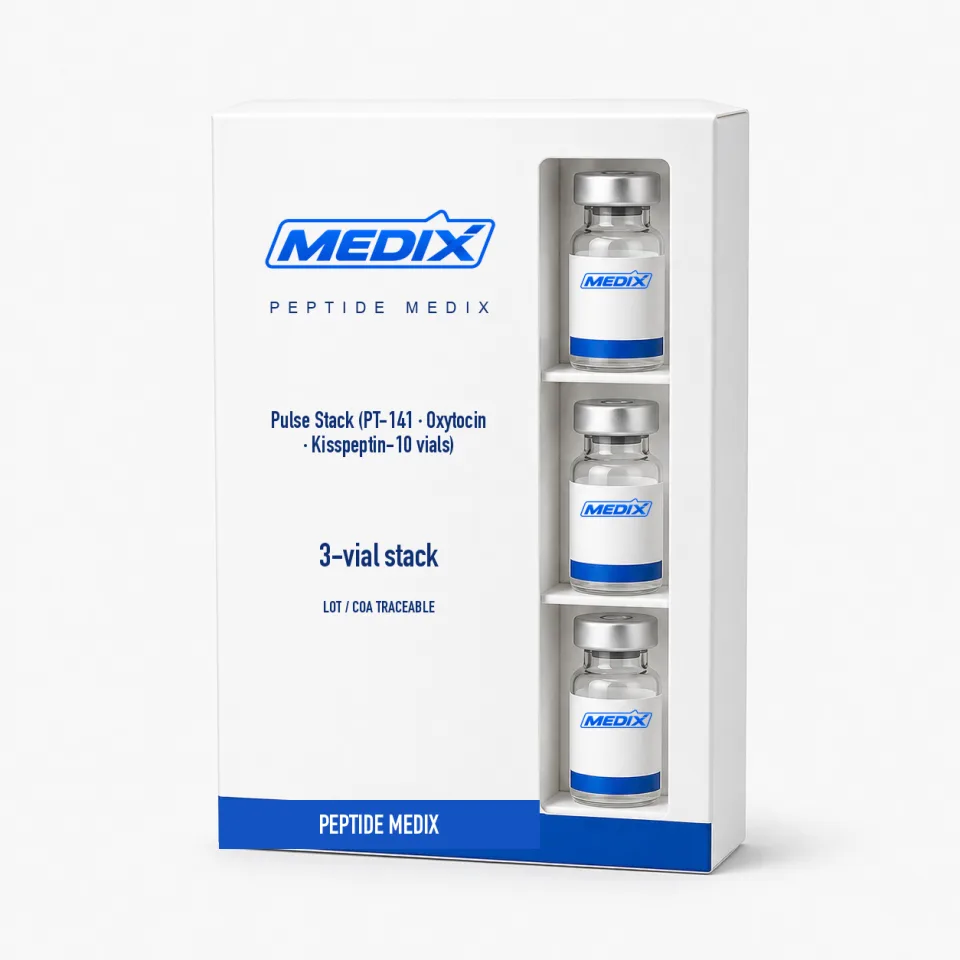
Pulse Stack (PT-141 · Oxytocin · Kisspeptin-10 vials)
Three-vial neuroendocrine kit: PT-141, oxytocin and kisspeptin-10
- FormLyophilized powder in each vial, individually capped
- Research areasMelanocortin receptor pharmacology, oxytocin receptor studies, GPR54 and GnRH axis
Overview
The Pulse Stack groups three neuroendocrine peptides — PT-141, oxytocin and kisspeptin-10 — as separately sealed lyophilized vials. Each engages a different receptor system within reproductive and social-behaviour neuroendocrinology, and together they cover melanocortin, oxytocin receptor and GPR54 signalling in a single research panel.
PT-141, also called bremelanotide, is a cyclic heptapeptide analogue derived from Melanotan II and studied as a melanocortin receptor agonist with activity at MC3R and MC4R. Oxytocin is the endogenous nonapeptide synthesised in the hypothalamus and released from the posterior pituitary, containing an intramolecular disulfide bridge between its two cysteine residues — a structural feature central to both its activity and its handling requirements. Kisspeptin-10 is the ten-residue C-terminal fragment of the KISS1 gene product, the ligand for GPR54, and occupies a well-defined position upstream of GnRH release in the reproductive axis.
These three would be poor candidates for co-formulation: oxytocin's disulfide is redox-sensitive, and the three are studied at very different concentrations. Each vial carries its own lot number, HPLC assay at ≥99% purity and certificate of analysis. Supplied as research material for laboratory investigation only.
Specifications
Supply & purity
- Form
- Lyophilized powder in each vial, individually capped
- Purity
- ≥99% by HPLC per vial; separate lot-matched COA for each
Handling & storage
- Storage (lyophilized)
- −20 °C, protected from light and moisture
- Storage (reconstituted)
- 2–8 °C, protected from light; oxytocin is least stable
Additional detail
- Product type
- Multi-vial research kit — three separately sealed vials
- Kit contents
- One PT-141 vial, one oxytocin vial, one kisspeptin-10 vial
- PT-141 (bremelanotide)
- CAS 189691-06-3 · C50H68N14O10 · 1025.16 g/mol
- Oxytocin
- CAS 50-56-6 · C43H66N12O12S2 · 1007.19 g/mol
- Kisspeptin-10
- CAS 374675-21-5 · C63H83N17O14 · 1302.47 g/mol
- Oxytocin sequence
- Cys-Tyr-Ile-Gln-Asn-Cys-Pro-Leu-Gly-NH2 (1-6 disulfide bridge)
- Kisspeptin-10 sequence
- Tyr-Asn-Trp-Asn-Ser-Phe-Gly-Leu-Arg-Phe-NH2
- Research areas
- Melanocortin receptor pharmacology, oxytocin receptor studies, GPR54 and GnRH axis
- Reconstitution
- Each vial prepared separately; avoid reducing agents with oxytocin
Working out the concentration
Pulse Stack (PT-141 · Oxytocin · Kisspeptin-10 vials) ships as a lyophilized powder, so nothing on this page can state a concentration: the figure you work with is the one you create when you add diluent. Put the vial mass and the volume you intend to use into the peptide reconstitution calculator and it returns mg/mL, mcg/mL and the mass sitting at each mark on a U-100 syringe.
Certificate of analysis
Every lot of Pulse Stack (PT-141 · Oxytocin · Kisspeptin-10 vials) is released against a certificate of analysis: the batch-specific laboratory data for that lot, not a generic document for the compound. The lot number on the certificate matches the lot number printed on the label you receive — the vial label itself, where the product is vialled — so the record and the material it describes can always be reconciled.
Purity: ≥99% by HPLC per vial — the specification for this listing. The figure for the lot you receive is the one reported on that lot’s certificate.
No lot certificate is on display on this page at the moment. That is a publishing state and not a testing one: lots are released and documented as described above whether or not the document is posted here, and we will send what exists for the lot in stock, or for a lot already on your bench, by its number.
Certificates are available on request before you order as well as after, with no account and no charge. Request the certificate for this listing, read the testing and documentation policy in full, or see how to read a peptide COA.
Questions about Pulse Stack (PT-141 · Oxytocin · Kisspeptin-10 vials)
How is PT-141 related to Melanotan II?
PT-141 is a metabolite-derived analogue of Melanotan II lacking the C-terminal amide group. That change shifts its melanocortin receptor profile toward MC3R and MC4R and away from the MC1R-driven pigment activity that characterises the parent compound.
Why is oxytocin the most fragile component?
Its structure depends on a disulfide bridge between cysteine residues 1 and 6. Reducing conditions open that ring and destroy activity, and the peptide also adsorbs to surfaces. Keep reducing agents away from it and prepare solutions close to the time of use.
Does each vial have its own certificate of analysis?
Yes. Each vial represents a distinct manufacturing lot released with its own COA reporting HPLC identity and purity for that peptide. Three separate documents accompany the kit, and current lot COAs can be requested before you place an order.
What is kisspeptin-10 used to study?
It is a standard research tool for the reproductive neuroendocrine axis. As the shortest active fragment of the KISS1 gene product, it binds GPR54 on kisspeptin-responsive neurons that sit upstream of GnRH release, making it useful for probing that hierarchy in models.
Why are these not sold as a blend?
Their stability profiles and working concentrations differ too much. Oxytocin is redox-sensitive, PT-141 is cyclic, and kisspeptin-10 carries a C-terminal amide. A single co-formulation would impose one set of conditions on three chemistries that need different care.
Related