- ≥99% by HPLC per vial
- Lot-matched certificate of analysis
- Ships next business day, tracked
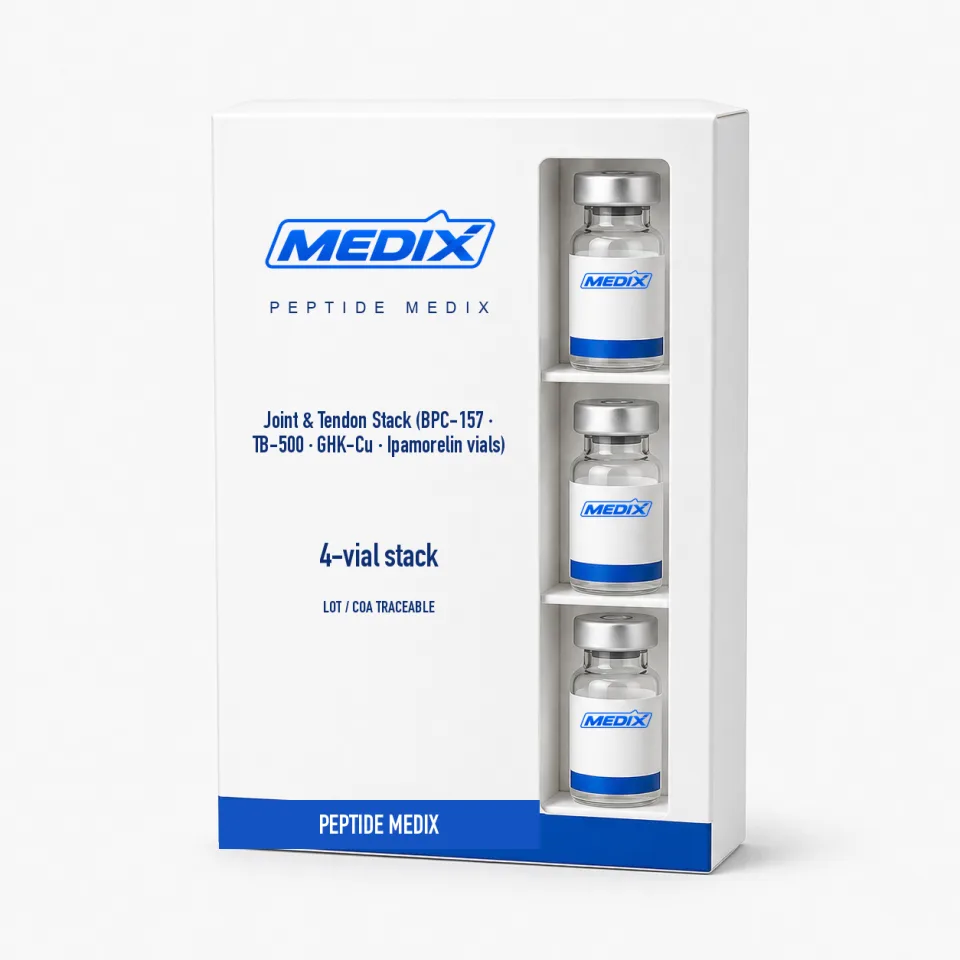
Joint & Tendon Stack (BPC-157 · TB-500 · GHK-Cu · Ipamorelin vials)
Four separately sealed vials: BPC-157, TB-500, GHK-Cu and ipamorelin
- FormLyophilized powder in each vial, individually capped
- Research areasTendon and ligament models, matrix synthesis, cell migration, GH-axis signalling
Overview
The Joint & Tendon Stack is a four-vial kit built around connective-tissue research: BPC-157, TB-500, GHK-Cu and ipamorelin, each supplied in its own sealed lyophilized vial. It extends the standard three-peptide repair grouping by adding a growth hormone secretagogue, which brings an endocrine arm to a panel that would otherwise be entirely local in scope.
BPC-157 is a synthetic 15-residue sequence studied extensively in rodent tendon and ligament models. TB-500 reproduces the actin-binding domain of thymosin beta-4 and appears throughout cell-migration literature. GHK-Cu is a copper(II)-bound tripeptide with a long in-vitro record around collagen and matrix protein synthesis in fibroblast culture. Ipamorelin is the outlier: a five-residue selective agonist at the ghrelin receptor GHS-R1a, included because growth hormone and IGF-1 signalling appear repeatedly in the connective-tissue literature alongside local repair mechanisms.
Four separate vials mean four independent variables. A protocol can hold the three local peptides constant while varying the secretagogue arm, or run any subset as a control. Each vial carries its own lot number, HPLC assay at ≥99% purity and certificate of analysis, and the kit is supplied for laboratory research only.
Specifications
Supply & purity
- Form
- Lyophilized powder in each vial, individually capped
- Purity
- ≥99% by HPLC per vial; separate lot-matched COA for each
Handling & storage
- Storage (lyophilized)
- −20 °C, protected from light and moisture
- Storage (reconstituted)
- 2–8 °C, protected from light
Additional detail
- Product type
- Multi-vial research kit — four separately sealed vials
- Kit contents
- One BPC-157 vial, one TB-500 vial, one GHK-Cu vial, one ipamorelin vial
- BPC-157
- CAS 137525-51-0 · C62H98N16O22 · 1419.55 g/mol
- TB-500
- CAS 885340-08-9 · C38H68N10O14 · 889.02 g/mol
- GHK-Cu
- CAS 89030-95-5 · C14H24N6O4·Cu · 403.93 g/mol
- Ipamorelin
- CAS 170851-70-4 · C38H49N9O5 · 711.85 g/mol
- Ipamorelin class
- Selective ghrelin receptor (GHS-R1a) pentapeptide agonist
- Research areas
- Tendon and ligament models, matrix synthesis, cell migration, GH-axis signalling
- Reconstitution
- Each vial prepared separately at protocol-defined concentration
Working out the concentration
Joint & Tendon Stack (BPC-157 · TB-500 · GHK-Cu · Ipamorelin vials) ships as a lyophilized powder, so nothing on this page can state a concentration: the figure you work with is the one you create when you add diluent. Put the vial mass and the volume you intend to use into the peptide reconstitution calculator and it returns mg/mL, mcg/mL and the mass sitting at each mark on a U-100 syringe.
Certificate of analysis
Every lot of Joint & Tendon Stack (BPC-157 · TB-500 · GHK-Cu · Ipamorelin vials) is released against a certificate of analysis: the batch-specific laboratory data for that lot, not a generic document for the compound. The lot number on the certificate matches the lot number printed on the label you receive — the vial label itself, where the product is vialled — so the record and the material it describes can always be reconciled.
Purity: ≥99% by HPLC per vial — the specification for this listing. The figure for the lot you receive is the one reported on that lot’s certificate.
No lot certificate is on display on this page at the moment. That is a publishing state and not a testing one: lots are released and documented as described above whether or not the document is posted here, and we will send what exists for the lot in stock, or for a lot already on your bench, by its number.
Certificates are available on request before you order as well as after, with no account and no charge. Request the certificate for this listing, read the testing and documentation policy in full, or see how to read a peptide COA.
Questions about Joint & Tendon Stack (BPC-157 · TB-500 · GHK-Cu · Ipamorelin vials)
Why is ipamorelin in a tendon and joint kit?
Because growth hormone and IGF-1 signalling recur throughout the connective-tissue literature alongside local repair mechanisms. Ipamorelin adds a systemic secretagogue arm to a panel that would otherwise cover only tissue-level processes, and separate vials keep the two arms distinguishable.
How does this differ from the Wolverine Stack?
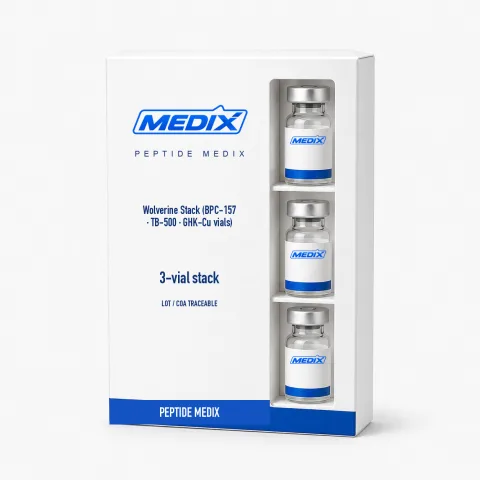
The Wolverine Stack contains three vials — BPC-157, TB-500 and GHK-Cu. This kit adds a fourth, ipamorelin, extending the panel from purely local repair mechanisms into growth hormone axis signalling. Everything else about the format is the same.
Does every vial have its own COA?
Yes. All four vials are distinct manufacturing lots, each released with its own certificate of analysis reporting HPLC identity and purity for that peptide. Four separate documents accompany the kit and current lot COAs can be requested beforehand.
Which vial produces a coloured solution?
Only GHK-Cu. The pale blue tint comes from the copper(II) ion coordinated within the tripeptide and confirms the complex is dissolved and intact. BPC-157, TB-500 and ipamorelin all reconstitute to clear colourless solutions.
Can a subset of the kit be used?
Yes, and that is a core advantage of the format. Any vial can be run alone or omitted as a control, and unopened lyophilized vials stored sealed at −20 °C away from light and moisture stay stable well beyond a year.
Related