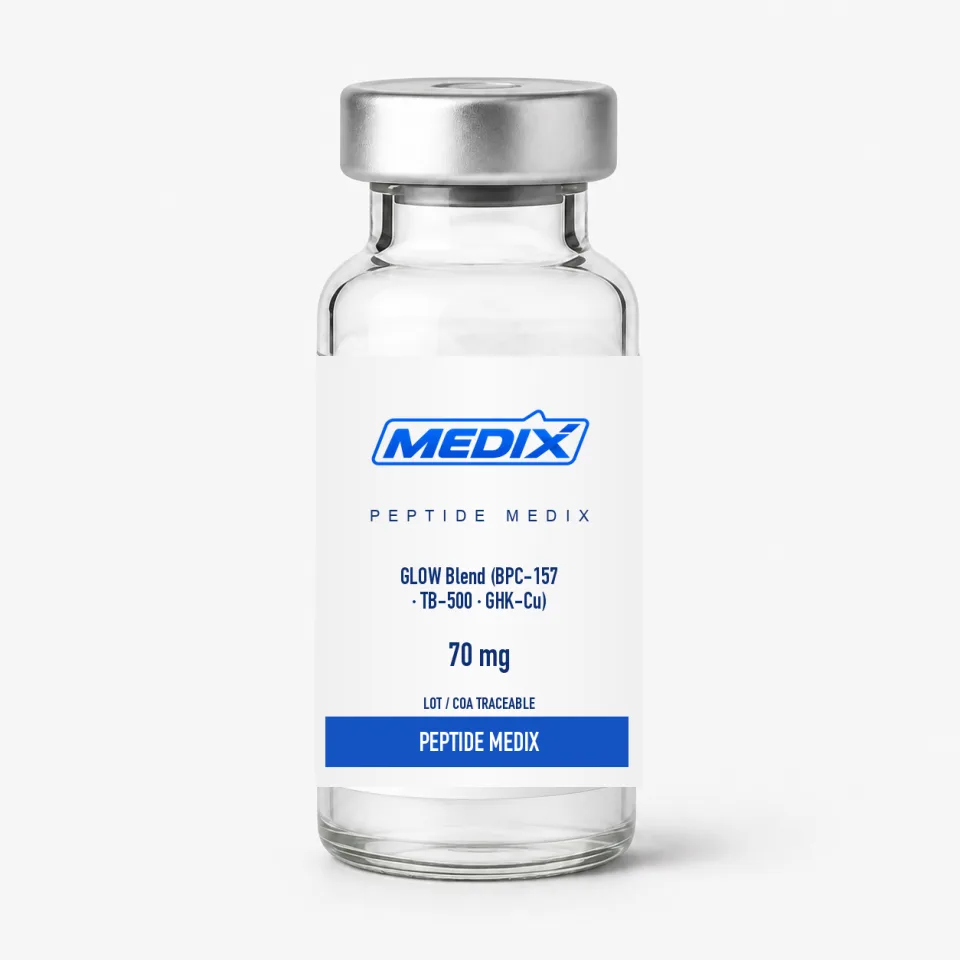
- ≥99% by HPLC per component
- Lot-matched certificate of analysis
- Ships next business day, tracked
GLOW Blend (BPC-157 · TB-500 · GHK-Cu)
Three-peptide research blend of GHK-Cu, BPC-157 and TB-500 in a single 70 mg vial
- FormLyophilized powder, sealed glass vial
- Research areasCollagen and matrix biology, wound models, cell migration studies
Overview
GLOW Blend combines three of the most frequently requested research peptides — GHK-Cu, BPC-157 and TB-500 — in one 70 mg lyophilized vial. It is the dermatology- and matrix-oriented sibling of the four-component KLOW Blend, dropping KPV and keeping the copper tripeptide as the dominant component by mass.
GHK-Cu carries most of the weight in this formulation. It is a naturally occurring glycyl-L-histidyl-L-lysine tripeptide bound to copper(II), first identified in human plasma in the 1970s and studied since then in fibroblast culture and skin models. BPC-157, a synthetic 15-residue sequence derived from a protein found in gastric juice, and TB-500, the actin-binding fragment of thymosin beta-4, are the two peptides most commonly paired with it in connective-tissue and wound-model work.
Specifications
Supply & purity
- Form
- Lyophilized powder, sealed glass vial
- Purity
- ≥99% by HPLC per component; lot-matched COA
- Solubility
- Bacteriostatic water or sterile water
Handling & storage
- Storage (lyophilized)
- −20 °C, protected from light and moisture
- Storage (reconstituted)
- 2–8 °C, protected from light
Additional detail
- Product type
- Three-peptide research blend, single vial
- Components
- GHK-Cu, BPC-157, TB-500 (thymosin beta-4 fragment)
- Total peptide content
- 70 mg per vial
- Typical component split
- GHK-Cu 50 mg · BPC-157 10 mg · TB-500 10 mg
- Component CAS numbers
- GHK-Cu 89030-95-5 · BPC-157 137525-51-0 · TB-500 885340-08-9
- BPC-157 sequence
- Gly-Glu-Pro-Pro-Pro-Gly-Lys-Pro-Ala-Asp-Asp-Ala-Gly-Leu-Val
- Appearance in solution
- Clear pale blue, from the copper(II) complex
- Research areas
- Collagen and matrix biology, wound models, cell migration studies
Working out the concentration
A lyophilized vial carries a mass on the label and no concentration anywhere, so the first calculation of any protocol is the reconstitution one. The peptide concentration calculator converts vial mass plus diluent volume into mg/mL, and back into the draw volume for a given mass.
Certificate of analysis
Every lot of GLOW Blend (BPC-157 · TB-500 · GHK-Cu) is released against a certificate of analysis: the batch-specific laboratory data for that lot, not a generic document for the compound. The lot number on the certificate matches the lot number printed on the label you receive — the vial label itself, where the product is vialled — so the record and the material it describes can always be reconciled.
Purity: ≥99% by HPLC per component — the specification for this listing. The figure for the lot you receive is the one reported on that lot’s certificate.
No lot certificate is on display on this page at the moment. That is a publishing state and not a testing one: lots are released and documented as described above whether or not the document is posted here, and we will send what exists for the lot in stock, or for a lot already on your bench, by its number.
Certificates are available on request before you order as well as after, with no account and no charge. Request the certificate for this listing, read the testing and documentation policy in full, or see how to read a peptide COA.
Questions about GLOW Blend (BPC-157 · TB-500 · GHK-Cu)
How does GLOW Blend differ from KLOW Blend?
GLOW contains three peptides — GHK-Cu, BPC-157 and TB-500 — at 70 mg total. KLOW adds KPV, the alpha-MSH-derived tripeptide, for 80 mg total. Laboratories choose between them based on whether the study design includes an inflammatory-signalling arm.
Why is the solution blue?
The blue colour comes from the copper(II) ion coordinated in the GHK-Cu complex. It is an inherent property of the molecule and indicates the copper peptide is present and in solution. Colourless material or a green-brown shift would be the unexpected result.
Is a certificate of analysis available?
Yes. Each lot is HPLC-assayed and released with a lot-matched COA that reports identity and purity for every component separately, not just for the blend as a whole. The current lot document can be requested before you place an order.
Related