- ≥99% by HPLC per component
- Lot-matched certificate of analysis
- Ships next business day, tracked
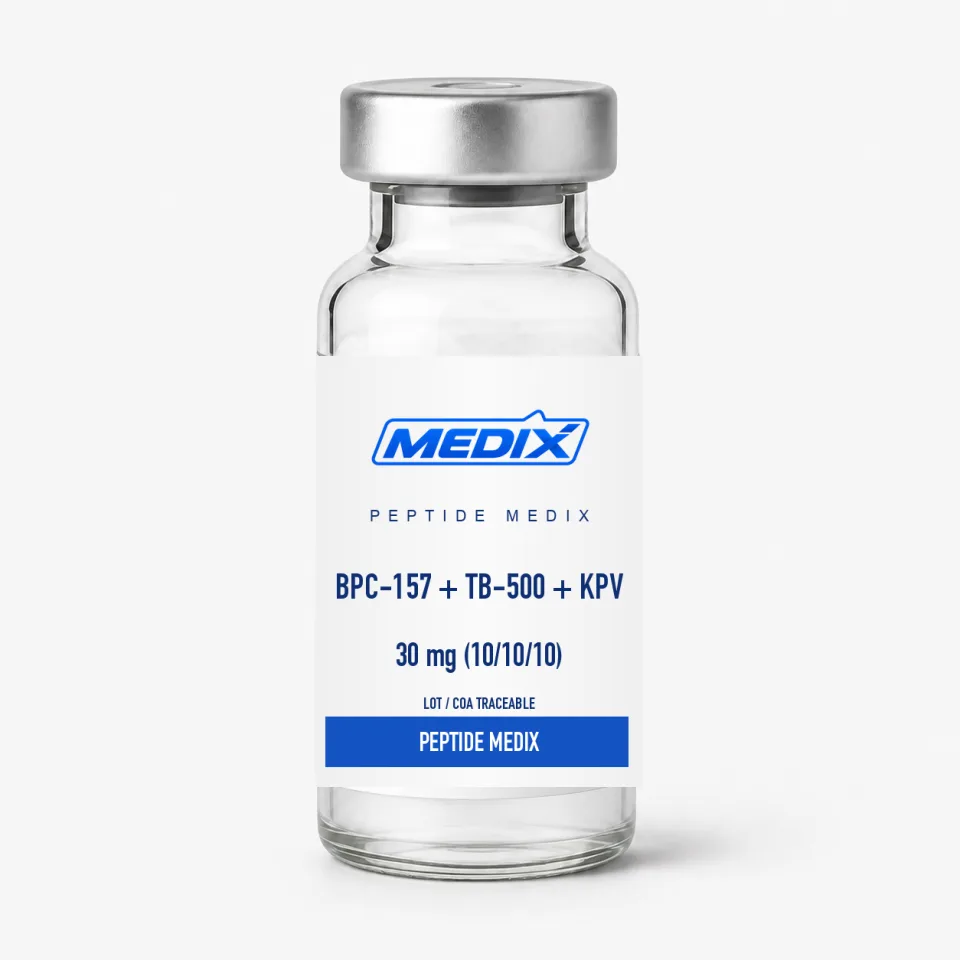
BPC-157 + TB-500 + KPV Peptide Blend
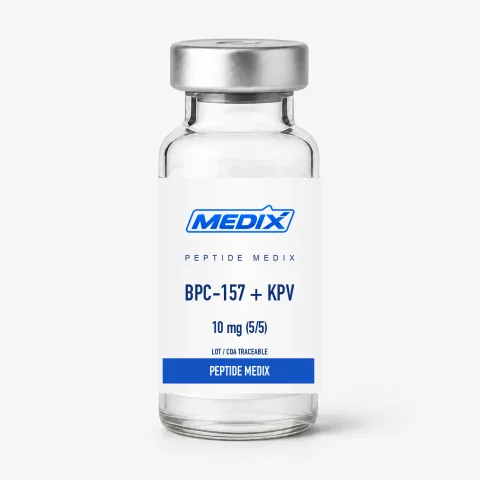
Co-formulated 30 mg research vial of BPC-157, TB-500 and KPV at 10 mg each
- FormLyophilized powder, sealed glass vial
- Research areasGastrointestinal mucosa, inflammatory signalling, connective-tissue repair models
Overview
This blend places three peptides at equal weight — BPC-157, TB-500 and KPV, 10 mg each — into a single 30 mg lyophilized vial. Unlike the copper-heavy GLOW and KLOW formulations, the even 10/10/10 split keeps the three components on comparable footing, which suits study designs where no single peptide is meant to dominate the preparation.
The combination is common in gastrointestinal and inflammatory research contexts, where the mucosal orientation of BPC-157 and the NF-κB-related interest in KPV overlap. Peptide Medix supplies the vial as a white lyophilized powder assayed to ≥99% purity per component by HPLC, released against a lot-matched certificate of analysis, and sold strictly for laboratory research use.
Specifications
Supply & purity
- Form
- Lyophilized powder, sealed glass vial
- Purity
- ≥99% by HPLC per component; lot-matched COA
- Solubility
- Bacteriostatic water or sterile water
Handling & storage
- Storage (lyophilized)
- −20 °C, protected from light and moisture
- Storage (reconstituted)
- 2–8 °C, used within the study window
Additional detail
- Product type
- Three-peptide research blend, single vial
- Components
- BPC-157, TB-500 (thymosin beta-4 fragment), KPV
- Total peptide content
- 30 mg per vial (10 mg each)
- BPC-157
- CAS 137525-51-0 · C62H98N16O22 · 1419.55 g/mol
- TB-500
- CAS 885340-08-9 · C38H68N10O14 · 889.02 g/mol
- KPV
- CAS 67727-97-3 · C16H30N4O4 · 342.43 g/mol
- Appearance
- White to off-white powder; clear colourless solution when reconstituted
- Research areas
- Gastrointestinal mucosa, inflammatory signalling, connective-tissue repair models
Working out the concentration
BPC-157 + TB-500 + KPV ships as a lyophilized powder, so nothing on this page can state a concentration: the figure you work with is the one you create when you add diluent. Put the vial mass and the volume you intend to use into the peptide reconstitution calculator and it returns mg/mL, mcg/mL and the mass sitting at each mark on a U-100 syringe.
Certificate of analysis
Every lot of BPC-157 + TB-500 + KPV is released against a certificate of analysis: the batch-specific laboratory data for that lot, not a generic document for the compound. The lot number on the certificate matches the lot number printed on the label you receive — the vial label itself, where the product is vialled — so the record and the material it describes can always be reconciled.
Purity: ≥99% by HPLC per component — the specification for this listing. The figure for the lot you receive is the one reported on that lot’s certificate.
No lot certificate is on display on this page at the moment. That is a publishing state and not a testing one: lots are released and documented as described above whether or not the document is posted here, and we will send what exists for the lot in stock, or for a lot already on your bench, by its number.
Certificates are available on request before you order as well as after, with no account and no charge. Request the certificate for this listing, read the testing and documentation policy in full, or see how to read a peptide COA.
Questions about BPC-157 + TB-500 + KPV
How does this differ from a BPC-157 and TB-500 blend?
The addition of KPV is the difference. Two-peptide Wolverine-style blends cover the repair and cell-migration literature; adding the alpha-MSH-derived tripeptide brings an inflammatory-signalling component that laboratories working on mucosal or colitis models typically want in the same vial.
What is the ratio in this vial?
Equal parts by mass — 10 mg of BPC-157, 10 mg of TB-500 and 10 mg of KPV, for 30 mg total. Because the three molecules differ substantially in molecular weight, the molar ratio is not 1:1:1; KPV contributes the most molecules per milligram.
Is each component tested separately?
Yes. The lot-matched certificate of analysis reports identity and purity for BPC-157, TB-500 and KPV individually by HPLC rather than giving a single combined figure. Request the current lot COA if you want to review it before ordering.
Should the reconstituted solution be coloured?
No. Unlike GHK-Cu-containing blends, this formulation has no copper complex, so a properly reconstituted vial gives a clear colourless solution. Any tint, cloudiness or visible particulate is a reason to stop and set the vial aside.
Can this be used on people or animals?
No. This is a research chemical sold for in-vitro and laboratory use by qualified researchers only. It is not a drug, supplement or veterinary product, it has not been evaluated for administration to any living subject, and Peptide Medix supplies no dosing or usage instructions.
Related