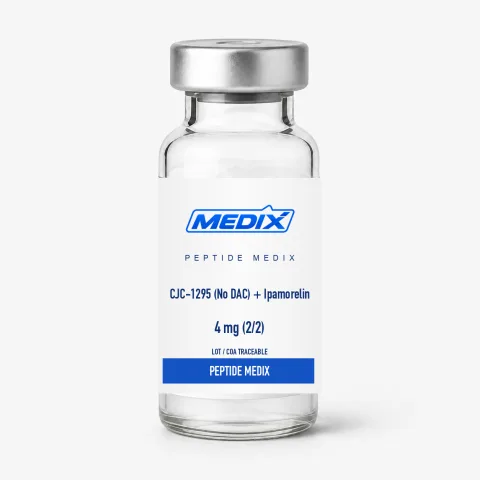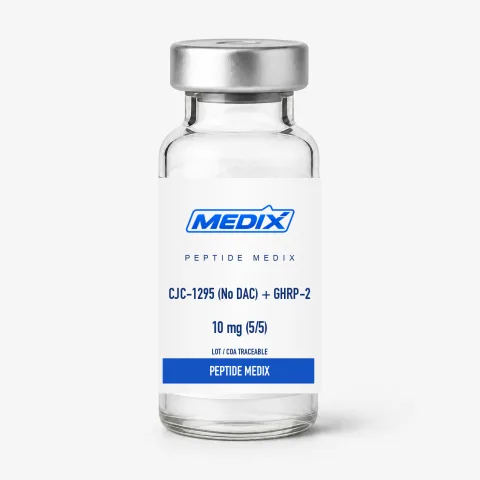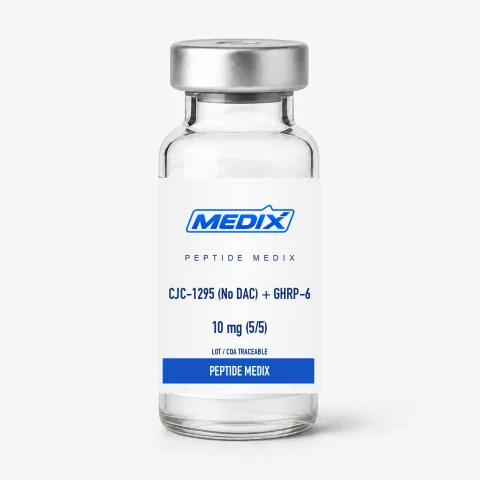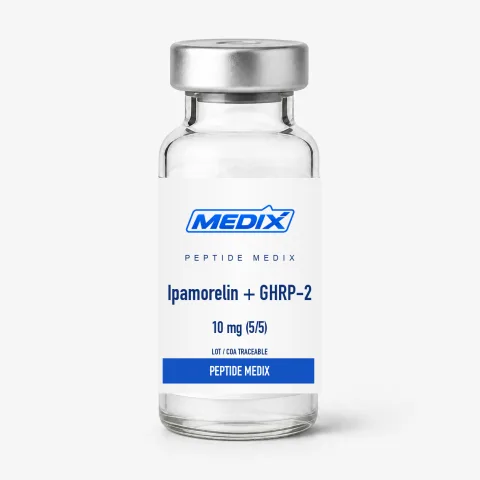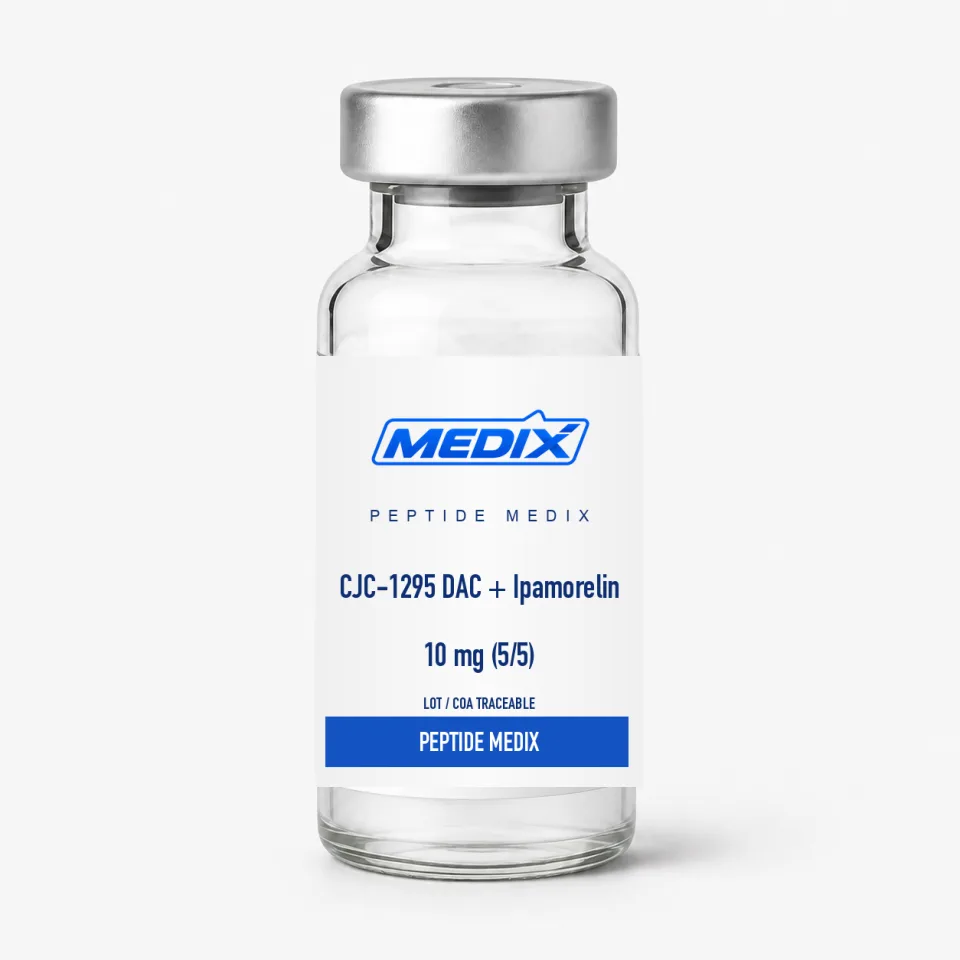
- ≥99% by HPLC per component
- Lot-matched certificate of analysis
- Ships next business day, tracked
CJC-1295 DAC + Ipamorelin
Albumin-binding GHRH analogue co-lyophilized with a selective GHS-R1a agonist
- FormLyophilized powder, sealed glass vial with crimped stopper
- Research areasSomatotroph signalling, GH pulse amplitude versus frequency, IGF-1 dynamics, receptor desensitisation
Overview
This vial co-lyophilizes two growth-hormone secretagogues at a 1:1 mass ratio: CJC-1295 with DAC, a modified GRF(1-29) analogue carrying a drug affinity complex, and ipamorelin, a selective pentapeptide agonist at the growth hormone secretagogue receptor. The 10 mg option contains 5 mg of each peptide; the 20 mg option contains 10 mg of each.
The pairing is a classic experimental design in somatotroph pharmacology because the two peptides act on different receptors. CJC-1295 DAC signals through the GHRH receptor and raises the amplitude of the pituitary's secretory response, while ipamorelin acts on the ghrelin receptor, a separate pathway that contributes the pulse. The DAC modification — a maleimidopropionyl group that forms a covalent bond with cysteine-34 of circulating albumin — extends the analogue's residence time dramatically compared with the unconjugated version, so this blend produces a very different exposure profile from the No-DAC pairing.
Specifications
Supply & purity
- Form
- Lyophilized powder, sealed glass vial with crimped stopper
- Purity
- ≥99% by HPLC per component; lot-matched COA available
- Available sizes
- 10 mg total (5 mg / 5 mg); 20 mg total (10 mg / 10 mg)
- Solubility
- Bacteriostatic or sterile water; both peptides dissolve readily
Additional detail
- Product type
- Co-lyophilized two-peptide blend, single vial
- Blend ratio
- 1:1 CJC-1295 DAC to ipamorelin by mass
- CJC-1295 DAC
- CAS 863288-34-0 · C165H269N47O46 · 3647.28 g/mol
- CJC-1295 DAC structure
- Modified GRF(1-29) (D-Ala2, Gln8, Ala15, Leu27) extended with Lys30-maleimidopropionamide
- Ipamorelin
- CAS 170851-70-4 · C38H49N9O5 · 711.85 g/mol
- Ipamorelin sequence
- Aib-His-D-2-Nal-D-Phe-Lys-NH2
- Molecular targets
- GHRH receptor (CJC-1295 DAC) and growth hormone secretagogue receptor 1a (ipamorelin)
- Conjugation chemistry
- Maleimide–thiol addition of the DAC group to cysteine-34 of serum albumin
- Research areas
- Somatotroph signalling, GH pulse amplitude versus frequency, IGF-1 dynamics, receptor desensitisation
- Storage
- Lyophilized: −20 °C, sealed, protected from light and moisture. Reconstituted: 2–8 °C within the study window.
Working out the concentration
CJC-1295 DAC + Ipamorelin ships as a lyophilized powder, so nothing on this page can state a concentration: the figure you work with is the one you create when you add diluent. Put the vial mass and the volume you intend to use into the peptide reconstitution calculator and it returns mg/mL, mcg/mL and the mass sitting at each mark on a U-100 syringe.
Certificate of analysis
Every lot of CJC-1295 DAC + Ipamorelin is released against a certificate of analysis: the batch-specific laboratory data for that lot, not a generic document for the compound. The lot number on the certificate matches the lot number printed on the label you receive — the vial label itself, where the product is vialled — so the record and the material it describes can always be reconciled.
Purity: ≥99% by HPLC per component — the specification for this listing. The figure for the lot you receive is the one reported on that lot’s certificate.
No lot certificate is on display on this page at the moment. That is a publishing state and not a testing one: lots are released and documented as described above whether or not the document is posted here, and we will send what exists for the lot in stock, or for a lot already on your bench, by its number.
Certificates are available on request before you order as well as after, with no account and no charge. Request the certificate for this listing, read the testing and documentation policy in full, or see how to read a peptide COA.
Questions about CJC-1295 DAC + Ipamorelin
What is in the CJC-1295 DAC + Ipamorelin vial?
A single lyophilized vial containing both peptides at a 1:1 mass ratio: 5 mg of each in the 10 mg option, 10 mg of each in the 20 mg option. Nothing else is added — no diluent, carrier or preservative — so the researcher sets the working concentration at reconstitution.
How does this differ from the CJC-1295 No DAC + Ipamorelin blend?
The DAC version carries a maleimidopropionyl group that binds covalently to albumin, extending its reported half-life from minutes to days. The No-DAC blend produces short, discrete signalling episodes. Studies comparing sustained receptor occupancy with pulsatile stimulation typically use both.
Why combine a GHRH analogue with a ghrelin-receptor agonist?
They act on different receptors: CJC-1295 DAC on the GHRH receptor and ipamorelin on GHS-R1a, which also influences somatostatin tone. Running them together lets investigators ask whether the two pathways behave additively or synergistically on somatotroph output in a given model.
Is a certificate of analysis available?
Yes. Each peptide is assayed by HPLC to a ≥99% specification with mass-spectrometric identity confirmation, and the blended lot carries a matched certificate of analysis reporting both components. Current lot COAs can be requested before ordering.
What diluent is used?
Bacteriostatic water is standard for multi-draw laboratory preparations, and sterile water suits single-use work. Add it slowly against the vial wall and swirl until the cake dissolves; the result should be clear and colourless. Do not shake, and do not use acidic diluents.
How should the reconstituted blend be stored?
At 2–8 °C, protected from light, drawn with aseptic technique and used within the window defined by the protocol. Keep the vial upright, avoid repeated warming to room temperature, and discard any preparation that develops cloudiness, colour or visible particulates.
Related