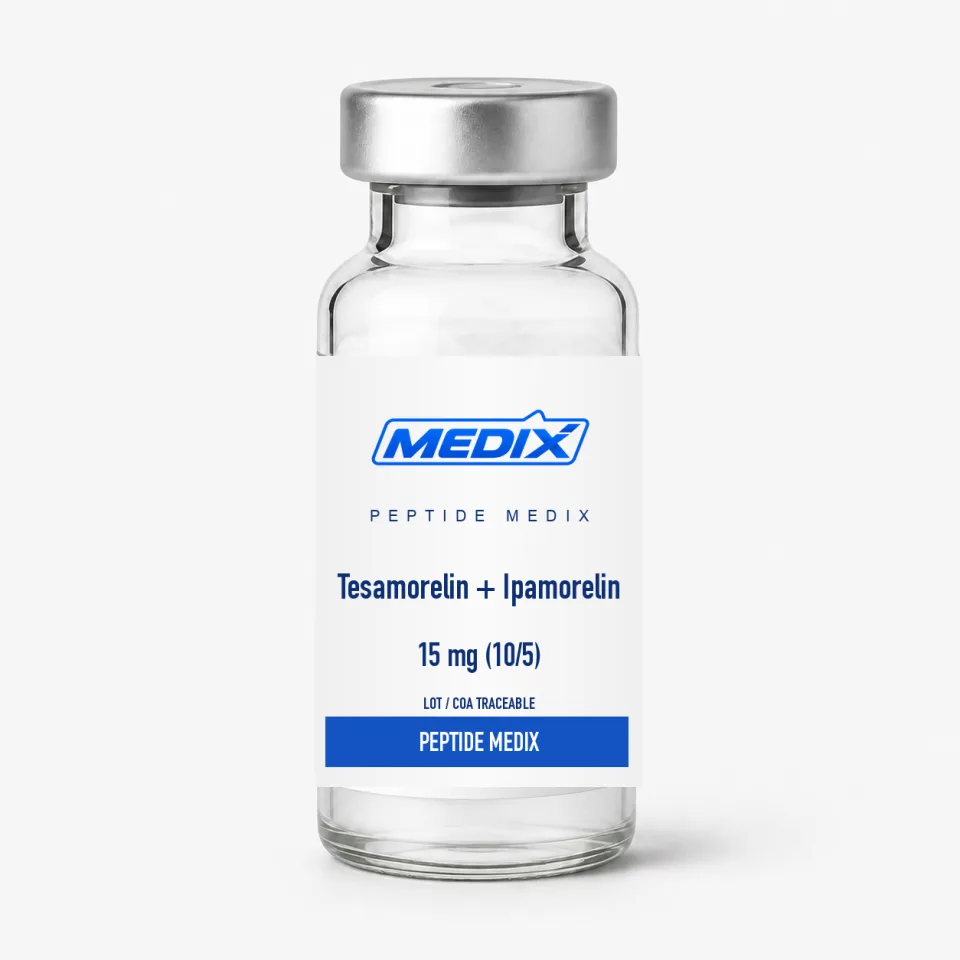
- ≥99% by HPLC per component
- Lot-matched certificate of analysis
- Ships next business day, tracked
Tesamorelin + Ipamorelin
Stabilised 44-residue GHRH analogue paired with a selective GHS-receptor agonist
- FormCo-lyophilized powder, sealed glass vial
- Mol. weightTesamorelin: 5135.86 g/mol · Ipamorelin: 711.85 g/mol
- Research areasVisceral adipose tissue models, GH/IGF-1 axis, body composition, lipid metabolism
Overview
This blend pairs Tesamorelin, a full-length 44-residue analogue of human growth hormone-releasing hormone, with Ipamorelin, a five-residue agonist at the growth hormone secretagogue receptor. Tesamorelin differs from the shorter GHRH fragments used in most secretagogue research: it retains the complete GHRH(1-44) sequence and carries a trans-3-hexenoyl group on the N-terminal tyrosine, a modification that blocks dipeptidyl peptidase-4 cleavage and gives it markedly better stability than unmodified GHRH.
Ipamorelin supplies the second arm. It is a pentapeptide, Aib-His-D-2-Nal-D-Phe-Lys-NH2, assembled largely from unnatural residues, and it acts at the growth hormone secretagogue receptor rather than the GHRH receptor, so the pair engages two distinct receptors on the same somatotroph. The component masses are very different, 5135.86 g/mol against 711.85, which means the 2:1 mass ratio of the fill works out to roughly 1:3.6 in molar terms with ipamorelin in numerical excess, a conversion any molar-reporting design needs to make explicitly. Vials hold 15 mg (10 mg/5 mg) or 30 mg (20 mg/10 mg), dried together as one cake and reconstituted in bacteriostatic water, with the sealed vial at −20 °C.
Specifications
Identity
- CAS number
- Tesamorelin: 218949-48-5 · Ipamorelin: 170851-70-4
- Molecular formula
- Tesamorelin: C221H366N72O67S · Ipamorelin: C38H49N9O5
- Molecular weight
- Tesamorelin: 5135.86 g/mol · Ipamorelin: 711.85 g/mol
- Peptide class
- Stabilised full-length GHRH analogue with a growth hormone secretagogue receptor agonist
Supply & purity
- Form
- Co-lyophilized powder, sealed glass vial
- Purity
- ≥99% by HPLC per component; lot-matched COA available
- Available sizes
- 15 mg (10 mg/5 mg), 30 mg (20 mg/10 mg)
- Solubility
- Bacteriostatic water
Additional detail
- Blend ratio
- 2:1 Tesamorelin to Ipamorelin
- Tesamorelin structure
- trans-3-hexenoyl-modified human GHRH(1-44) analogue, 44 residues, C-terminal amide
- Ipamorelin sequence
- Aib-His-D-2-Nal-D-Phe-Lys-NH2
- Research areas
- Visceral adipose tissue models, GH/IGF-1 axis, body composition, lipid metabolism
- Storage
- Lyophilized: −20 °C, protected from light and moisture. Reconstituted: 2–8 °C, use within the study window.
Working out the concentration
Reconstitution is where the arithmetic lives. The same vial made up with 1 mL or with 3 mL of diluent gives three-fold different numbers, which is why a reconstitution volume calculator is more use here than a fixed table: enter the vial mass and your diluent volume and read the concentration back.
Certificate of analysis
Every lot of Tesamorelin + Ipamorelin is released against a certificate of analysis: the batch-specific laboratory data for that lot, not a generic document for the compound. The lot number on the certificate matches the lot number printed on the label you receive — the vial label itself, where the product is vialled — so the record and the material it describes can always be reconciled.
Purity: ≥99% by HPLC per component — the specification for this listing. The figure for the lot you receive is the one reported on that lot’s certificate.
No lot certificate is on display on this page at the moment. That is a publishing state and not a testing one: lots are released and documented as described above whether or not the document is posted here, and we will send what exists for the lot in stock, or for a lot already on your bench, by its number.
Certificates are available on request before you order as well as after, with no account and no charge. Request the certificate for this listing, read the testing and documentation policy in full, or see how to read a peptide COA.
Questions about Tesamorelin + Ipamorelin
How does Tesamorelin differ from CJC-1295 or Sermorelin?
Sermorelin and CJC-1295 (No DAC) are 29-residue GHRH fragments. Tesamorelin retains the full 44-residue sequence and adds a trans-3-hexenoyl group at the N-terminus that blocks DPP-4 cleavage, giving it substantially better stability and a longer functional window than either fragment.
Why is this blend 2:1 rather than 1:1?
Tesamorelin has a molecular weight roughly seven times that of Ipamorelin, so equal masses would not give comparable molar quantities. The 10 mg/5 mg and 20 mg/10 mg ratios reflect how the pair is typically balanced in research preparations. Each component's mass is stated on the certificate of analysis.
Is each peptide tested independently?
Yes. Purity is established by HPLC and identity by mass spectrometry for each peptide at an independent laboratory before the two are co-lyophilized. The certificate of analysis is matched to the lot number printed on your vial and can be requested at any time.
How should the vial be stored?
Store the sealed lyophilized vial at −20 °C, protected from light and moisture, where it is stable long-term. After reconstitution keep it at 2–8 °C and use within your study window; avoid repeated freeze–thaw cycles and prolonged exposure to room temperature or direct light.
Can this be used in humans?
No. This blend is supplied strictly for in-vitro and laboratory animal research. We provide no dosing guidance.
Related