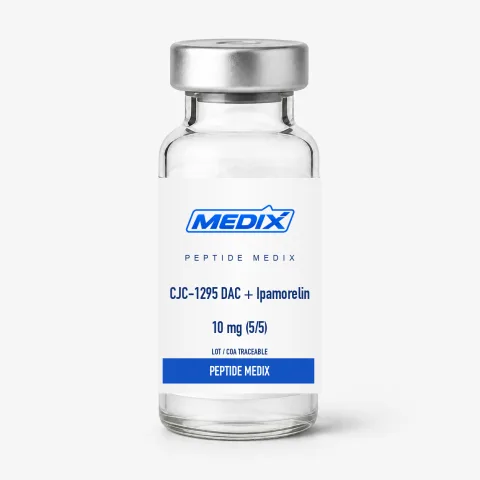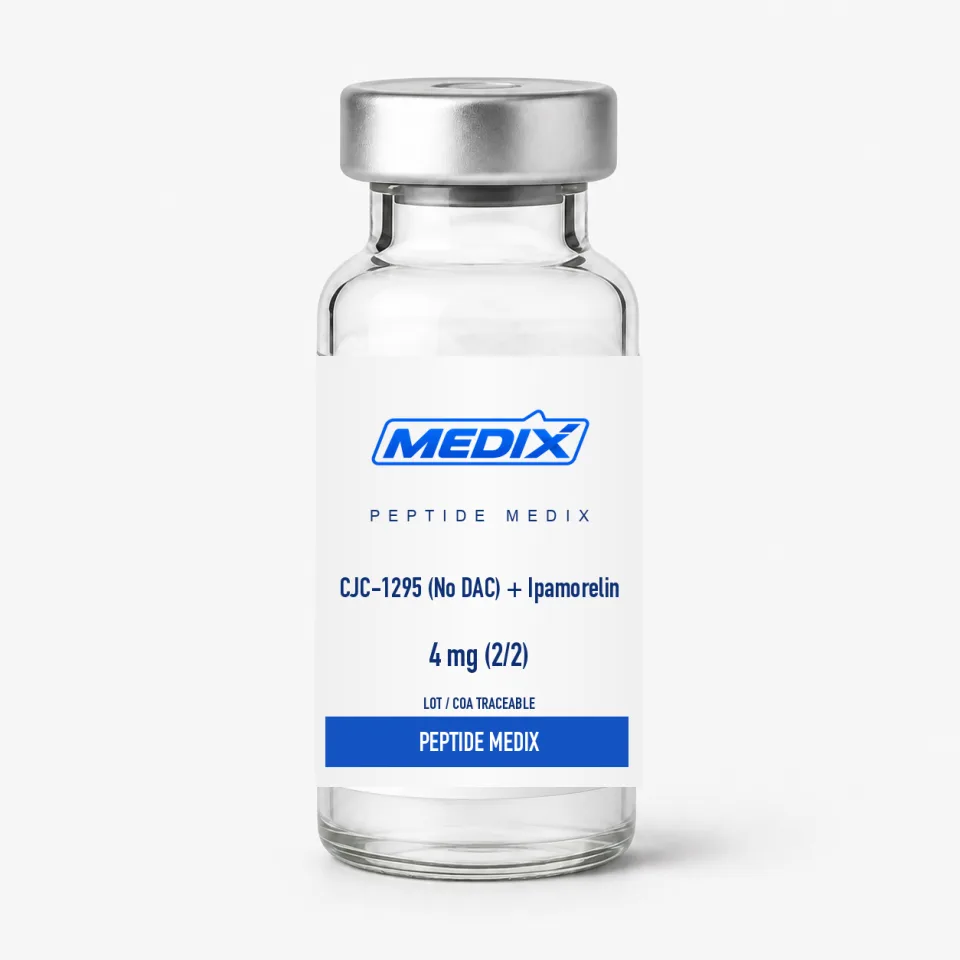
- ≥99% by HPLC per component
- Lot-matched certificate of analysis
- Ships next business day, tracked
CJC-1295 (No DAC) + Ipamorelin
GHRH analogue and selective ghrelin-receptor agonist co-lyophilized in one vial
- FormCo-lyophilized powder, sealed glass vial
- Mol. weightCJC-1295 (No DAC): 3367.93 g/mol · Ipamorelin: 711.85 g/mol
- Research areasPulsatile GH release, somatotroph signalling, IGF-1 axis, body-composition and sleep-architecture models
Overview
This blend places two growth-hormone secretagogues with different mechanisms into a single co-lyophilized vial. CJC-1295 without DAC — also catalogued as Modified GRF (1-29) — is a 29-residue analogue of growth hormone-releasing hormone carrying four amino-acid substitutions that resist dipeptidyl peptidase-4 cleavage. It engages the GHRH receptor on somatotrophs. Ipamorelin is a pentapeptide agonist at the growth hormone secretagogue receptor, the same receptor ghrelin acts on, and is the most selective of the commonly studied GHRPs.
Four fills are listed — 4 mg (2/2), 10 mg (5/5), 20 mg (10/10) and a ten-vial kit of 5 mg/5 mg cakes — so a pilot experiment and an extended series can both stay on one lot number. Equal masses are not equal molar amounts: at 3367.93 and 711.85 g/mol, a 5 mg/5 mg cake supplies roughly 4.7 times as many ipamorelin molecules as GHRH-analogue molecules. The question the pairing exists to address is whether GHRH-receptor and secretagogue-receptor signalling on the same somatotroph combine additively or more than additively, which needs single-agent control arms alongside the blend, and for those the separate vials remain necessary.
Specifications
Identity
- CAS number
- CJC-1295 (No DAC): 863288-34-0 · Ipamorelin: 170851-70-4
- Molecular formula
- CJC-1295 (No DAC): C152H252N44O42 · Ipamorelin: C38H49N9O5
- Molecular weight
- CJC-1295 (No DAC): 3367.93 g/mol · Ipamorelin: 711.85 g/mol
- Peptide class
- GHRH analogue combined with a growth hormone secretagogue receptor agonist
Supply & purity
- Form
- Co-lyophilized powder, sealed glass vial
- Purity
- ≥99% by HPLC per component; lot-matched COA available
- Available sizes
- 4 mg (2/2), 10 mg (5/5), 20 mg (10/10)
- Solubility
- Bacteriostatic water
Additional detail
- Blend ratio
- 1:1 CJC-1295 (No DAC) to Ipamorelin
- CJC-1295 sequence
- Tyr-D-Ala-Asp-Ala-Ile-Phe-Thr-Gln-Ser-Tyr-Arg-Lys-Val-Leu-Ala-Gln-Leu-Ser-Ala-Arg-Lys-Leu-Leu-Gln-Asp-Ile-Leu-Ser-Arg-NH2
- Ipamorelin sequence
- Aib-His-D-2-Nal-D-Phe-Lys-NH2
- Research areas
- Pulsatile GH release, somatotroph signalling, IGF-1 axis, body-composition and sleep-architecture models
- Storage
- Lyophilized: −20 °C, protected from light and moisture. Reconstituted: 2–8 °C, use within the study window.
Working out the concentration
The vial sizes above — 4 mg (2/2), 10 mg (5/5), 20 mg (10/10) — describe a mass of material, not a strength. Choose a diluent volume, work it out with the reconstitution calculator, and you have the concentration for your own vial of CJC-1295 (No DAC) + Ipamorelin plus the volume that carries any mass you want to withdraw.
Certificate of analysis
Every lot of CJC-1295 (No DAC) + Ipamorelin is released against a certificate of analysis: the batch-specific laboratory data for that lot, not a generic document for the compound. The lot number on the certificate matches the lot number printed on the label you receive — the vial label itself, where the product is vialled — so the record and the material it describes can always be reconciled.
Purity: ≥99% by HPLC per component — the specification for this listing. The figure for the lot you receive is the one reported on that lot’s certificate.
No lot certificate is on display on this page at the moment. That is a publishing state and not a testing one: lots are released and documented as described above whether or not the document is posted here, and we will send what exists for the lot in stock, or for a lot already on your bench, by its number.
Certificates are available on request before you order as well as after, with no account and no charge. Request the certificate for this listing, read the testing and documentation policy in full, or see how to read a peptide COA.
Questions about CJC-1295 (No DAC) + Ipamorelin
What is the difference between CJC-1295 with and without DAC?
The DAC version carries a Drug Affinity Complex maleimide that binds serum albumin, extending its presence for days. The No DAC form used in this blend omits that group, so it acts briefly and produces a discrete pulse. Researchers studying pulsatility choose the No DAC form for exactly that reason.
Is each component tested separately?
Yes. Purity and identity are established for each peptide by an independent laboratory using HPLC and mass spectrometry before blending, and the resulting certificate of analysis is matched to the lot number printed on your vial. It is available on request.
What does 10 mg (5/5) mean?
It is the total peptide mass in the vial, split evenly between the two components — 5 mg of CJC-1295 (No DAC) and 5 mg of Ipamorelin. The 20 mg vial contains 10 mg of each. Both are dried together as one cake, so reconstitution yields a fixed 1:1 solution.
Why is Ipamorelin used rather than an older GHRP?
Ipamorelin was characterised as unusually selective for the growth hormone secretagogue receptor, releasing growth hormone with far less effect on cortisol, ACTH and prolactin than GHRP-6 or GHRP-2. In study designs where those hormones would confound the endpoint, that selectivity matters.
Related