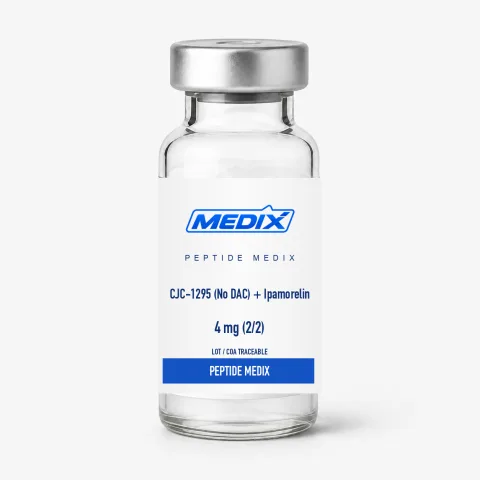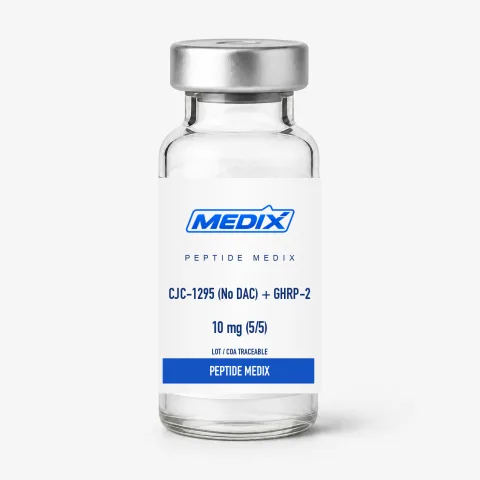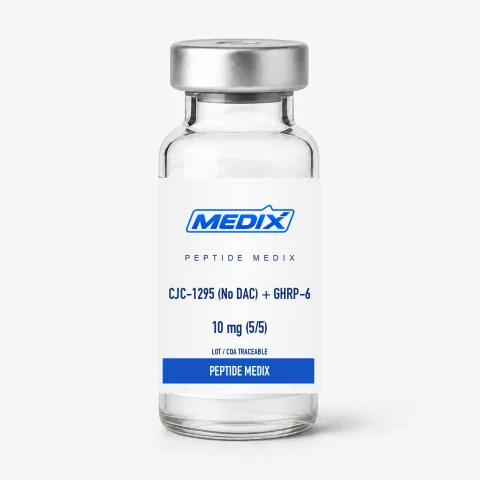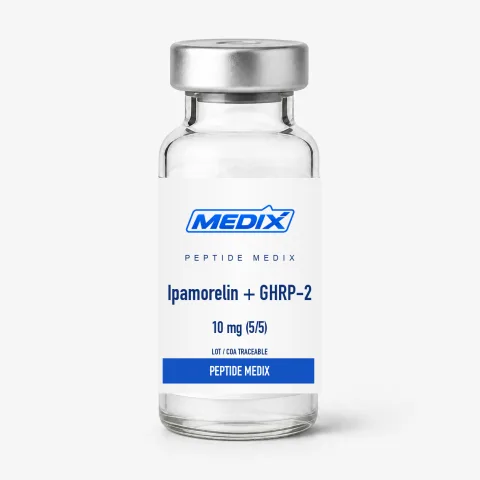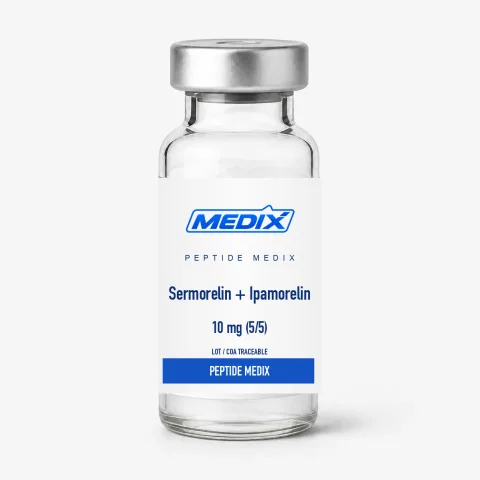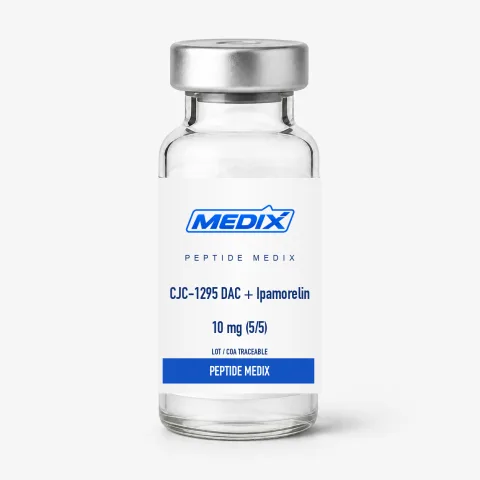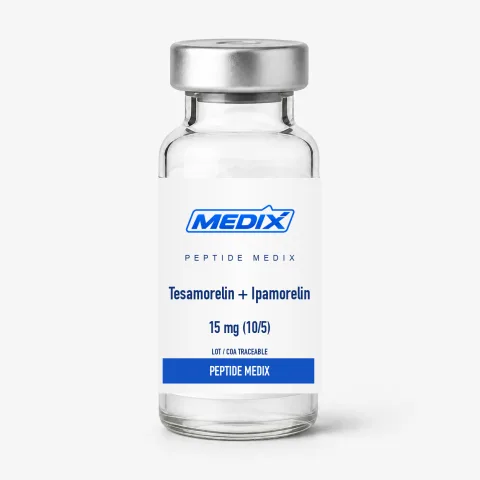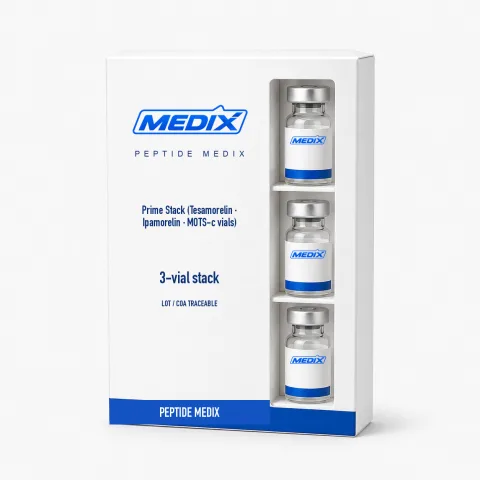
- ≥99% by HPLC per vial
- Lot-matched certificate of analysis
- Ships next business day, tracked
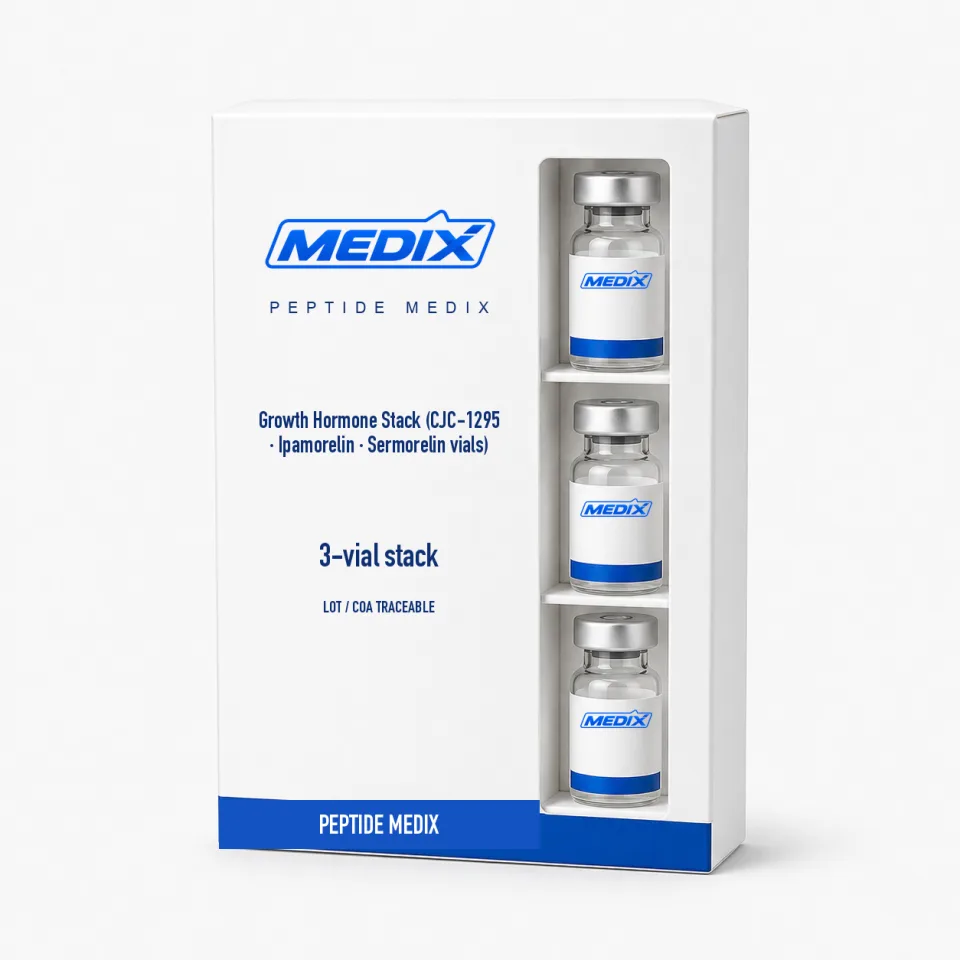
Growth Hormone Stack (CJC-1295 · Ipamorelin · Sermorelin vials)
Three-vial growth hormone axis kit: CJC-1295 no-DAC, ipamorelin and sermorelin
- FormLyophilized powder in each vial, individually capped
- Research areasGHRH receptor signalling, GHS-R1a pharmacology, pituitary secretion models
Overview
The Growth Hormone Stack assembles three secretagogue-class peptides as separate sealed vials: CJC-1295 without DAC, ipamorelin and sermorelin. All three are studied in relation to pituitary growth hormone release, but they arrive at it through two distinct receptor systems, which is what makes the grouping useful in a comparative study design.
Sermorelin is the first 29 residues of human growth hormone-releasing hormone — the shortest fragment retaining full biological activity at the GHRH receptor. CJC-1295 without DAC, also catalogued as Mod GRF 1-29, is that same fragment with four amino-acid substitutions intended to resist enzymatic degradation and extend its half-life relative to native sermorelin. Ipamorelin sits outside the GHRH family altogether: it is a synthetic pentapeptide agonist at the ghrelin receptor GHS-R1a, and published characterisation described it as unusually selective, with limited effect on cortisol and prolactin in the animal models tested.
Supplying the three separately lets a laboratory run GHRH-analogue and ghrelin-receptor arms independently, or compare sermorelin directly against its stabilised analogue. Each vial is HPLC-assayed to ≥99% purity with its own lot-matched certificate of analysis, and the kit is sold strictly for laboratory research.
Specifications
Supply & purity
- Form
- Lyophilized powder in each vial, individually capped
- Purity
- ≥99% by HPLC per vial; separate lot-matched COA for each
Handling & storage
- Storage (lyophilized)
- −20 °C, protected from light and moisture
- Storage (reconstituted)
- 2–8 °C, protected from light
Additional detail
- Product type
- Multi-vial research kit — three separately sealed vials
- Kit contents
- One CJC-1295 no-DAC vial, one ipamorelin vial, one sermorelin vial
- CJC-1295 (no DAC)
- CAS 863288-34-0 · C152H252N44O42 · 3367.93 g/mol
- Sermorelin
- CAS 86168-78-7 · C149H246N44O42S · 3357.93 g/mol
- Ipamorelin
- CAS 170851-70-4 · C38H49N9O5 · 711.85 g/mol
- Ipamorelin sequence
- Aib-His-D-2-Nal-D-Phe-Lys-NH2
- Peptide classes
- Two GHRH(1-29) analogues and one selective ghrelin receptor agonist
- Research areas
- GHRH receptor signalling, GHS-R1a pharmacology, pituitary secretion models
- Reconstitution
- Each vial prepared separately at protocol-defined concentration
Working out the concentration
Growth Hormone Stack (CJC-1295 · Ipamorelin · Sermorelin vials) ships as a lyophilized powder, so nothing on this page can state a concentration: the figure you work with is the one you create when you add diluent. Put the vial mass and the volume you intend to use into the peptide reconstitution calculator and it returns mg/mL, mcg/mL and the mass sitting at each mark on a U-100 syringe.
Certificate of analysis
Every lot of Growth Hormone Stack (CJC-1295 · Ipamorelin · Sermorelin vials) is released against a certificate of analysis: the batch-specific laboratory data for that lot, not a generic document for the compound. The lot number on the certificate matches the lot number printed on the label you receive — the vial label itself, where the product is vialled — so the record and the material it describes can always be reconciled.
Purity: ≥99% by HPLC per vial — the specification for this listing. The figure for the lot you receive is the one reported on that lot’s certificate.
No lot certificate is on display on this page at the moment. That is a publishing state and not a testing one: lots are released and documented as described above whether or not the document is posted here, and we will send what exists for the lot in stock, or for a lot already on your bench, by its number.
Certificates are available on request before you order as well as after, with no account and no charge. Request the certificate for this listing, read the testing and documentation policy in full, or see how to read a peptide COA.
Questions about Growth Hormone Stack (CJC-1295 · Ipamorelin · Sermorelin vials)
What is the difference between CJC-1295 no-DAC and sermorelin?
Both are based on the GHRH(1-29) fragment. CJC-1295 without DAC carries four amino-acid substitutions intended to resist enzymatic cleavage, particularly by DPP-4, giving it a longer half-life than native sermorelin while acting at the same receptor.
Does no-DAC mean something is missing?
It means the drug affinity complex is absent. Full CJC-1295 includes a maleimide group that binds serum albumin and extends its presence to days. The no-DAC form, also called Mod GRF 1-29, has a much shorter profile and is studied where a brief pulse is wanted.
Why include a ghrelin receptor agonist alongside two GHRH analogues?
Because GHS-R1a and the GHRH receptor are separate signalling routes to the same pituitary cell. Study designs comparing or combining the two arms need a molecule from each family, and ipamorelin is the selective option most often used for the ghrelin side.
Are the vials tested individually?
Yes. Each vial is its own manufacturing lot with its own certificate of analysis reporting HPLC identity and purity for that peptide. Three separate documents accompany the kit, and current lot COAs can be requested before you order.
How long do the sealed vials last?
Lyophilized peptide stored sealed at −20 °C, away from light and moisture, is generally stable well beyond a year. The retest date printed on each lot's certificate of analysis is the governing figure for that particular vial.
Related