- ≥99% by HPLC per vial
- Lot-matched certificate of analysis
- Ships next business day, tracked
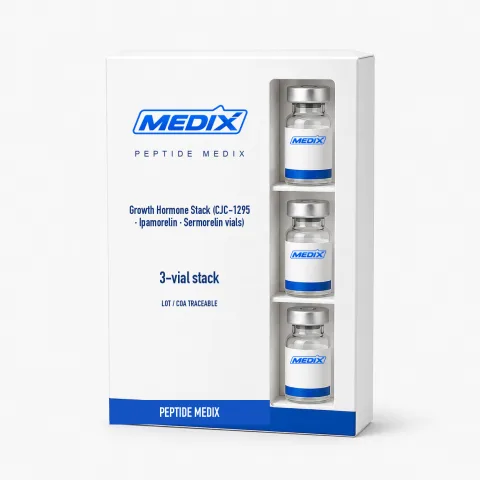
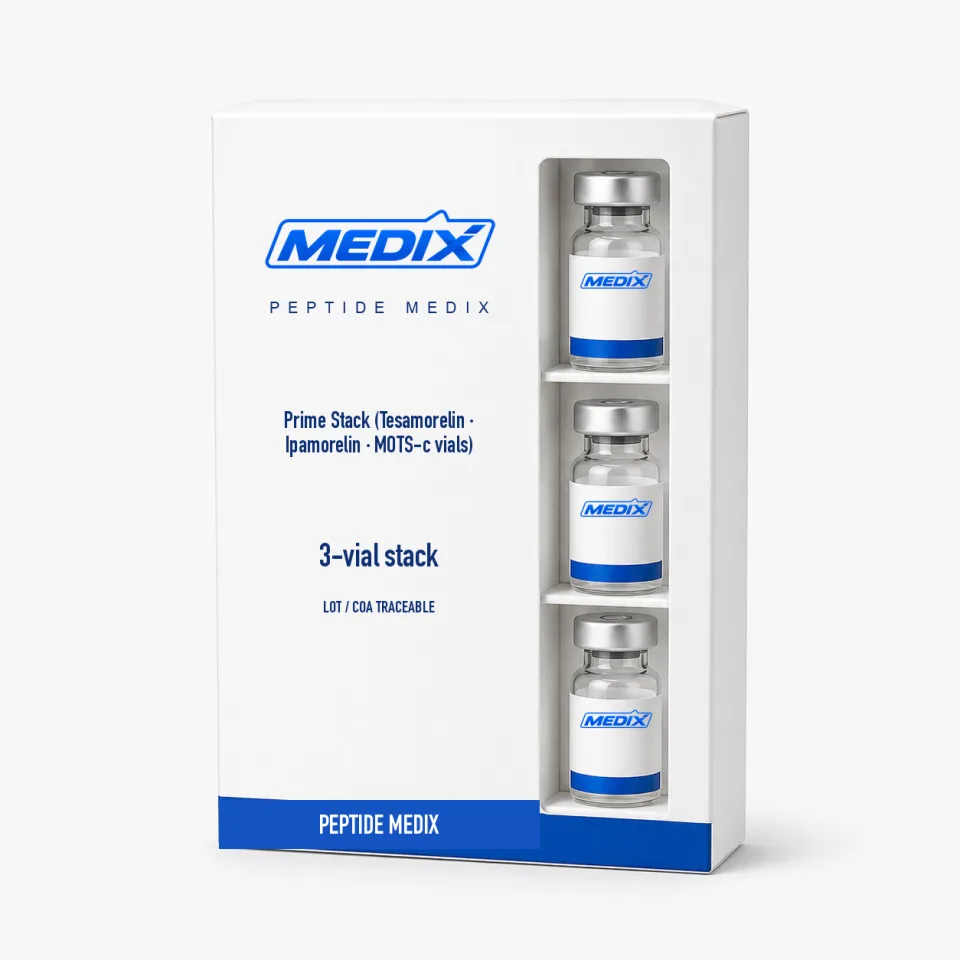
Prime Stack (Tesamorelin · Ipamorelin · MOTS-c vials)
Three-vial performance kit: tesamorelin, ipamorelin and MOTS-c
- FormLyophilized powder in each vial, individually capped
- Research areasGHRH receptor signalling, GHS-R1a pharmacology, AMPK and mitochondrial metabolism
Overview
The Prime Stack pairs the growth hormone axis with mitochondrial biology, supplying tesamorelin, ipamorelin and MOTS-c as three separately sealed lyophilized vials. Two of the three act on the pituitary through different receptors; the third operates at the level of the mitochondrion and has no relationship to the somatotropic axis at all.
Tesamorelin is a stabilised analogue of growth hormone-releasing hormone — the full GHRH(1-44) sequence carrying a trans-3-hexenoyl group at the N-terminus that resists dipeptidyl peptidase-4 cleavage. Ipamorelin is a five-residue agonist at the ghrelin receptor GHS-R1a, described in its original characterisation as selective, with limited movement of cortisol and prolactin in the animal models reported. MOTS-c is different in kind: a 16-residue peptide encoded within the mitochondrial 12S rRNA gene, studied in relation to AMPK signalling and metabolic homeostasis.
Keeping the three unmixed lets a study run each arm independently — GHRH receptor, ghrelin receptor and mitochondrial — or combine them in whatever ratio a design requires. Each vial is HPLC-assayed to ≥99% purity with its own lot-matched certificate of analysis. Supplied as research material for laboratory use only.
Specifications
Supply & purity
- Form
- Lyophilized powder in each vial, individually capped
- Purity
- ≥99% by HPLC per vial; separate lot-matched COA for each
Handling & storage
- Storage (lyophilized)
- −20 °C, protected from light and moisture
- Storage (reconstituted)
- 2–8 °C, protected from light
Additional detail
- Product type
- Multi-vial research kit — three separately sealed vials
- Kit contents
- One tesamorelin vial, one ipamorelin vial, one MOTS-c vial
- Tesamorelin
- CAS 218949-48-5 · C221H366N72O67S · 5135.86 g/mol
- Ipamorelin
- CAS 170851-70-4 · C38H49N9O5 · 711.85 g/mol
- MOTS-c
- CAS 1627580-64-6 · C101H152N28O22S2 · 2174.55 g/mol
- Tesamorelin class
- GHRH(1-44) analogue with N-terminal trans-3-hexenoyl group
- Ipamorelin sequence
- Aib-His-D-2-Nal-D-Phe-Lys-NH2
- Research areas
- GHRH receptor signalling, GHS-R1a pharmacology, AMPK and mitochondrial metabolism
- Reconstitution
- Each vial prepared separately at protocol-defined concentration
Working out the concentration
Because Prime Stack (Tesamorelin · Ipamorelin · MOTS-c vials) arrives dry, its concentration is a decision rather than a specification. Run the numbers through the reconstitution calculator — vial mass in, diluent volume in, mg/mL and mass per syringe unit out.
Certificate of analysis
Every lot of Prime Stack (Tesamorelin · Ipamorelin · MOTS-c vials) is released against a certificate of analysis: the batch-specific laboratory data for that lot, not a generic document for the compound. The lot number on the certificate matches the lot number printed on the label you receive — the vial label itself, where the product is vialled — so the record and the material it describes can always be reconciled.
Purity: ≥99% by HPLC per vial — the specification for this listing. The figure for the lot you receive is the one reported on that lot’s certificate.
No lot certificate is on display on this page at the moment. That is a publishing state and not a testing one: lots are released and documented as described above whether or not the document is posted here, and we will send what exists for the lot in stock, or for a lot already on your bench, by its number.
Certificates are available on request before you order as well as after, with no account and no charge. Request the certificate for this listing, read the testing and documentation policy in full, or see how to read a peptide COA.
Questions about Prime Stack (Tesamorelin · Ipamorelin · MOTS-c vials)
How does tesamorelin differ from sermorelin?
Sermorelin is the truncated GHRH(1-29) fragment. Tesamorelin is the full 44-residue sequence with a trans-3-hexenoyl group at the N-terminus that resists DPP-4 cleavage. Both act at the GHRH receptor, but tesamorelin is the more stable molecule.
Why include MOTS-c with two GH-axis peptides?
Because it addresses a different level of biology. Tesamorelin and ipamorelin act on pituitary receptors; MOTS-c is a mitochondrial-derived peptide studied around AMPK and cellular energetics. The kit lets a panel cover endocrine and mitochondrial arms separately.
Does each vial come with its own COA?
Yes. Each vial is a distinct manufacturing lot released with its own certificate of analysis reporting HPLC identity and purity for that peptide. Three separate documents accompany the kit, and current lot COAs can be requested beforehand.
Which peptide needs the most careful handling?
Tesamorelin. At roughly 5,136 g/mol it is the largest molecule in the kit and the most vulnerable to shear damage, so bacteriostatic water should be added slowly down the vial wall and the vial swirled rather than shaken or vortexed.
Can the vials be used at different points in a study?
Yes. Unopened lyophilized vials stored sealed at −20 °C away from light and moisture remain stable well beyond a year, so components can be staged across study phases rather than all prepared at once.
Related