- ≥99% by HPLC per component
- Lot-matched certificate of analysis
- Ships next business day, tracked
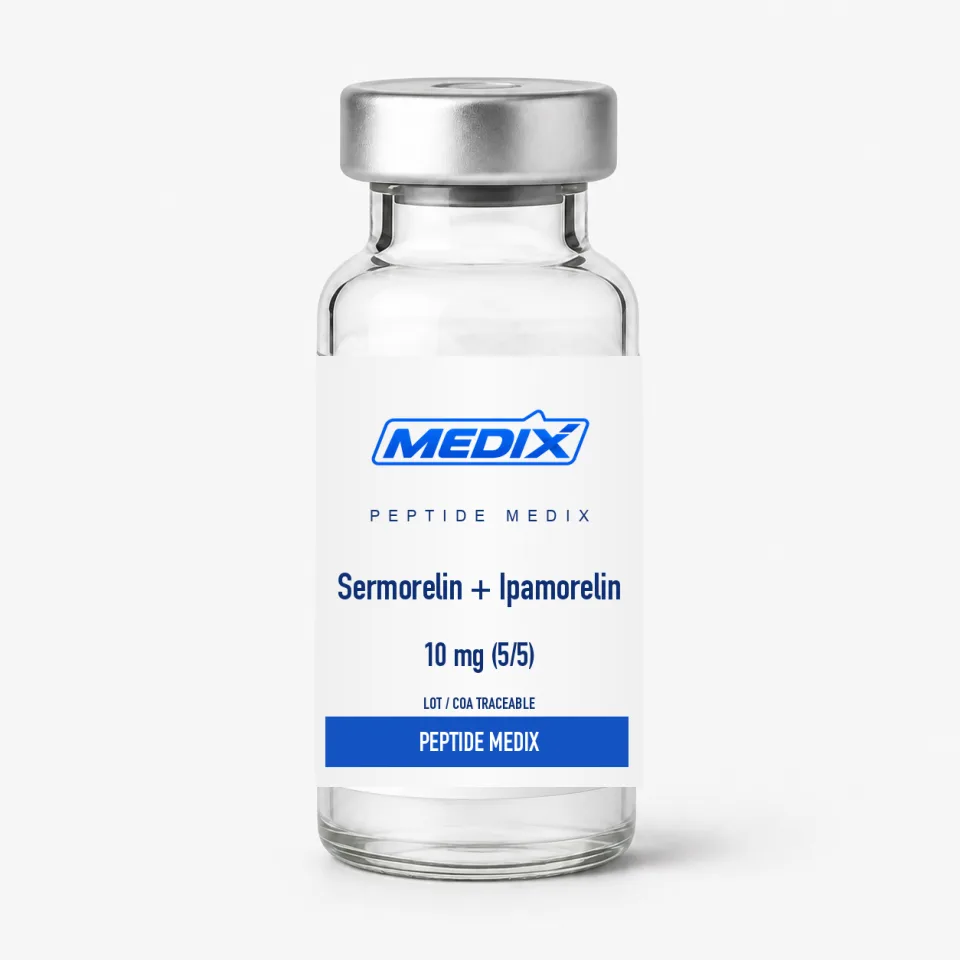
Sermorelin + Ipamorelin
Native GHRH (1-29) fragment paired with a selective ghrelin-receptor pentapeptide
- FormCo-lyophilized powder, sealed glass vial
- Mol. weightSermorelin: 3357.93 g/mol · Ipamorelin: 711.85 g/mol
- Research areasPituitary somatotroph function, pulsatile GH release, sleep-architecture models, IGF-1 axis, ageing models
Overview
Sermorelin is GRF (1-29) amide: the first twenty-nine residues of human growth hormone-releasing hormone, the shortest fragment that retains full receptor activity. Unlike the modified analogues in this category it carries no substitutions and no acyl group — the sequence is native. That makes it the closest available proxy for endogenous GHRH and the reason it remains the reference compound in pituitary-function research, where an unmodified ligand is preferable to a stabilised one.
Ipamorelin supplies the second pathway. It is a pentapeptide agonist at the growth hormone secretagogue receptor, developed at Novo Nordisk and characterised as unusually selective: in the original pharmacology it released growth hormone with minimal effect on ACTH, cortisol or prolactin, unlike the earlier GHRP-6 and GHRP-2 compounds. Pairing it with Sermorelin brings a second receptor into play and reduces somatostatin tone, which otherwise limits how strongly a somatotroph responds to GHRH stimulation.
The combination is studied where investigators want a physiologically faithful stimulus rather than a maximally stabilised one. Peptide Medix supplies both peptides co-lyophilized in a single sealed vial at a 1:1 ratio, third-party tested by HPLC with a lot-matched certificate of analysis.
Specifications
Identity
- CAS number
- Sermorelin: 86168-78-7 · Ipamorelin: 170851-70-4
- Molecular formula
- Sermorelin: C149H246N44O42S · Ipamorelin: C38H49N9O5
- Molecular weight
- Sermorelin: 3357.93 g/mol · Ipamorelin: 711.85 g/mol
- Peptide class
- Native GHRH fragment with a growth hormone secretagogue receptor agonist
Supply & purity
- Form
- Co-lyophilized powder, sealed glass vial
- Purity
- ≥99% by HPLC per component; lot-matched COA available
- Available sizes
- 10 mg (5 mg/5 mg), 20 mg (10 mg/10 mg)
- Solubility
- Bacteriostatic water
Additional detail
- Blend ratio
- 1:1 Sermorelin to Ipamorelin
- Sermorelin sequence
- Tyr-Ala-Asp-Ala-Ile-Phe-Thr-Asn-Ser-Tyr-Arg-Lys-Val-Leu-Gly-Gln-Leu-Ser-Ala-Arg-Lys-Leu-Leu-Gln-Asp-Ile-Met-Ser-Arg-NH2 (GRF 1-29 amide)
- Ipamorelin sequence
- Aib-His-D-2-Nal-D-Phe-Lys-NH2
- Research areas
- Pituitary somatotroph function, pulsatile GH release, sleep-architecture models, IGF-1 axis, ageing models
- Storage
- Lyophilized: −20 °C, protected from light and moisture. Reconstituted: 2–8 °C, use within the study window.
Working out the concentration
Reconstitution is where the arithmetic lives. The same vial made up with 1 mL or with 3 mL of diluent gives three-fold different numbers, which is why a reconstitution volume calculator is more use here than a fixed table: enter the vial mass and your diluent volume and read the concentration back.
Certificate of analysis
Every lot of Sermorelin + Ipamorelin is released against a certificate of analysis: the batch-specific laboratory data for that lot, not a generic document for the compound. The lot number on the certificate matches the lot number printed on the label you receive — the vial label itself, where the product is vialled — so the record and the material it describes can always be reconciled.
Purity: ≥99% by HPLC per component — the specification for this listing. The figure for the lot you receive is the one reported on that lot’s certificate.
No lot certificate is on display on this page at the moment. That is a publishing state and not a testing one: lots are released and documented as described above whether or not the document is posted here, and we will send what exists for the lot in stock, or for a lot already on your bench, by its number.
Certificates are available on request before you order as well as after, with no account and no charge. Request the certificate for this listing, read the testing and documentation policy in full, or see how to read a peptide COA.
Questions about Sermorelin + Ipamorelin
How is Sermorelin different from CJC-1295 (No DAC)?
Both are 29-residue GHRH fragments, but Sermorelin is the unmodified native sequence while CJC-1295 (No DAC) carries four substitutions that resist DPP-4 cleavage. Sermorelin is therefore shorter-acting and closer to endogenous GHRH, which is why it remains the reference ligand in pituitary-function research.
Why combine a GHRH fragment with Ipamorelin?
They act at different receptors on the same pituitary cell. Sermorelin engages the GHRH receptor while Ipamorelin activates the ghrelin receptor and reduces somatostatin tone, which otherwise caps the response. Animal and cell models report a larger measured growth hormone pulse from the pair than from either alone.
Are both peptides third-party tested?
Yes. Each component is analysed independently by HPLC for purity and mass spectrometry for identity before co-lyophilization. The certificate of analysis is matched to the lot number printed on your vial and can be requested before ordering or after delivery.
What does 20 mg (10/10) mean?
It is total peptide mass split evenly between the components — 10 mg of Sermorelin and 10 mg of Ipamorelin. The smaller vial contains 5 mg of each. Both peptides are dried together as a single cake, so reconstitution yields a fixed 1:1 solution.
How stable is Sermorelin once reconstituted?
Less stable than the modified GHRH analogues, since the native sequence is readily cleaved. Keep reconstituted vials at 2–8 °C, protect them from light and repeated warming, and plan study windows accordingly rather than assuming multi-week solution stability.
Can this blend be used in humans?
No. It is supplied strictly for in-vitro and laboratory animal research. No dosing guidance is provided.
Related