- ≥99% by HPLC per vial
- Lot-matched certificate of analysis
- Ships next business day, tracked
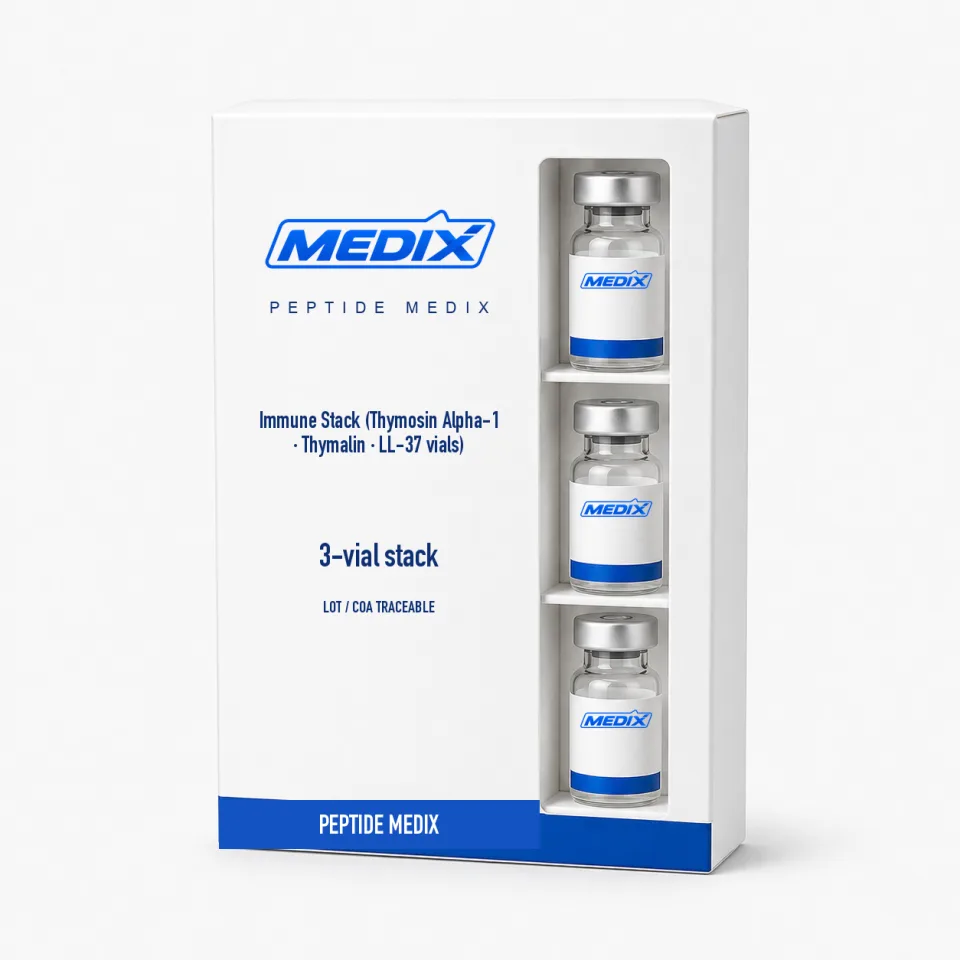
Immune Stack (Thymosin Alpha-1 · Thymalin · LL-37 vials)
Three-vial immunology kit: Thymosin Alpha-1, Thymalin and LL-37
- FormLyophilized powder in each vial, individually capped
- Research areasT-cell maturation markers, thymic peptide biology, innate immune and membrane studies
Overview
The Immune Stack brings together three peptides from immunology research — Thymosin Alpha-1, Thymalin and LL-37 — supplied as three separately sealed lyophilized vials. The grouping spans thymic biology and innate antimicrobial defence, two areas that intersect but are studied with different assay systems.
Thymosin Alpha-1 is a 28-residue acetylated peptide originally isolated from thymosin fraction 5, a thymic extract, and it is the best characterised molecule of the group. Thymalin is a different kind of preparation entirely: a low-molecular-weight polypeptide complex derived from calf thymus tissue, developed in the Russian bioregulator tradition rather than as a single defined sequence. LL-37 belongs to a third category — it is the only human cathelicidin, a 37-residue cationic antimicrobial peptide released by proteolytic processing of hCAP18, and it carries a large Western research literature on membrane interaction and innate immune signalling.
Each vial is assayed by HPLC and released with its own lot-matched certificate of analysis. Keeping the three unmixed is essential here: LL-37 is a strongly cationic, membrane-active peptide with handling requirements unlike those of the two thymic preparations. The kit is sold as research material for laboratory investigation only.
Specifications
Supply & purity
- Form
- Lyophilized powder in each vial, individually capped
- Purity
- ≥99% by HPLC per vial; separate lot-matched COA for each
Handling & storage
- Storage (lyophilized)
- −20 °C, protected from light and moisture
- Storage (reconstituted)
- 2–8 °C, protected from light
Additional detail
- Product type
- Multi-vial research kit — three separately sealed vials
- Kit contents
- One Thymosin Alpha-1 vial, one Thymalin vial, one LL-37 vial
- Thymosin Alpha-1
- CAS 62304-98-7 · C129H215N33O55 · 3108.30 g/mol
- Thymalin
- CAS 79621-14-0 · thymic polypeptide complex, not a single sequence
- LL-37
- CAS 154947-66-7 · 4493.33 g/mol · 37 residues
- Thymosin Alpha-1 class
- N-terminally acetylated 28-residue thymic peptide
- LL-37 class
- Human cathelicidin, cationic antimicrobial peptide from hCAP18
- Research areas
- T-cell maturation markers, thymic peptide biology, innate immune and membrane studies
- Reconstitution
- Each vial prepared separately; LL-37 requires low-binding labware
Working out the concentration
Because Immune Stack (Thymosin Alpha-1 · Thymalin · LL-37 vials) arrives dry, its concentration is a decision rather than a specification. Run the numbers through the reconstitution calculator — vial mass in, diluent volume in, mg/mL and mass per syringe unit out.
Certificate of analysis
Every lot of Immune Stack (Thymosin Alpha-1 · Thymalin · LL-37 vials) is released against a certificate of analysis: the batch-specific laboratory data for that lot, not a generic document for the compound. The lot number on the certificate matches the lot number printed on the label you receive — the vial label itself, where the product is vialled — so the record and the material it describes can always be reconciled.
Purity: ≥99% by HPLC per vial — the specification for this listing. The figure for the lot you receive is the one reported on that lot’s certificate.
No lot certificate is on display on this page at the moment. That is a publishing state and not a testing one: lots are released and documented as described above whether or not the document is posted here, and we will send what exists for the lot in stock, or for a lot already on your bench, by its number.
Certificates are available on request before you order as well as after, with no account and no charge. Request the certificate for this listing, read the testing and documentation policy in full, or see how to read a peptide COA.
Questions about Immune Stack (Thymosin Alpha-1 · Thymalin · LL-37 vials)
Is Thymalin a single peptide?
No. Thymalin is a low-molecular-weight polypeptide complex extracted from calf thymus rather than one synthesised sequence, which is why no single molecular formula or weight is listed for it. Its certificate of analysis characterises the fraction rather than reporting one molecule.
Why does LL-37 need special labware?
LL-37 is strongly cationic and adsorbs readily onto standard glass and polypropylene, which can silently reduce the concentration actually present in an assay. Low-binding tubes and tips are the usual precaution, along with aliquoting rather than repeatedly re-entering one vial.
Does each vial have its own COA?
Yes. Each vial is a separate manufacturing lot released with its own certificate of analysis. Because Thymalin is a complex rather than a defined sequence, its document reports a fraction profile rather than a single-peptide purity figure like the other two.
How does Thymosin Alpha-1 differ from Thymalin?
Thymosin Alpha-1 is a defined, chemically synthesised 28-residue peptide with a known sequence and molecular weight. Thymalin is an extracted polypeptide fraction from thymic tissue. They share a thymic research context but are entirely different classes of material.
Can I run just one component?
Yes. The vials are independent, so a protocol can use one now and keep the others sealed at −20 °C. Unopened lyophilized peptide stored cold and dry remains stable well beyond a year, with the retest date on each lot's COA governing.
Related