- Lot-matched certificate of analysis
- Ships next business day, tracked
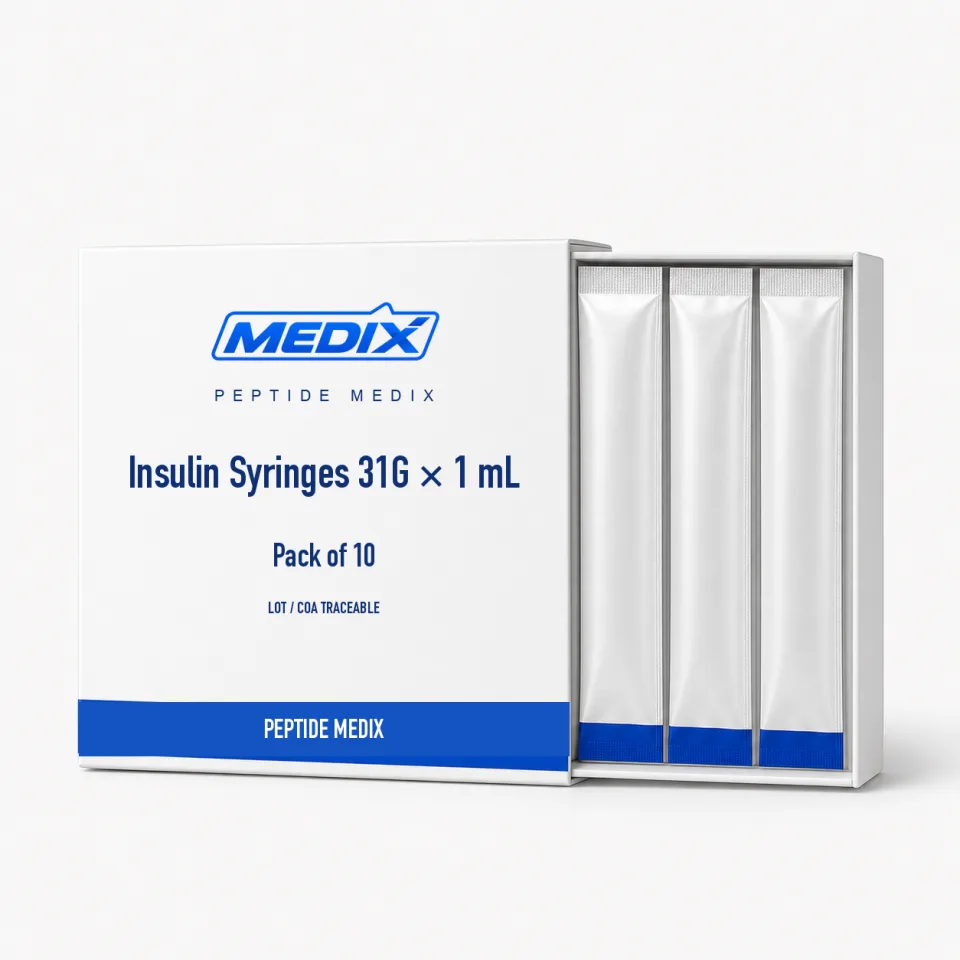
Insulin Syringes 31G × 1 mL
Sterile 1 mL insulin syringes with fixed 31G × 5/16 in needle for lab reconstitution
Overview
These 1 mL insulin syringes are the general-purpose measuring tool of the peptide research bench. Each unit is a single-piece syringe with a permanently attached 31 gauge, 5/16 inch (8 mm) needle, a clear barrel graduated in 0.01 mL increments to 1 mL (100 units on the U-100 scale), and a low-dead-space plunger tip. They arrive sterile, individually wrapped and ready to use.
In reconstitution work the syringe is used to draw a precisely measured volume of bacteriostatic or sterile water and introduce it into a lyophilized peptide vial. The 31G needle is fine enough to pass through a rubber stopper repeatedly with minimal coring, while the 1 mL capacity is well matched to the 1–3 mL volumes typically used to dissolve a 5 mg to 20 mg vial. The same syringes are also used to withdraw measured aliquots of reconstituted solution into sterile empty vials for storage or further dilution.
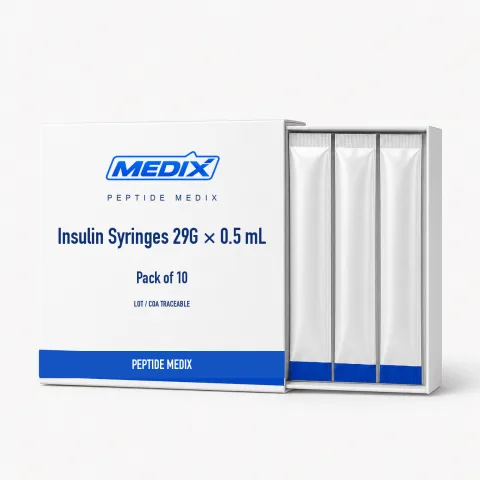
Peptide Medix stocks these syringes in a pack of 10, a pack of 50 and a full box of 100, so both occasional users and higher-throughput laboratories can order in the quantity they need. A 29G × 0.5 mL version is available separately for researchers who prefer a shorter, finer-graduated barrel. All syringes are sold as laboratory consumables.
Units, volume and mass
Graduations on an insulin-style barrel are units, and a unit is a volume and not a mass — what that volume carries depends entirely on how the vial was made up. The unit converter does units to mL to mcg; the reconstitution calculator does the vial.
Certificate of analysis
Every lot of Insulin Syringes 31G × 1 mL is released against its own lot documentation, and where the manufacturer issues a certificate of analysis for it, that certificate is the record for the lot rather than a generic document for the compound. The lot number on the certificate matches the lot number printed on the label you receive — the vial label itself, where the product is vialled — so the record and the material it describes can always be reconciled.
This listing carries no purity percentage, so none is claimed for it here. Where the manufacturer issues analytical documentation for a lot of this item, it is passed on unaltered — ask and we will send whatever exists.
No lot certificate is on display on this page at the moment. That is a publishing state and not a testing one: lots are released and documented as described above whether or not the document is posted here, and we will send what exists for the lot in stock, or for a lot already on your bench, by its number.
Certificates are available on request before you order as well as after, with no account and no charge. Request the certificate for this listing, read the testing and documentation policy in full, or see how to read a peptide COA.
Questions about Insulin Syringes 31G × 1 mL
What does 31G × 1 mL mean?
31G is the needle gauge — a fine needle roughly 0.26 mm in outer diameter — and 1 mL is the syringe capacity. The needle on this model is 5/16 in (8 mm) long and permanently attached. The barrel is graduated in 0.01 mL steps, which correspond to single units on the U-100 insulin scale.
Why are insulin syringes used for peptide reconstitution?
Their fine fixed needles pass through vial stoppers with minimal coring, the narrow barrel and 0.01 mL graduations make small volumes easy to measure, and the low dead space means very little diluent or peptide solution is left behind. Those properties suit the small volumes involved in laboratory peptide preparation.
Are the syringes sterile and single-use?
Yes. Each syringe is sterilized and individually sealed with protective caps on the needle and plunger. They are single-use devices; a fresh syringe should be used for each vial entry and every used syringe should go straight into a sharps container.
What pack sizes are available?
We offer a pack of 10 for occasional reconstitution, a pack of 50 for regular use, and a full box of 100 for laboratories preparing many vials or aliquots. The 29G × 0.5 mL model is stocked separately in packs of 10 and boxes of 100.
How do these differ from the 29G × 0.5 mL syringes?
The 31G × 1 mL syringe has a thinner needle and twice the capacity, making it the more versatile tool for drawing diluent. The 29G × 0.5 mL model has a slightly larger-bore needle and its scale is spread over a shorter volume, which some researchers prefer for very small transfers.
Related