- Lot-matched certificate of analysis
- Ships next business day, tracked
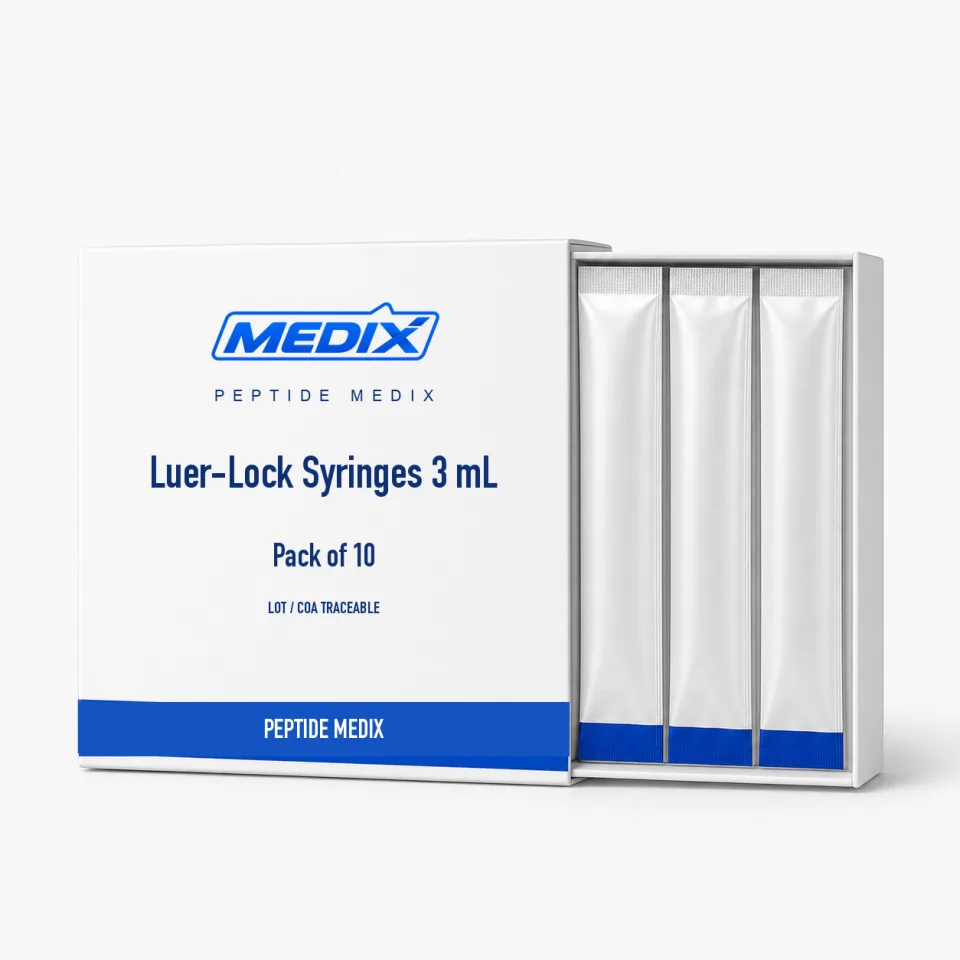
Luer-Lock Syringes 3 mL
Sterile 3 mL syringes with threaded luer-lock tip, needle not included
Overview
These are 3 mL sterile single-use syringes with a threaded luer-lock tip. The luer-lock design is the reason they belong in a reconstitution workflow rather than the more common slip-tip: the threaded collar screws onto a matching needle hub or filter housing and holds it there under pressure. A slip tip relies on friction alone, and friction is exactly what fails when you push liquid through a 0.22 µm membrane and back-pressure rises.
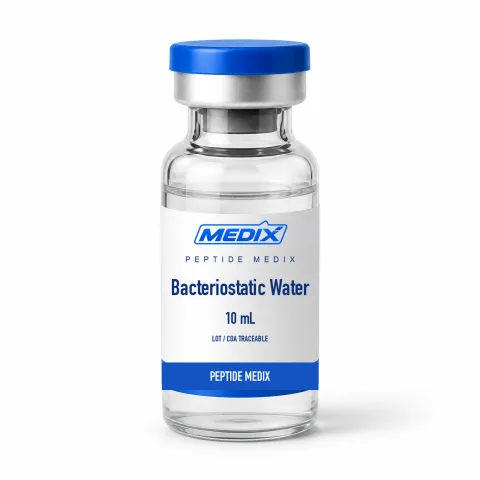
At 3 mL, the barrel is sized for the diluent side of peptide work — drawing bacteriostatic water from a 10 mL or 30 mL vial and delivering a measured volume into a lyophilized peptide vial in a single controlled push. Graduations at 0.1 mL suit that job well. They are not intended for measuring the small volumes drawn from a reconstituted vial afterwards; a 1 mL insulin-style syringe graduated in 0.01 mL increments is the right tool there, and most benches keep both.
Units, volume and mass
Graduations on an insulin-style barrel are units, and a unit is a volume and not a mass — what that volume carries depends entirely on how the vial was made up. The unit converter does units to mL to mcg; the reconstitution calculator does the vial.
Certificate of analysis
Every lot of Luer-Lock Syringes 3 mL is released against its own lot documentation, and where the manufacturer issues a certificate of analysis for it, that certificate is the record for the lot rather than a generic document for the compound. The lot number on the certificate matches the lot number printed on the label you receive — the vial label itself, where the product is vialled — so the record and the material it describes can always be reconciled.
This listing carries no purity percentage, so none is claimed for it here. Where the manufacturer issues analytical documentation for a lot of this item, it is passed on unaltered — ask and we will send whatever exists.
No lot certificate is on display on this page at the moment. That is a publishing state and not a testing one: lots are released and documented as described above whether or not the document is posted here, and we will send what exists for the lot in stock, or for a lot already on your bench, by its number.
Certificates are available on request before you order as well as after, with no account and no charge. Request the certificate for this listing, read the testing and documentation policy in full, or see how to read a peptide COA.
Questions about Luer-Lock Syringes 3 mL
Do these syringes come with needles?
No. They are supplied as barrels with a threaded luer-lock tip, and needles are attached separately. This is deliberate — the same syringe can take a drawing needle, a fine dispensing needle or a 0.22 µm syringe filter depending on the step, which a fixed-needle syringe cannot.
What is the difference between luer-lock and luer-slip?
Both use the same standard 6% taper, so any needle fits either. Luer-slip relies on friction; luer-lock adds a threaded collar that mechanically captures the needle hub. Under back-pressure — filtration, fine needles, viscous solutions — a slip fitting can separate, which is why filtration work uses luer-lock.
Can I use a 3 mL syringe to draw from a reconstituted peptide vial?
It works, but it is the wrong tool for precision. Graduations here are 0.1 mL, and syringe accuracy is worst in the bottom fifth of the scale. Small measured withdrawals belong in a 1 mL insulin-style syringe with 0.01 mL graduations; the 3 mL barrel is for the diluent side.
Are they sterile, and can they be reused?
They are sterile as packaged and strictly single-use. The elastomer plunger seal is not built to survive autoclaving, and reuse after liquid contact risks carry-over between preparations that will confound analytical results. Discard any syringe whose blister wrapper is torn or previously opened.
Will these fit standard 0.22 µm syringe filters?
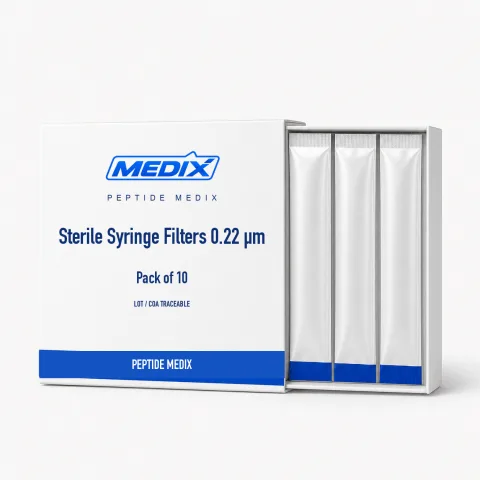
Yes, provided the filter housing has a luer-lock inlet, which most laboratory filters do. Check before use — a luer-slip filter will seat on the taper but will not thread, and that is precisely the situation where filtration back-pressure can push the fitting apart.
Which pack size should I order?
Packs of 10 suit occasional reconstitution or a single short study. The box of 100 is the better value per unit for a bench running regular preparations, and having plenty on hand discourages the false economy of reusing a syringe between vials.
Related