- Lot-matched certificate of analysis
- Ships next business day, tracked
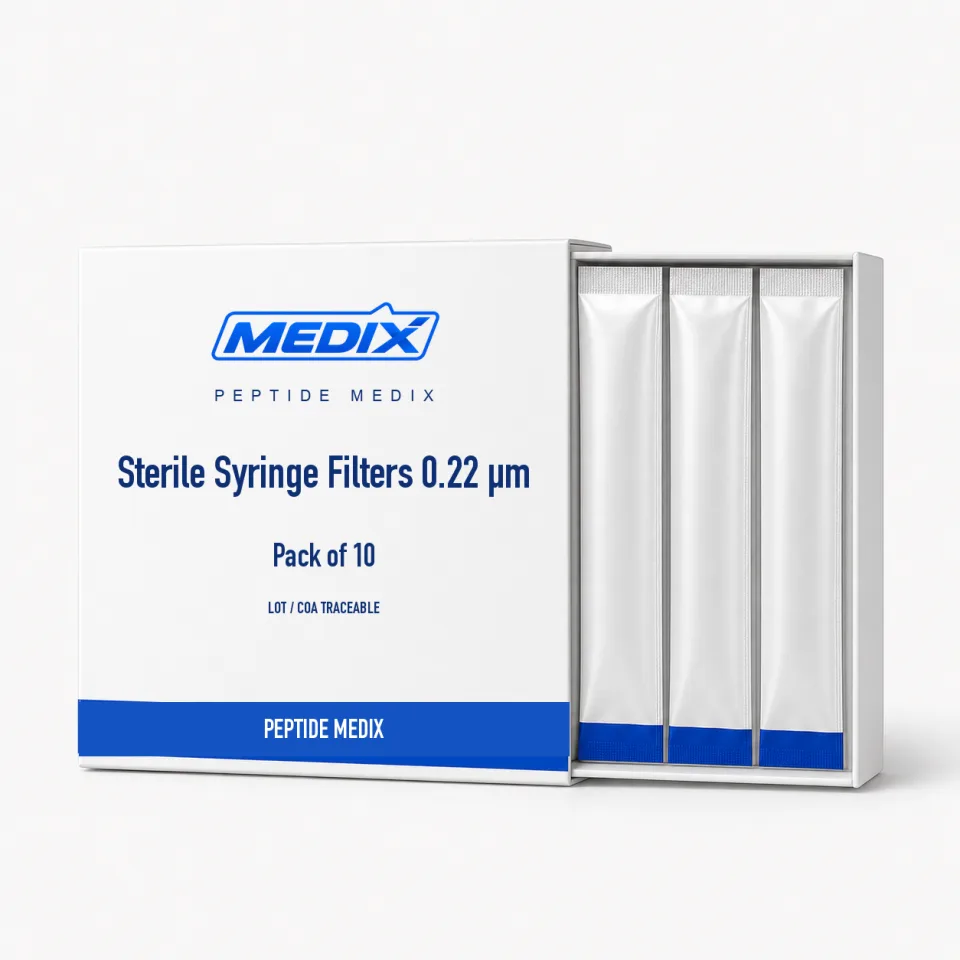
Sterile Syringe Filters 0.22 µm
0.22 µm PES membrane, luer-lock, individually sterile-packed filters
Overview
A syringe filter is the standard way to sterilise a small volume of solution that cannot be autoclaved. Heat destroys peptides, so filtration through a 0.22 µm membrane is the only practical route to a sterile peptide preparation in a general laboratory. These filters use a polyethersulfone membrane in a polypropylene housing with a female luer-lock inlet and male luer slip outlet, and each unit arrives individually wrapped and sterile.
The 0.22 µm rating is not arbitrary. It is the pore size conventionally accepted as sterilising-grade because it retains the small bacteria used as the industry challenge organism, notably Brevundimonas diminuta. A 0.45 µm filter clarifies a solution and removes particulates but is not considered sterilising, and neither rating removes viruses, mycoplasma or endotoxin — those require different technology entirely.
In peptide workflows these filters appear at two points: sterilising a reconstituted solution before it is transferred into a sealed vial for storage, and clarifying a solution that shows fine particulate or slight haze before analysis. Polyethersulfone is the usual membrane choice for both because it has low protein binding, which matters when the solute is present at low concentration and any adsorption to the membrane represents a real loss of material.
Diluent volume and concentration
Diluent volume is the one variable that sets the concentration of a reconstituted vial, so it is worth fixing on paper first. The peptide reconstitution calculator turns vial mass and diluent volume into mg/mL, mcg/mL and mass per syringe unit.
Certificate of analysis
Every lot of Sterile Syringe Filters 0.22 µm is released against its own lot documentation, and where the manufacturer issues a certificate of analysis for it, that certificate is the record for the lot rather than a generic document for the compound. The lot number on the certificate matches the lot number printed on the label you receive — the vial label itself, where the product is vialled — so the record and the material it describes can always be reconciled.
This listing carries no purity percentage, so none is claimed for it here. Where the manufacturer issues analytical documentation for a lot of this item, it is passed on unaltered — ask and we will send whatever exists.
No lot certificate is on display on this page at the moment. That is a publishing state and not a testing one: lots are released and documented as described above whether or not the document is posted here, and we will send what exists for the lot in stock, or for a lot already on your bench, by its number.
Certificates are available on request before you order as well as after, with no account and no charge. Request the certificate for this listing, read the testing and documentation policy in full, or see how to read a peptide COA.
Questions about Sterile Syringe Filters 0.22 µm
Why filter a peptide solution instead of autoclaving it?
Autoclaving uses steam at 121 °C, which denatures and degrades peptides. Filtration through a 0.22 µm membrane achieves sterilisation at ambient temperature without chemically altering the solute, which makes it the standard route for heat-sensitive solutions in a general laboratory.
What is the difference between 0.22 µm and 0.45 µm?
0.22 µm is the accepted sterilising-grade rating because it retains the small bacteria used as the standard challenge organism. 0.45 µm clarifies a solution and removes visible particulate but is not sterilising. Use 0.22 µm whenever a sterile output is the goal.
Will filtering remove endotoxin?
No. Endotoxin is a lipopolysaccharide fragment far smaller than the pore size and passes straight through, as do viruses and mycoplasma. A filter maintains the microbiological quality of a sound preparation; it cannot repair one that has already been contaminated.
How much peptide is lost to the membrane?
Polyethersulfone is chosen precisely because it binds protein and peptide poorly, so losses are typically small. They are not zero, though, and they matter most at low concentrations and small volumes. Where quantitation is critical, measure concentration after filtration rather than before.
Can a filter be reused if only a small volume passed through?
No. These are single-use sterile devices. Once the wrapper is opened and solution has passed through, sterility of the flow path can no longer be assured, and the membrane may carry retained material. Do not autoclave, rinse or re-sterilise them.
What size syringe should be used with them?
Any standard syringe with a male luer-lock tip fits the inlet. A 25 mm filter suits volumes up to roughly 100 mL depending on particulate load, so 5 mL to 20 mL syringes are the usual pairing. Push slowly and steadily rather than forcing flow.
Related