- Lot-matched certificate of analysis
- Ships next business day, tracked
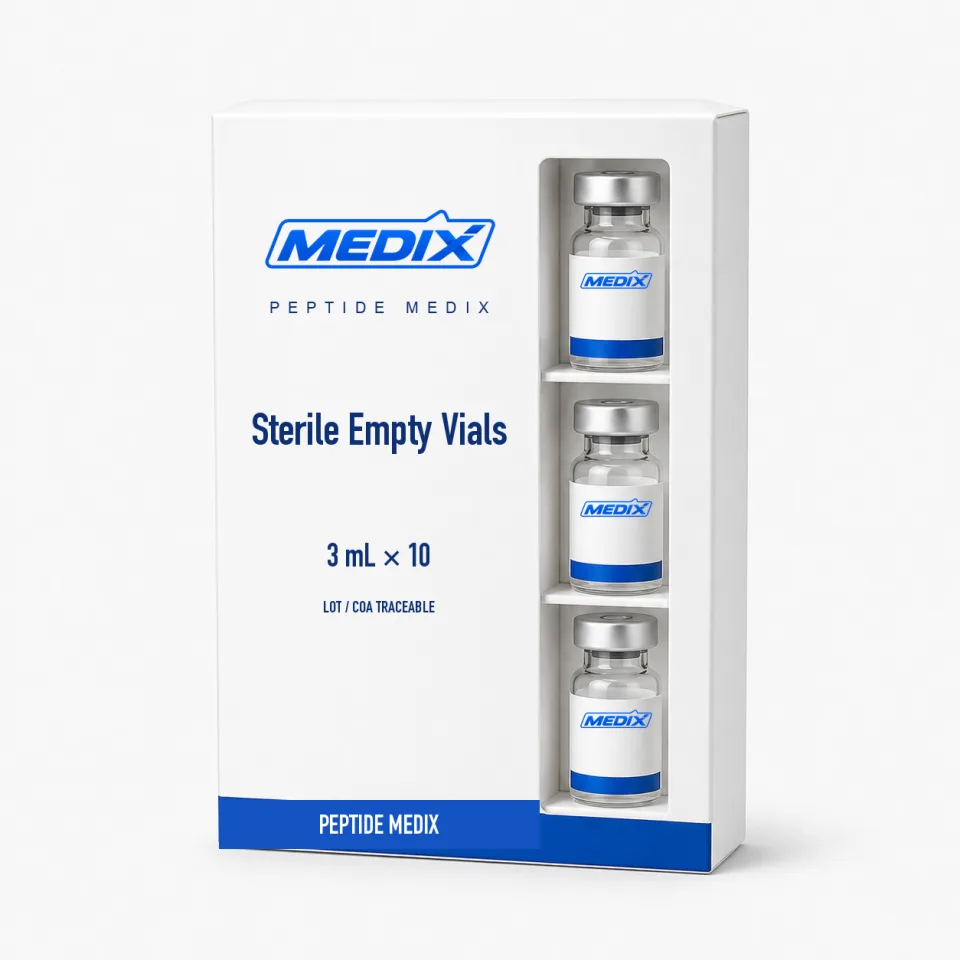
Sterile Empty Vials
Sterile, sealed empty glass vials for aliquoting and storing reconstituted peptides
Overview
In peptide research the most common use is aliquoting: once a lyophilized vial has been reconstituted, dividing the stock into several smaller vials means each aliquot is punctured fewer times, reduces the risk of contaminating the whole batch, and allows portions to be refrigerated or frozen separately. Empty vials are also used to prepare working dilutions at lower concentration, to combine components for a blend study, or simply to hold a measured volume of bacteriostatic water for a single experiment.
Clear borosilicate glass, a rubber stopper and a crimped aluminium flip-off cap make up the container, supplied ten to a pack in 3 mL and 10 mL sizes. Nominal working fills are about 2 mL and 8 mL respectively, and the shortfall is deliberate headspace: aqueous solutions expand as they freeze, and a full vial at −20 °C risks unseating the stopper or cracking the glass. Both the glass and the closure tolerate refrigerated and frozen storage. Filling is by syringe transfer through the stopper, venting with a second needle where displaced air would otherwise resist the plunger, and frozen vials are brought back to room temperature before entry so that condensation does not travel in on the needle.
Specifications
Supply & purity
- Available sizes
- 3 mL × 10 pack; 10 mL × 10 pack
Additional detail
- Product type
- Empty sterile serum-style vial
- Vial material
- Clear borosilicate glass
- Closure
- Rubber stopper with crimped aluminum flip-off cap
- Contents
- Empty — no diluent, no peptide
- Sterility
- Sterilized and sealed prior to shipment
- Fill method
- Syringe transfer through the stopper; vent with a second needle if required
- Nominal fill volume
- Up to about 2 mL (3 mL vial) or 8 mL (10 mL vial) to leave headspace
- Temperature range
- Suitable for refrigerated (2–8 °C) and frozen (−20 °C) storage
- Storage (unused)
- Room temperature, dry, in original tray
- Typical use
- Aliquoting, dilutions, blend preparation, single-experiment volumes
Diluent volume and concentration
How much of this you add is the whole of the concentration question: the same vial of peptide made up with 1 mL or with 3 mL gives three-fold different numbers. Work it out with the reconstitution calculator before the first vial is pierced.
Certificate of analysis
Every lot of Sterile Empty Vials is released against its own lot documentation, and where the manufacturer issues a certificate of analysis for it, that certificate is the record for the lot rather than a generic document for the compound. The lot number on the certificate matches the lot number printed on the label you receive — the vial label itself, where the product is vialled — so the record and the material it describes can always be reconciled.
This listing carries no purity percentage, so none is claimed for it here. Where the manufacturer issues analytical documentation for a lot of this item, it is passed on unaltered — ask and we will send whatever exists.
No lot certificate is on display on this page at the moment. That is a publishing state and not a testing one: lots are released and documented as described above whether or not the document is posted here, and we will send what exists for the lot in stock, or for a lot already on your bench, by its number.
Certificates are available on request before you order as well as after, with no account and no charge. Request the certificate for this listing, read the testing and documentation policy in full, or see how to read a peptide COA.
Questions about Sterile Empty Vials
What are sterile empty vials used for in peptide research?
Mainly for aliquoting: dividing a freshly reconstituted peptide vial into smaller sealed portions so each is punctured less often and can be refrigerated or frozen separately. They are also used to prepare working dilutions, to combine components for blend studies, and to hold measured volumes of diluent for a single experiment.
Which size should I choose?
The 3 mL vial handles aliquots up to roughly 2 mL and matches the size of most peptide vials in our catalog. The 10 mL vial is for larger working solutions, dilution series or holding a portion of bacteriostatic water. Both come ten to a pack.
Can the vials be frozen?
Yes. Borosilicate glass and the rubber stopper tolerate −20 °C storage. Leave adequate headspace because aqueous solutions expand when they freeze, and let vials warm to room temperature before entering the stopper so condensation does not enter the needle track.
Are the vials sterile and documented?
The vials are sterilized and sealed before shipment and remain sterile inside until the flip-off cap is removed. Lot information is on the packaging and available on request. As empty containers, HPLC purity does not apply; they contain no peptide or diluent.
Related