- Lot-matched certificate of analysis
- Ships next business day, tracked
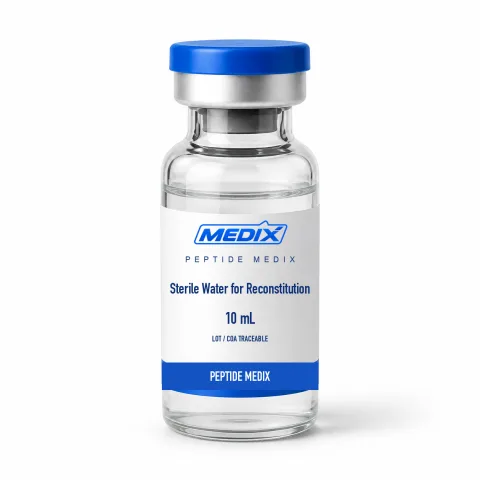
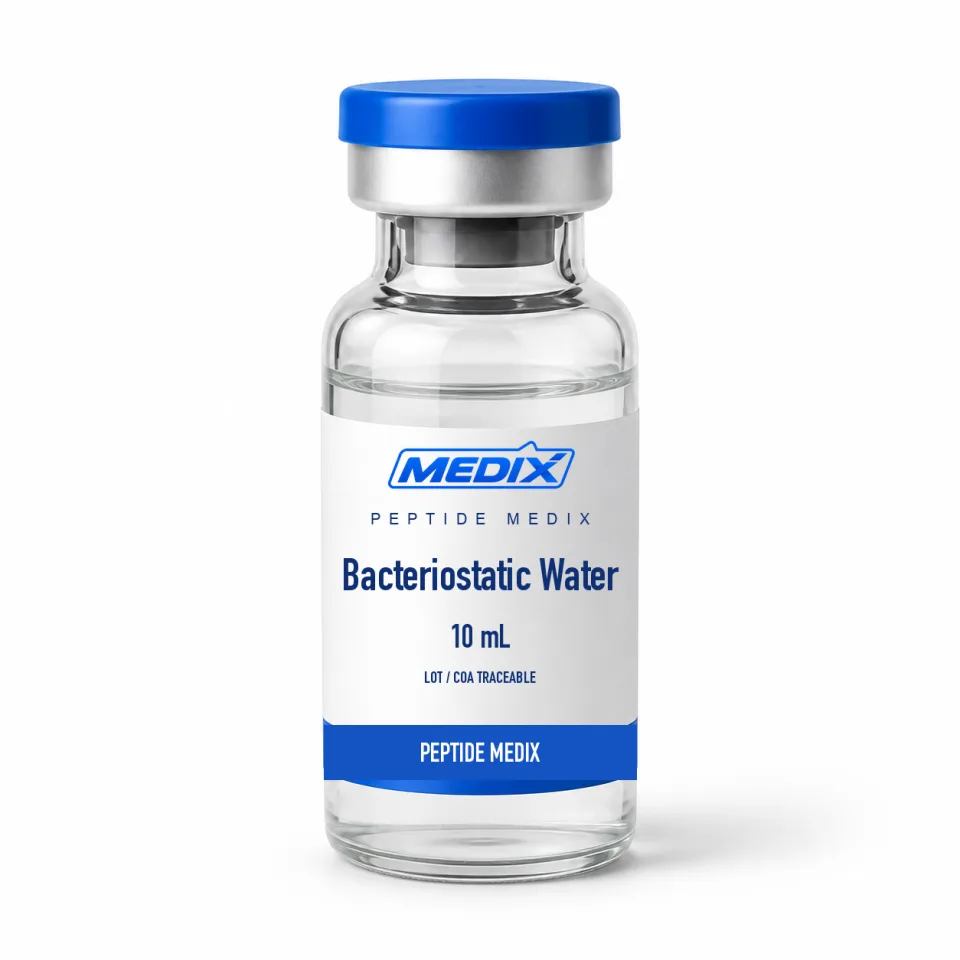
Bacteriostatic Water for Injection
Sterile water with 0.9% benzyl alcohol for multi-draw peptide reconstitution
Overview
Bacteriostatic water is sterile, non-pyrogenic water for reconstitution to which 0.9% benzyl alcohol has been added as a bacteriostatic preservative. It is the diluent most laboratories reach for when a lyophilized peptide vial will be entered more than once, because the benzyl alcohol suppresses the growth of most contaminating bacteria that could be introduced during repeated draws.
Benzyl alcohol is worth treating as an ingredient rather than an inert addition. At 0.9% it is present at roughly 9 mg per millilitre, enough to register in a chromatographic trace, to act as a vehicle component in cell-based assays, and to be incompatible with a small number of compounds. Where any of those matter, the preservative-free sterile water listed alongside is the alternative, at the cost of single-use handling. Stock formats are a 10 mL vial, a 30 mL vial and a three-pack of 30 mL, which spans a single peptide reconstitution through to a bench preparing many vials from one lot. Unopened vials sit at 20–25 °C away from light; after first entry the common convention is refrigeration with a defined in-use period of about 28 days.
Specifications
Supply & purity
- Available sizes
- 10 mL vial, 30 mL vial, 30 mL × 3 pack
Additional detail
- Product type
- Reconstitution diluent
- Appearance
- Clear, colorless liquid, free of visible particulates
- Sterility
- Sterile and non-pyrogenic as packaged
- Preservative
- Benzyl alcohol, bacteriostatic
- Typical use
- Dissolving lyophilized peptides for multi-draw laboratory preparations
- Storage (unopened)
- 20–25 °C (68–77 °F), protected from light; do not freeze
- Storage (after first entry)
- Commonly stored refrigerated and used within about 28 days
- Compatibility
- Suitable for most peptides; not for compounds incompatible with benzyl alcohol
Diluent volume and concentration
Diluent volume is the one variable that sets the concentration of a reconstituted vial, so it is worth fixing on paper first. The peptide reconstitution calculator turns vial mass and diluent volume into mg/mL, mcg/mL and mass per syringe unit.
Certificate of analysis
Every lot of Bacteriostatic Water is released against its own lot documentation, and where the manufacturer issues a certificate of analysis for it, that certificate is the record for the lot rather than a generic document for the compound. The lot number on the certificate matches the lot number printed on the label you receive — the vial label itself, where the product is vialled — so the record and the material it describes can always be reconciled.
This listing carries no purity percentage, so none is claimed for it here. Where the manufacturer issues analytical documentation for a lot of this item, it is passed on unaltered — ask and we will send whatever exists.
No lot certificate is on display on this page at the moment. That is a publishing state and not a testing one: lots are released and documented as described above whether or not the document is posted here, and we will send what exists for the lot in stock, or for a lot already on your bench, by its number.
Certificates are available on request before you order as well as after, with no account and no charge. Request the certificate for this listing, read the testing and documentation policy in full, or see how to read a peptide COA.
Questions about Bacteriostatic Water
What is the difference between bacteriostatic water and sterile water?
Both are sterile, non-pyrogenic water. Bacteriostatic water additionally contains 0.9% benzyl alcohol, a preservative that inhibits bacterial growth so a vial can be entered multiple times. Sterile water has no preservative and is intended for single use; once opened it should not be stored and reused.
Which peptides can be reconstituted with bacteriostatic water?
The large majority of lyophilized research peptides in our catalog, including BPC-157, TB-500, GHK-Cu, semaglutide, tirzepatide, CJC-1295, ipamorelin and MOTS-c, are routinely dissolved in bacteriostatic water for laboratory preparations. Check the product page or COA for any compound with a specific solvent recommendation.
How long can a vial be used once opened?
After the stopper is first punctured, most laboratories store the vial at 2–8 °C and discard it after roughly 28 days, or earlier if the solution becomes cloudy or discolored. Always follow your own facility's SOP and mark the date of first entry on the label.
Is bacteriostatic water tested and does it come with documentation?
The water is manufactured as a sterile, non-pyrogenic product and every vial is labeled with a lot number and expiration date. Documentation for the lot supplied is available on request. It is a reagent, not a peptide, so purity by HPLC does not apply in the same way it does to our peptide vials.
What sizes are available and how do I choose?
We stock 10 mL and 30 mL vials plus a 30 mL three-pack. A 10 mL vial is convenient for a handful of peptide reconstitutions; 30 mL suits laboratories preparing many vials or larger working volumes. Buying the three-pack lowers the per-vial cost for high-throughput benches.
Does bacteriostatic water need to be refrigerated?
Unopened vials are stored at controlled room temperature, 20–25 °C, away from light. Freezing should be avoided because it can compromise the seal. After first entry, refrigerated storage at 2–8 °C is the common practice for both the diluent vial and any peptide solutions prepared from it.
Related