- Lot-matched certificate of analysis
- Ships next business day, tracked
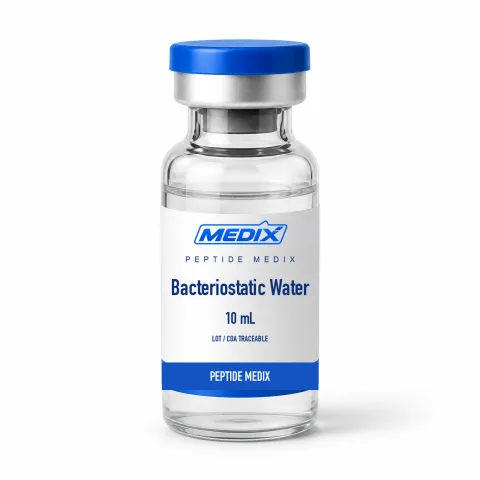
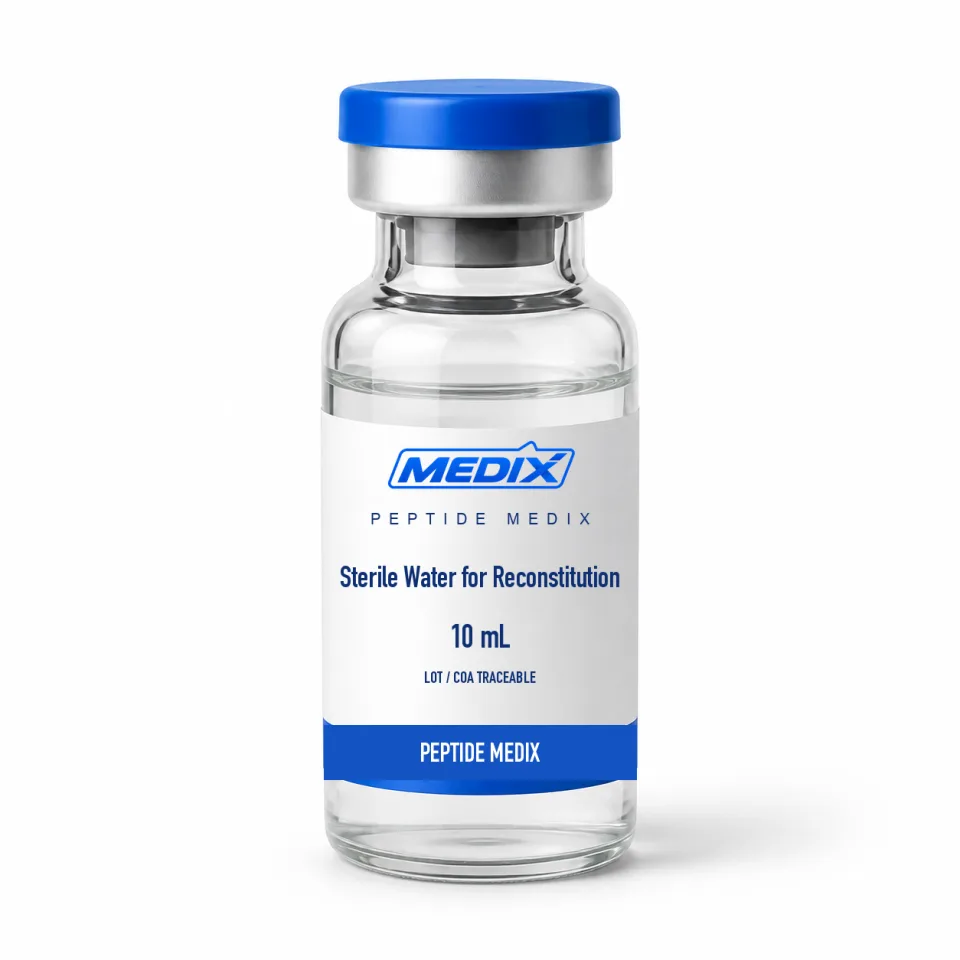
Sterile Water for Reconstitution
Preservative-free sterile water for single-use peptide reconstitution
Overview
Sterile Water for Reconstitution is purified water that has been sterilized and packaged without any added preservative or buffer. It is the simplest diluent available for dissolving lyophilized peptides and is chosen when a research protocol calls for a single-use preparation, when a compound is known to be sensitive to benzyl alcohol, or when a downstream assay could be affected by the presence of a preservative.
With no buffer, no salt and no tonicity agent, a solution made with it takes its pH and osmolality entirely from the peptide and from whatever it is subsequently diluted into, which is worth noting for assays where either matters and is the reason phosphate or other defined buffers are substituted for some applications. Vials are clear glass with a rubber stopper and aluminium flip-off cap in 10 mL and 30 mL fills; since the contents are preservative-free, the 10 mL size is often the more economical choice, as the remainder of an opened vial is discarded rather than kept. The common companion task is aliquoting: a preservative-free reconstitution divided into sterile empty vials and frozen avoids both repeated septum entry and benzyl alcohol in the final preparation.
Specifications
Supply & purity
- Available sizes
- 10 mL vial, 30 mL vial
Additional detail
- Product type
- Reconstitution diluent
- Composition
- Sterile, purified water only — no preservative, buffer or tonicity agent
- Container
- Clear glass vial, rubber stopper, aluminum flip-off cap
- Appearance
- Clear, colorless liquid, free of visible particulates
- Sterility
- Sterile and non-pyrogenic as packaged
- Preservative
- None
- Typical use
- Single-use dissolution of lyophilized peptides; preparation of aliquots for freezing
- Storage (unopened)
- 20–25 °C (68–77 °F), protected from light; do not freeze
- Storage (after opening)
- Single use — use promptly and discard remaining contents
- Compatibility
- Suitable for benzyl-alcohol-sensitive compounds and preservative-free assays
Diluent volume and concentration
How much of this you add is the whole of the concentration question: the same vial of peptide made up with 1 mL or with 3 mL gives three-fold different numbers. Work it out with the reconstitution calculator before the first vial is pierced.
Certificate of analysis
Every lot of Sterile Water for Reconstitution is released against its own lot documentation, and where the manufacturer issues a certificate of analysis for it, that certificate is the record for the lot rather than a generic document for the compound. The lot number on the certificate matches the lot number printed on the label you receive — the vial label itself, where the product is vialled — so the record and the material it describes can always be reconciled.
This listing carries no purity percentage, so none is claimed for it here. Where the manufacturer issues analytical documentation for a lot of this item, it is passed on unaltered — ask and we will send whatever exists.
No lot certificate is on display on this page at the moment. That is a publishing state and not a testing one: lots are released and documented as described above whether or not the document is posted here, and we will send what exists for the lot in stock, or for a lot already on your bench, by its number.
Certificates are available on request before you order as well as after, with no account and no charge. Request the certificate for this listing, read the testing and documentation policy in full, or see how to read a peptide COA.
Questions about Sterile Water for Reconstitution
Why would I choose sterile water instead of bacteriostatic water?
Sterile water contains no benzyl alcohol, making it the right choice when a preservative could affect an assay, when a peptide is sensitive to benzyl alcohol, or when a reconstituted solution will be used at once or frozen in aliquots. For multi-draw vials stored in a refrigerator, bacteriostatic water is usually preferred.
What sizes are offered?
Sterile Water for Reconstitution is available in 10 mL and 30 mL vials. Because the product is single-use, many laboratories favor the 10 mL size so less is discarded after each reconstitution; the 30 mL vial suits larger one-time preparations.
Is the water tested and documented?
The vials are manufactured as sterile, non-pyrogenic water and every vial is labeled with a lot number and expiration date. Documentation for the supplied lot is available on request. As a plain reagent, purity by HPLC is not the applicable metric; sterility and endotoxin limits are.
How should sterile water be stored?
Store sealed vials at 20–25 °C, protected from light, and do not freeze the sealed container. Inspect the vial for an intact seal and a clear, particulate-free appearance before each use, and discard any vial that appears cloudy or damaged.
Related