- Lot-matched certificate of analysis
- Ships next business day, tracked
Vial Labels & Reconstitution Log Sheets
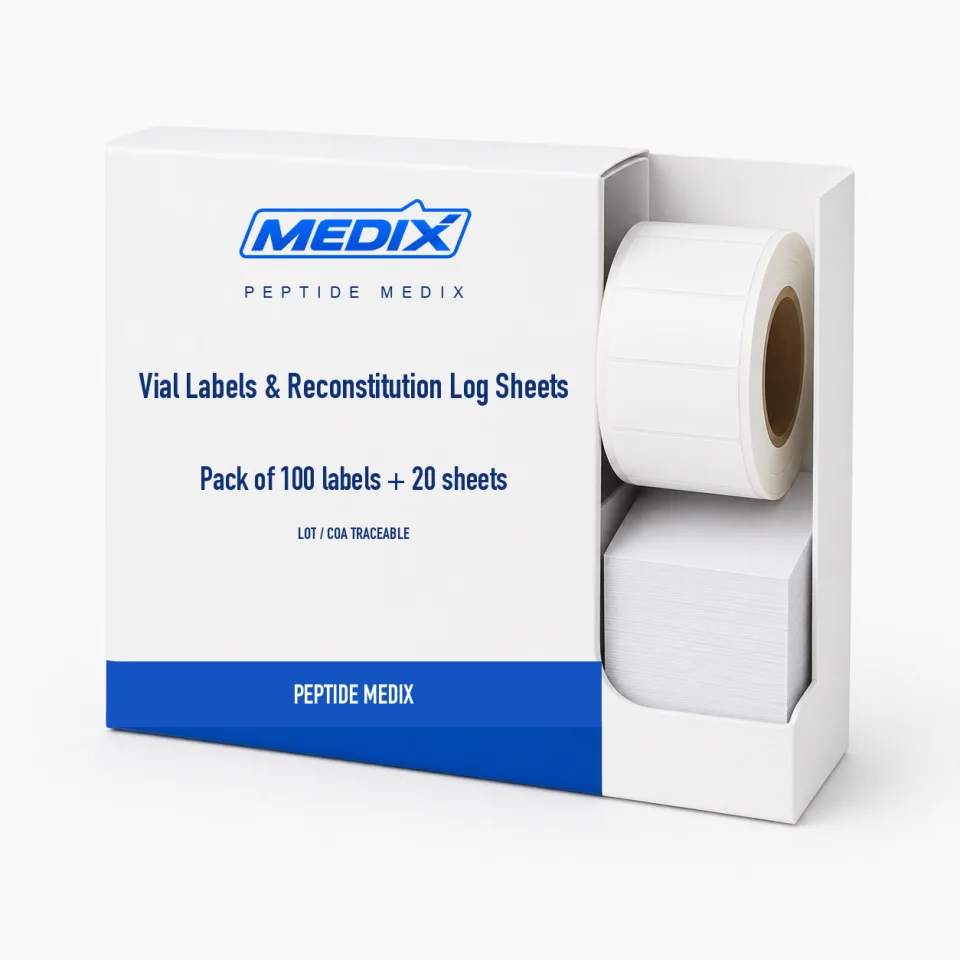
100 write-on vial labels plus 20 reconstitution log sheets for lab records
Overview
This pack covers the record-keeping half of a reconstitution workflow. It contains 100 write-on vial labels and 20 printed log sheets, and it holds no peptide, diluent or chemical of any kind. The purpose is straightforward: a reconstituted vial that is not labelled is an unidentified solution, and an unidentified solution is a discarded experiment.
The labels are printed on a water- and alcohol-resistant synthetic film with a permanent acrylic adhesive that holds on cold glass, so a label applied before a vial goes into refrigerated or freezer storage stays put and stays legible. Pre-printed fields prompt for compound, concentration, diluent, reconstitution date, lot number, initials and a use-by date, with a blank area for notes. The matte surface accepts ballpoint, fine-tip permanent marker and pencil without smearing.
The log sheets extend the same information to a sheet that lives with the study record rather than on the vial. Each is a letter-size grid with rows for date, compound, lot, vial size, diluent volume, resulting concentration, storage location and operator initials — the fields an audit or a repeat experiment actually needs. Supplied for laboratory use only.
Certificate of analysis
Every lot of Vial Labels & Reconstitution Log Sheets is released against its own lot documentation, and where the manufacturer issues a certificate of analysis for it, that certificate is the record for the lot rather than a generic document for the compound. The lot number on the certificate matches the lot number printed on the label you receive — the vial label itself, where the product is vialled — so the record and the material it describes can always be reconciled.
This listing carries no purity percentage, so none is claimed for it here. Where the manufacturer issues analytical documentation for a lot of this item, it is passed on unaltered — ask and we will send whatever exists.
No lot certificate is on display on this page at the moment. That is a publishing state and not a testing one: lots are released and documented as described above whether or not the document is posted here, and we will send what exists for the lot in stock, or for a lot already on your bench, by its number.
Certificates are available on request before you order as well as after, with no account and no charge. Request the certificate for this listing, read the testing and documentation policy in full, or see how to read a peptide COA.
Questions about Vial Labels & Reconstitution Log Sheets
What exactly is in the pack?
One hundred write-on vial labels and twenty letter-size reconstitution log sheets. There is no peptide, diluent, syringe or chemical of any kind in this pack — it is purely documentation stock intended to pair with vials and supplies you already have.
Will the labels stay on in a freezer?
They are made from synthetic film with a permanent acrylic adhesive selected for cold-glass adhesion. The important step is application: apply to a clean, dry, room-temperature vial and press firmly, then let the adhesive set before chilling, rather than labelling an already-cold vial.
What should be written on each label?
Compound and original lot number, diluent used and volume added, the resulting concentration, reconstitution date, operator initials and a use-by date. Those fields are pre-printed as prompts so nothing is left off in the moment.
Why keep a separate log sheet?
The label identifies a vial while it exists; the log sheet is the record that outlives it. It captures information the label has no room for and lets you trace which lot and which reconstitution produced a given dataset long after the vial has been discarded.
Do the labels work with alcohol swabbing?
The film and adhesive tolerate incidental isopropyl alcohol contact, which matters because stoppers are swabbed before every entry. Entries made in ballpoint or fine-tip permanent marker resist smearing; water-based inks are not recommended for that reason.
Related