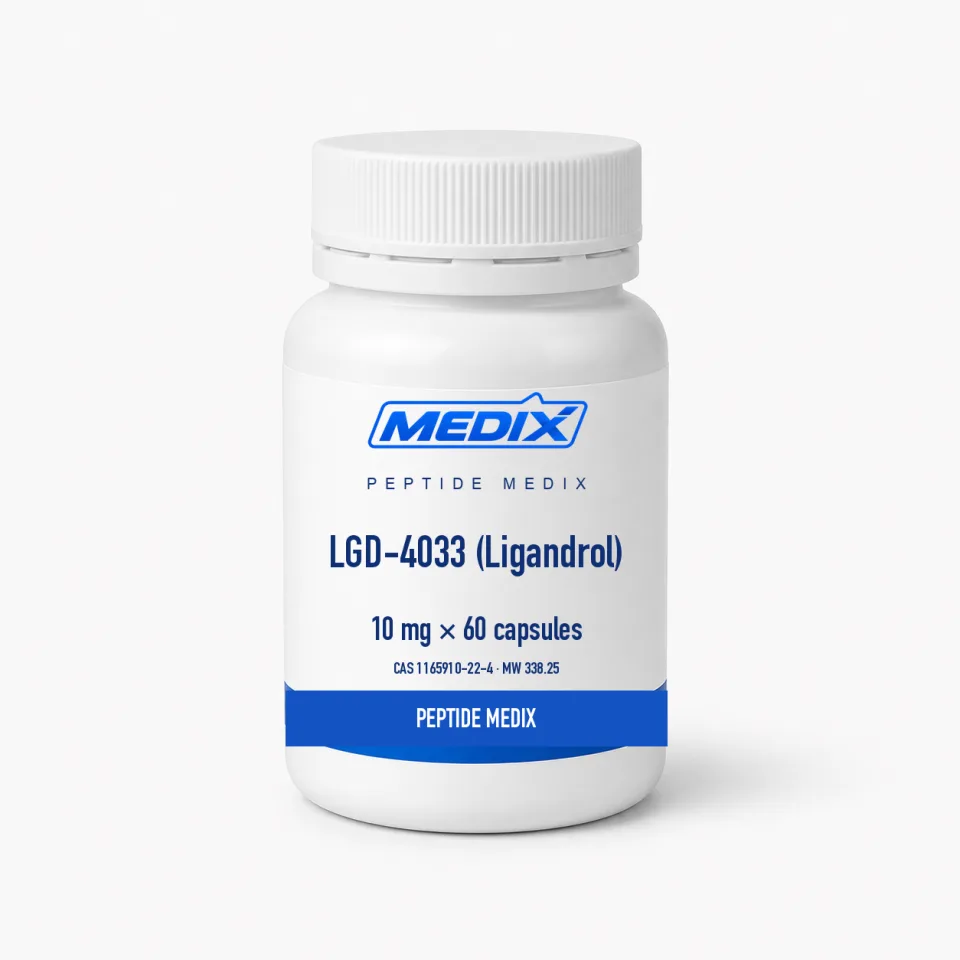
- ≥98% by HPLC
- Lot-matched certificate of analysis
- Ships next business day, tracked
LGD-4033 (Ligandrol)
Non-steroidal selective androgen receptor modulator, capsules or liquid
- FormOral capsules in a sealed bottle, or 30 mL solution in an amber dropper bottle
- Mol. weight338.25 g/mol
- Research areasAndrogen receptor pharmacology, muscle and bone tissue selectivity, anti-doping analytical methods
Overview
LGD-4033, commonly called Ligandrol and also catalogued as VK5211, is a non-steroidal selective androgen receptor modulator. Chemically it is a benzonitrile bearing a trifluoromethyl group and a pyrrolidine ring with a trifluoro-hydroxyethyl substituent, and it is not a peptide or a hormone — it is a small synthetic organic molecule that binds the androgen receptor ligand-binding domain.
Two formats are stocked from the same lot-tested material: sixty 10 mg capsules in a sealed bottle, and 30 mL of solution at 20 mg/mL in an amber dropper bottle. Capsules fix unit content, which suits designs with many repeat administrations; the solution suits dilution series and vehicle-matched in-vitro work, where the carrier itself becomes a variable that control wells must account for. Among the selective androgen receptor modulators listed here, LGD-4033 is generally reported as the more potent androgen receptor ligand in binding and transactivation assays, while ostarine is more often described as a partial agonist, which is why the two are commonly run as separate arms. Purity is specified at 98% or better by HPLC, and storage is simply sealed, dry and at room temperature.
Specifications
Identity
- CAS number
- 1165910-22-4
- Molecular formula
- C14H12F6N2O
- Molecular weight
- 338.25 g/mol
Supply & purity
- Form
- Oral capsules in a sealed bottle, or 30 mL solution in an amber dropper bottle
- Purity
- ≥98% by HPLC; lot-matched COA available
- Available sizes
- 10 mg × 60 capsules; 30 mL liquid at 20 mg/mL
Additional detail
- Compound class
- Non-steroidal selective androgen receptor modulator (SARM)
- Also known as
- Ligandrol, VK5211, anabolicum
- Molecular target
- Androgen receptor ligand-binding domain
- Chemical description
- Trifluoromethyl-substituted benzonitrile with a pyrrolidinyl trifluoro-hydroxyethyl group
- Research areas
- Androgen receptor pharmacology, muscle and bone tissue selectivity, anti-doping analytical methods
- Regulatory status
- Not an approved drug; not a dietary supplement or dietary ingredient; WADA prohibited
- Storage
- Room temperature in the sealed container, dry and protected from light
Units and conversions
Capsule and troche strengths are stated per unit, so the figure a method needs is usually a conversion rather than a dilution. The mcg to mg converter handles the milligram-to-microgram step, and the millilitre arithmetic if you are working from a solution format instead.
Certificate of analysis
Every lot of LGD-4033 (Ligandrol) is released against a certificate of analysis: the batch-specific laboratory data for that lot, not a generic document for the compound. The lot number on the certificate matches the lot number printed on the label you receive — the vial label itself, where the product is vialled — so the record and the material it describes can always be reconciled.
Purity: ≥98% by HPLC — the specification for this listing. The figure for the lot you receive is the one reported on that lot’s certificate.
No lot certificate is on display on this page at the moment. That is a publishing state and not a testing one: lots are released and documented as described above whether or not the document is posted here, and we will send what exists for the lot in stock, or for a lot already on your bench, by its number.
Certificates are available on request before you order as well as after, with no account and no charge. Request the certificate for this listing, read the testing and documentation policy in full, or see how to read a peptide COA.
Questions about LGD-4033 (Ligandrol)
Is LGD-4033 a peptide?
No. It is a small synthetic organic molecule with a molecular weight of about 338 g/mol — a benzonitrile derivative, not an amino acid chain. It is grouped with research compounds rather than peptides and requires no reconstitution or cold-chain storage.
What does the published research cover?
Work to date spans androgen receptor binding and coregulator recruitment in vitro, rodent studies comparing muscle, bone and prostate endpoints, a Phase 1 pharmacokinetic and hormone-marker study in healthy men, and a substantial anti-doping analytical literature on detection methods.
What purity and documentation are supplied?
Each lot is tested by HPLC to at least 98% purity with identity confirmation, and a lot-matched certificate of analysis is available. Independent analyses of consumer SARM products have often found mislabelling, which is why lot-level documentation matters for this class.
Is it detectable in anti-doping testing?
Yes. LGD-4033 is listed by the World Anti-Doping Agency as a prohibited anabolic agent, and validated LC-MS/MS assays detect the parent compound and its metabolites with long detection windows. Much of the published analytical literature exists for exactly this purpose.
Related