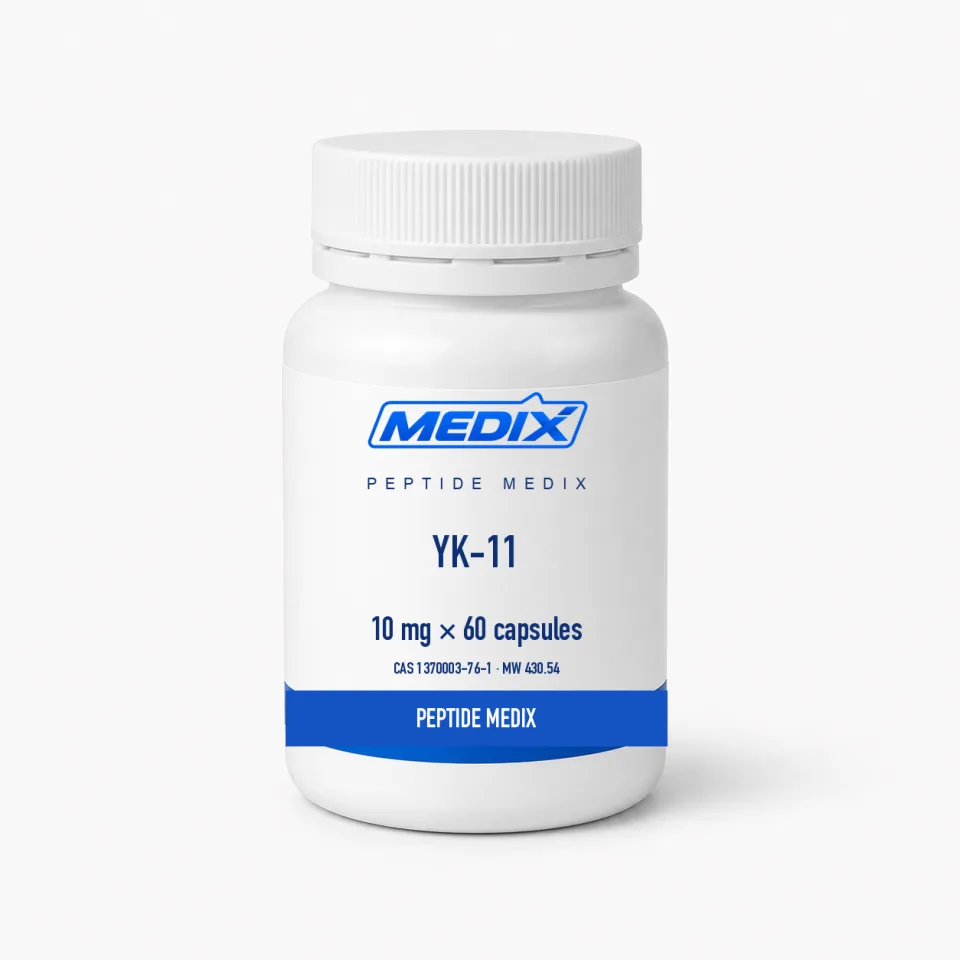
- ≥98% by HPLC
- Lot-matched certificate of analysis
- Ships next business day, tracked
YK-11
Steroidal partial androgen receptor modulator studied in myostatin work
- FormOral capsules in a sealed bottle, or research liquid in a dropper bottle
- Mol. weight430.54 g/mol
- Research areasAndrogen receptor partial agonism, follistatin and myostatin signalling, myotube differentiation
Overview
YK-11 is a synthetic research compound usually grouped with the SARMs, though it sits apart from the rest of that class in one important way: its structure is steroidal. The molecule is built on a 5α-androstane scaffold derived from dihydrotestosterone and carries a gem-dimethyl malonate ester at C-17, giving a formula of C25H34O6, a mass of 430.54 g/mol and CAS number 1370003-76-1. Compounds such as RAD-140 or LGD-4033, by contrast, have no steroid nucleus at all.
It was first described by Yuichiro Kanno and colleagues in Japan around 2011, in work characterising partial agonism at the androgen receptor. The reports that drew most attention came shortly afterwards, when cultured C2C12 myotubes exposed to the compound were described as increasing follistatin expression — follistatin being an endogenous antagonist of myostatin. That single line of cell-culture evidence is the origin of the widespread description of YK-11 as a “myostatin inhibitor”, a label the published data supports only loosely and only in vitro.
We supply YK-11 as 10 mg capsules in 60-count bottles and as a 30 mL research liquid at 20 mg/mL, tested by HPLC to at least 98% with a lot-matched certificate of analysis available. YK-11 is not an approved drug in any country, is not a lawful dietary ingredient in the United States, and is offered strictly for laboratory research use.
Specifications
Identity
- CAS number
- 1370003-76-1
- Molecular formula
- C25H34O6
- Molecular weight
- 430.54 g/mol
Supply & purity
- Form
- Oral capsules in a sealed bottle, or research liquid in a dropper bottle
- Purity
- ≥98% by HPLC; lot-matched COA available
- Solubility
- Poorly water soluble; DMSO or ethanol used for concentrated stocks
Additional detail
- Available options
- 10 mg × 60 capsules; 30 mL liquid at 20 mg/mL
- Compound class
- Steroidal selective androgen receptor modulator (partial agonist)
- Core structure
- 5α-androstane nucleus with a gem-dimethyl malonate ester at C-17
- Molecular target
- Androgen receptor; downstream follistatin expression studied in myotubes
- Research areas
- Androgen receptor partial agonism, follistatin and myostatin signalling, myotube differentiation
- Storage (capsules and solid)
- Room temperature, sealed with desiccant, away from light, heat and humidity
- Storage (research liquid)
- Cool and dark, closure tight; refrigerate for extended study windows
- Regulatory status
- Not an approved drug; not a lawful dietary ingredient in the US; prohibited by WADA
Units and conversions
The arithmetic on an oral format is unit arithmetic rather than dilution arithmetic. Use the milligram to microgram converter to line a per-unit figure up against a method written in different units.
Certificate of analysis
Every lot of YK-11 is released against a certificate of analysis: the batch-specific laboratory data for that lot, not a generic document for the compound. The lot number on the certificate matches the lot number printed on the label you receive — the vial label itself, where the product is vialled — so the record and the material it describes can always be reconciled.
Purity: ≥98% by HPLC — the specification for this listing. The figure for the lot you receive is the one reported on that lot’s certificate.
No lot certificate is on display on this page at the moment. That is a publishing state and not a testing one: lots are released and documented as described above whether or not the document is posted here, and we will send what exists for the lot in stock, or for a lot already on your bench, by its number.
Certificates are available on request before you order as well as after, with no account and no charge. Request the certificate for this listing, read the testing and documentation policy in full, or see how to read a peptide COA.
Questions about YK-11
Is YK-11 actually a SARM?
It is sold and discussed as one, but structurally it is a steroid. The molecule is a dihydrotestosterone derivative with a gem-dimethyl malonate ester at C-17, whereas compounds such as RAD-140 and LGD-4033 have no steroid nucleus. It is more accurately described as a steroidal partial androgen receptor agonist.
Does YK-11 inhibit myostatin?
Not directly, on the published evidence. Cell-culture work in C2C12 myotubes reported increased expression of follistatin, a natural myostatin antagonist. That is an indirect and in-vitro observation, and it is the sole basis for the myostatin-inhibitor label the compound is usually given.
What does partial agonist mean here?
It means YK-11 binds the androgen receptor but produces a smaller maximal transcriptional response than a full agonist like DHT. In a system already exposed to a full agonist, a partial agonist can compete for the pocket and reduce the overall signal, so context determines the observed direction of effect.
How is purity verified and is a COA supplied?
Each lot is analysed by HPLC to at least 98% purity with identity confirmation against the expected 430.54 g/mol mass. A certificate of analysis matched to the lot number printed on your bottle is available on request at any point before or after purchase.
Capsules or research liquid — which format suits a study?
Capsules give a fixed 10 mg unit with no preparation step, which suits repeated-unit protocols. The 30 mL liquid at 20 mg/mL is easier when a study needs variable amounts or dilution into a vehicle, since volume can be measured directly rather than opening multiple capsules.
Related