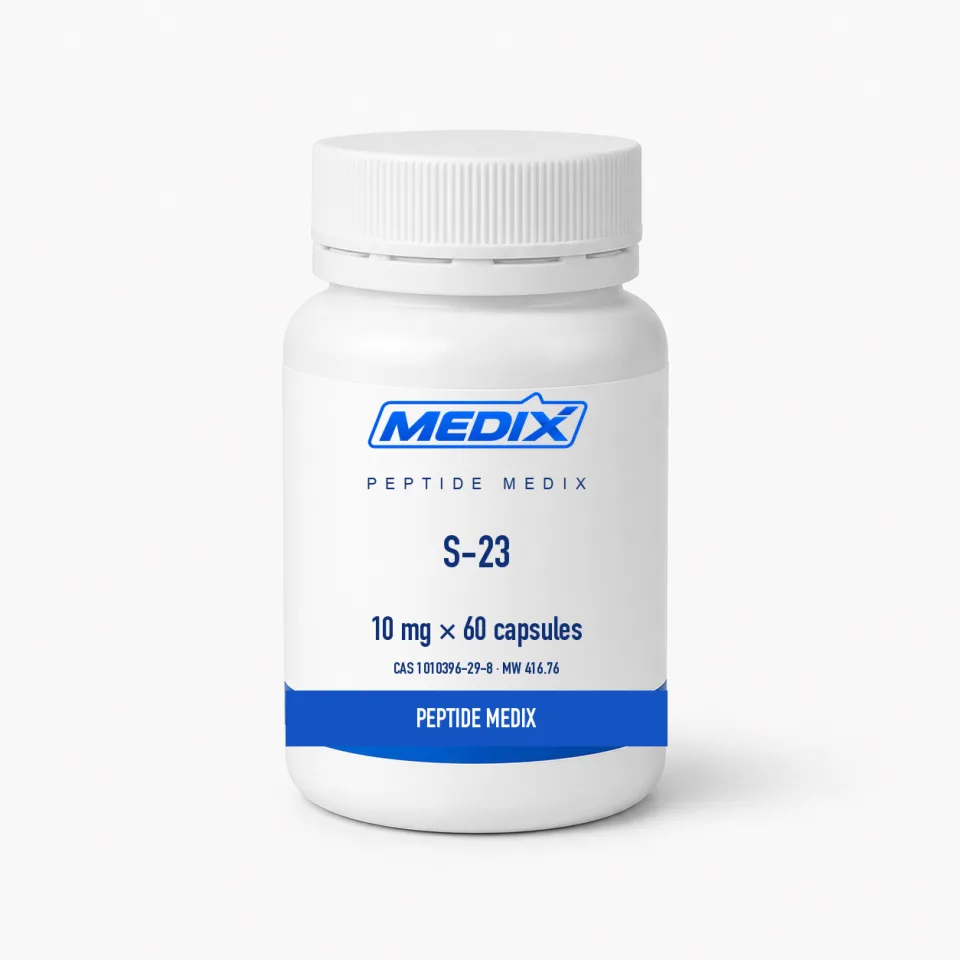
- HPLC tested with lot-matched COA available
- Lot-matched certificate of analysis
- Ships next business day, tracked
S-23
Non-steroidal selective androgen receptor modulator, capsules or 20 mg/mL liquid
- FormPowder-filled hard capsules, or clear solution in a 30 mL dropper bottle
- Mol. weight416.76 g/mol
- Research areasAndrogen receptor pharmacology, tissue selectivity, muscle and bone models, male contraception research
Overview
S-23 is a non-steroidal selective androgen receptor modulator, part of the aryl propionamide chemical series that also produced andarine (S-4) and, further back, the earliest SARM leads developed from bicalutamide-type scaffolds. Like the rest of that series it is a small synthetic molecule rather than a steroid, and it binds the androgen receptor without the four-ring steroid nucleus that defines testosterone and its derivatives.
The interest that drove its original characterisation was tissue selectivity. SARMs were designed to explore whether androgen receptor engagement in muscle and bone could be separated from engagement in prostate and other tissues, a question with obvious relevance to muscle-wasting research. S-23 is noted in the literature for relatively high binding affinity within its series, and it was also examined as a candidate male hormonal contraceptive in rodent studies, where suppression of spermatogenesis was reported to be reversible on withdrawal.
Specifications
Identity
- CAS number
- 1010396-29-8
- Molecular formula
- C18H13ClF4N2O3
- Molecular weight
- 416.76 g/mol
Supply & purity
- Form
- Powder-filled hard capsules, or clear solution in a 30 mL dropper bottle
- Purity
- HPLC tested with lot-matched COA available
- Available sizes
- 10 mg × 60 capsules; 30 mL liquid at 20 mg/mL (600 mg total)
- Solubility
- Poorly water-soluble; DMSO, ethanol and PEG-based vehicles used for stock solutions
Additional detail
- Compound class
- Non-steroidal SARM; aryl propionamide series
- Molecular target
- Androgen receptor (AR), a nuclear hormone receptor
- Related compounds
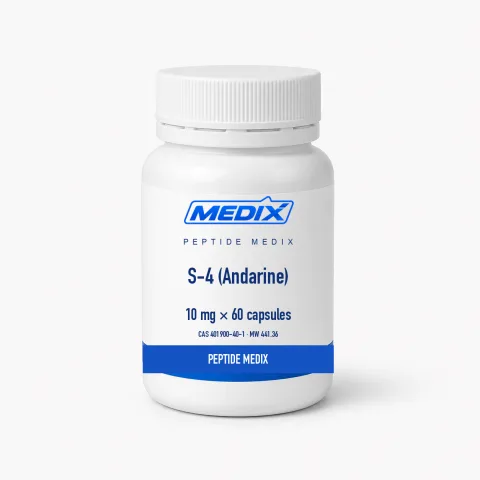
- Andarine (S-4) and other aryl propionamide SARMs
- Research areas
- Androgen receptor pharmacology, tissue selectivity, muscle and bone models, male contraception research
- Regulatory status
- Not approved as a drug; not a dietary supplement; on the WADA Prohibited List
- Storage (capsules)
- Cool, dry conditions in the sealed bottle, away from light and humidity
- Storage (solution)
- 2–8 °C, protected from light, tightly capped
Units and conversions
Capsule and troche strengths are stated per unit, so the figure a method needs is usually a conversion rather than a dilution. The mcg to mg converter handles the milligram-to-microgram step, and the millilitre arithmetic if you are working from a solution format instead.
Certificate of analysis
Every lot of S-23 is released against a certificate of analysis: the batch-specific laboratory data for that lot, not a generic document for the compound. The lot number on the certificate matches the lot number printed on the label you receive — the vial label itself, where the product is vialled — so the record and the material it describes can always be reconciled.
Purity: HPLC tested with lot-matched COA available — the specification for this listing. The figure for the lot you receive is the one reported on that lot’s certificate.
No lot certificate is on display on this page at the moment. That is a publishing state and not a testing one: lots are released and documented as described above whether or not the document is posted here, and we will send what exists for the lot in stock, or for a lot already on your bench, by its number.
Certificates are available on request before you order as well as after, with no account and no charge. Request the certificate for this listing, read the testing and documentation policy in full, or see how to read a peptide COA.
Questions about S-23
Is S-23 a peptide?
No. It is a small non-steroidal organic molecule of 416.76 g/mol containing chlorine and fluorine substituents, with no amino acid residues at all. It sits in the research-compounds department because it is a research chemical rather than a peptide, and it acts on a nuclear receptor rather than a cell-surface one.
How does it compare to other SARMs in the catalog?
S-23 and andarine both come from the aryl propionamide series, while RAD-140 and LGD-4033 belong to different chemical classes. Comparative binding affinity and tissue-selectivity profiles differ between them, which is exactly why laboratories run them side by side in the same assay.
Is a certificate of analysis available?
Yes. Each lot is analysed by HPLC for identity and purity, and a lot-matched certificate of analysis is available on request. Given how often SARM-labelled products have been found mislabelled in published surveys, checking the lot number against the certificate before starting work is worth the minute it takes.
Related