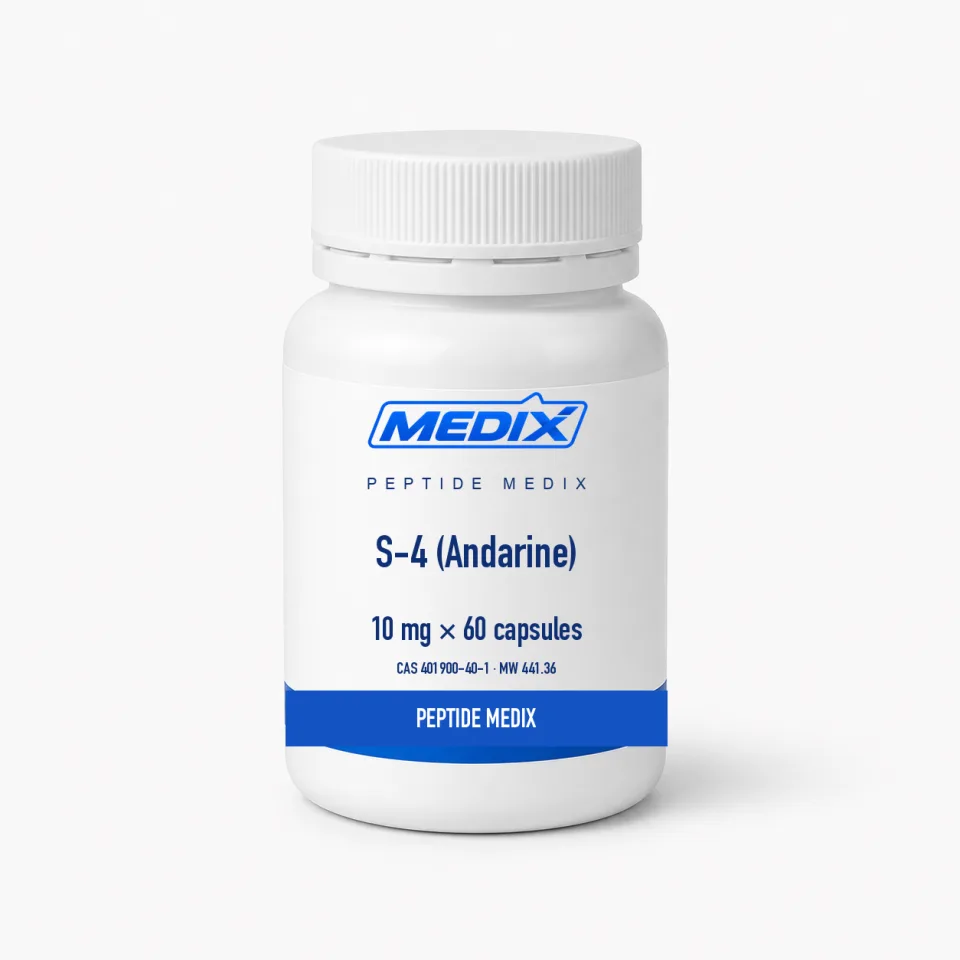
- ≥98% by chromatographic assay
- Lot-matched certificate of analysis
- Ships next business day, tracked
S-4 (Andarine)
Aryl-propionamide selective androgen receptor modulator, capsules or liquid
- FormOral capsules in a sealed bottle, or solution in a 30 mL dropper bottle
- Mol. weight441.36 g/mol
- Research areasTissue-selective androgen signalling, muscle and bone models, androgen receptor pharmacology, anti-doping analytical methods
Overview
S-4, commonly called andarine, is a non-steroidal selective androgen receptor modulator from the aryl-propionamide chemical series. It was derived from work on non-steroidal antiandrogens such as bicalutamide: chemists modified that scaffold until the resulting molecules bound the androgen receptor but produced agonist rather than antagonist signalling in muscle and bone tissue. Andarine was among the first compounds in that series to be characterised in detail in the published literature.
Because it is a small organic molecule and not a peptide, andarine needs no cold chain and no reconstitution. We supply it two ways: as 10 mg capsules in a sealed sixty-count bottle, and as a 30 mL solution at 20 mg/mL in a dropper bottle for laboratories that prefer to pipette a defined volume into media or vehicle. Each lot is assayed chromatographically for identity and purity to a ≥98% specification, with a lot-matched certificate of analysis available on request.
Specifications
Identity
- CAS number
- 401900-40-1
- Molecular formula
- C19H18F3N3O6
- Molecular weight
- 441.36 g/mol
Supply & purity
- Form
- Oral capsules in a sealed bottle, or solution in a 30 mL dropper bottle
- Purity
- ≥98% by chromatographic assay; lot-matched COA available
- Solubility
- Poorly soluble in water; soluble in DMSO, ethanol and propylene glycol
Additional detail
- Available options
- 10 mg × 60 capsules; 30 mL liquid at 20 mg/mL
- Also known as
- Andarine, S-4, GTx-007, acetamidoxolutamide
- Compound class
- Non-steroidal selective androgen receptor modulator (aryl-propionamide series)
- Research areas
- Tissue-selective androgen signalling, muscle and bone models, androgen receptor pharmacology, anti-doping analytical methods
- Storage
- Cool, dry and dark; refrigerate the liquid format and keep it upright
Units and conversions
The arithmetic on an oral format is unit arithmetic rather than dilution arithmetic. Use the milligram to microgram converter to line a per-unit figure up against a method written in different units.
Certificate of analysis
Every lot of S-4 (Andarine) is released against a certificate of analysis: the batch-specific laboratory data for that lot, not a generic document for the compound. The lot number on the certificate matches the lot number printed on the label you receive — the vial label itself, where the product is vialled — so the record and the material it describes can always be reconciled.
Purity: ≥98% by chromatographic assay — the specification for this listing. The figure for the lot you receive is the one reported on that lot’s certificate.
No lot certificate is on display on this page at the moment. That is a publishing state and not a testing one: lots are released and documented as described above whether or not the document is posted here, and we will send what exists for the lot in stock, or for a lot already on your bench, by its number.
Certificates are available on request before you order as well as after, with no account and no charge. Request the certificate for this listing, read the testing and documentation policy in full, or see how to read a peptide COA.
Questions about S-4 (Andarine)
What is S-4 (andarine)?
Andarine is a non-steroidal selective androgen receptor modulator in the aryl-propionamide series, developed from antiandrogen chemistry. It binds the androgen receptor and has been reported in animal studies to act as a partial agonist with different effects on muscle and bone tissue than on prostate tissue. It is a research compound, not a peptide.
Which format should a laboratory choose?
Capsules give a fixed 10 mg unit that suits studies where whole units are convenient and weighing equipment is limited. The 30 mL solution at 20 mg/mL lets a researcher pipette a precise volume into media or vehicle without weighing a poorly soluble solid, which is usually preferable for in vitro dilution series.
Is a certificate of analysis available?
Yes. Every lot is analysed for identity and purity by chromatographic assay with mass-spectrometric confirmation, specified at ≥98%, and a lot-matched COA is available on request. Independent surveys of the SARM market have found frequent mislabelling, which is why lot-level documentation matters.
How should it be stored?
Keep capsules sealed, dry and at room temperature or cooler, with the desiccant left in the bottle. The liquid format is best refrigerated at 2–8 °C, kept upright and shielded from light, with the cap closed firmly between draws to limit solvent evaporation and oxidation.
Related