- Lot-matched certificate of analysis
- Ships next business day, tracked
Research Compounds (SARMs & Small Molecules)
Phenylpiracetam
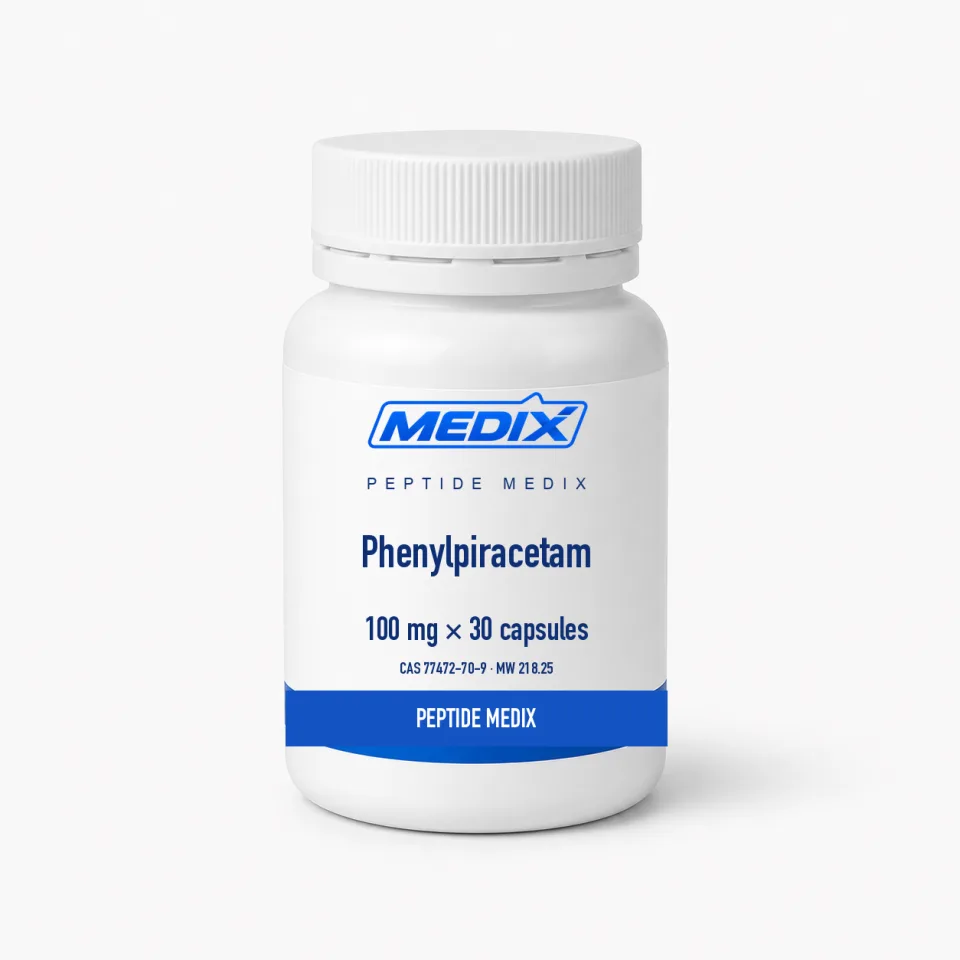
Phenylated racetam (fonturacetam), 100 mg capsules, 30 per bottle
- FormPowder-filled hard capsule, sealed bottle
- Mol. weight218.25 g/mol
- Research areasCognition and memory models, locomotor activity, stress adaptation, comparative racetam pharmacology
Overview
Phenylpiracetam is a small-molecule member of the racetam family, formed by adding a phenyl group to the pyrrolidone ring of piracetam. It is also encountered in the literature as fonturacetam and, in the older Soviet-era sources, as carphedon. The phenyl substitution changes the molecule's lipophilicity considerably relative to the parent compound, and that single structural difference is the starting point for most of the comparative pharmacology written about it.
The compound was developed in the Soviet Union and remains registered as a medicine in a small number of post-Soviet states; it has never been approved as a drug in the United States, and it is not a dietary supplement or food ingredient under US law. It carries a chiral centre, so it exists as R- and S-enantiomers with reported differences in activity, and racemic material is the form usually described in the literature and supplied for research.
Specifications
Identity
- CAS number
- 77472-70-9
- Molecular formula
- C12H14N2O2
- Molecular weight
- 218.25 g/mol
Supply & purity
- Form
- Powder-filled hard capsule, sealed bottle
- Available sizes
- 100 mg × 30 capsules
Additional detail
- Compound class
- Racetam; 2-oxo-pyrrolidine acetamide derivative
- Also known as
- Fonturacetam, carphedon, phenotropil
- Structural relationship
- Piracetam bearing a phenyl group at the 4-position of the pyrrolidone ring
- Stereochemistry
- One chiral centre; supplied as the racemate
- Appearance
- White to off-white crystalline powder within the capsule
- Research areas
- Cognition and memory models, locomotor activity, stress adaptation, comparative racetam pharmacology
- Storage
- Cool, dry conditions in the sealed bottle, away from light and humidity
Units and conversions
There is no reconstitution step for a solid oral format: the mass per unit of Phenylpiracetam is fixed on the label. Where a published method is written in micrograms and the label is in milligrams, the peptide unit converter does the conversion.
Certificate of analysis
Every lot of Phenylpiracetam is released against its own lot documentation, and where the manufacturer issues a certificate of analysis for it, that certificate is the record for the lot rather than a generic document for the compound. The lot number on the certificate matches the lot number printed on the label you receive — the vial label itself, where the product is vialled — so the record and the material it describes can always be reconciled.
This listing carries no purity percentage, so none is claimed for it here. Where the manufacturer issues analytical documentation for a lot of this item, it is passed on unaltered — ask and we will send whatever exists.
No lot certificate is on display on this page at the moment. That is a publishing state and not a testing one: lots are released and documented as described above whether or not the document is posted here, and we will send what exists for the lot in stock, or for a lot already on your bench, by its number.
Certificates are available on request before you order as well as after, with no account and no charge. Request the certificate for this listing, read the testing and documentation policy in full, or see how to read a peptide COA.
Questions about Phenylpiracetam
How does phenylpiracetam differ from piracetam?
Structurally it is piracetam carrying a phenyl group on the pyrrolidone ring. That substitution markedly increases lipophilicity, and comparative animal studies were designed largely to ask what that structural change does to distribution and behavioural endpoints relative to the parent compound.
Is it a peptide?
No. Phenylpiracetam is a small organic molecule of 218.25 g/mol with no amino acid residues, which is why it sits in the research-compounds department rather than among the peptides. It does appear alongside peptide nootropics such as semax and selank in comparative studies.
Is documentation available for the material?
Yes. Each lot is analysed by HPLC for identity and purity and a lot-matched certificate of analysis is available on request. Quote the lot number printed on the bottle when requesting the document, and record it alongside your results.
Related