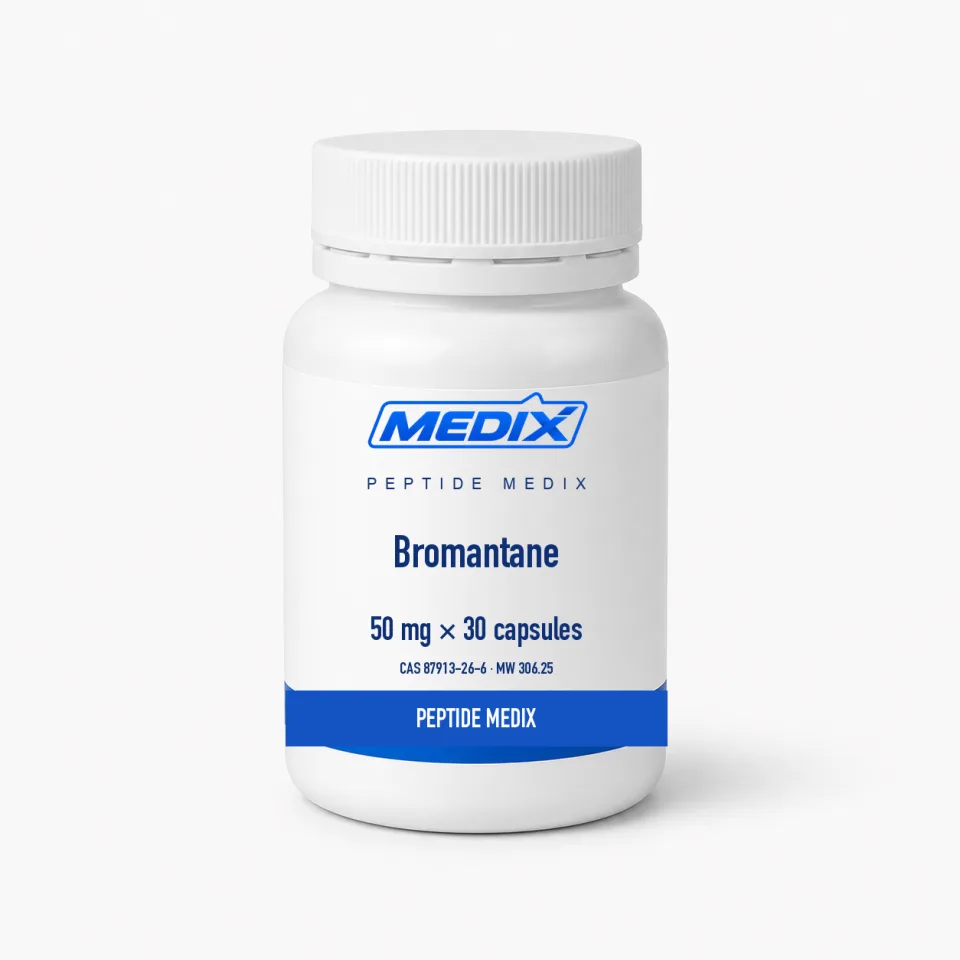
- ≥98% by chromatographic assay
- Lot-matched certificate of analysis
- Ships next business day, tracked
Research Compounds (SARMs & Small Molecules)
Bromantane
Adamantane-derived actoprotector studied in dopaminergic and fatigue models
- FormOral research capsules in a sealed bottle with desiccant
- Mol. weight306.25 g/mol
- Research areasDopamine synthesis enzymes, fatigue and asthenia models, anxiolytic-like behaviour, neuroimmune signalling
Overview
Bromantane is a small synthetic molecule built from an adamantane cage joined through a secondary amine to a 4-bromophenyl ring — formally N-(2-adamantyl)-N-(4-bromophenyl)amine. It came out of Soviet-era pharmacological programmes that looked for so-called actoprotectors: compounds studied for their reported ability to sustain physical and mental work output under heat, hypoxia and sleep restriction. It is sometimes catalogued under the development code ADK-709 and the Russian trade name Ladasten.
Chemically it is highly lipophilic and essentially insoluble in water, which distinguishes it sharply from the peptides in this catalogue and shapes how it is handled at the bench: stock solutions are usually prepared in DMSO or ethanol and diluted into assay media, and capsule material is weighed rather than reconstituted. Our capsules contain 50 mg of bromantane per unit in a sealed bottle, with identity confirmed by chromatographic analysis and a lot-matched certificate of analysis available on request.
Specifications
Identity
- CAS number
- 87913-26-6
- Molecular formula
- C16H20BrN
- Molecular weight
- 306.25 g/mol
Supply & purity
- Form
- Oral research capsules in a sealed bottle with desiccant
- Purity
- ≥98% by chromatographic assay; lot-matched COA available
- Solubility
- Practically insoluble in water; soluble in DMSO and ethanol
Additional detail
- Content per capsule
- 50 mg bromantane
- Available counts
- 30 capsules
- Chemical name
- N-(2-adamantyl)-N-(4-bromophenyl)amine
- Also known as
- Ladasten, ADK-709, bromantan
- Compound class
- Adamantane derivative; classified in the literature as an actoprotector
- Research areas
- Dopamine synthesis enzymes, fatigue and asthenia models, anxiolytic-like behaviour, neuroimmune signalling
- Storage
- Room temperature, dry, sealed and protected from light
Units and conversions
Capsule and troche strengths are stated per unit, so the figure a method needs is usually a conversion rather than a dilution. The mcg to mg converter handles the milligram-to-microgram step, and the millilitre arithmetic if you are working from a solution format instead.
Certificate of analysis
Every lot of Bromantane is released against a certificate of analysis: the batch-specific laboratory data for that lot, not a generic document for the compound. The lot number on the certificate matches the lot number printed on the label you receive — the vial label itself, where the product is vialled — so the record and the material it describes can always be reconciled.
Purity: ≥98% by chromatographic assay — the specification for this listing. The figure for the lot you receive is the one reported on that lot’s certificate.
No lot certificate is on display on this page at the moment. That is a publishing state and not a testing one: lots are released and documented as described above whether or not the document is posted here, and we will send what exists for the lot in stock, or for a lot already on your bench, by its number.
Certificates are available on request before you order as well as after, with no account and no charge. Request the certificate for this listing, read the testing and documentation policy in full, or see how to read a peptide COA.
Questions about Bromantane
What is bromantane?
Bromantane is a synthetic adamantane derivative, N-(2-adamantyl)-N-(4-bromophenyl)amine, developed in Russia and classified in the literature as an actoprotector. It is a small lipophilic molecule rather than a peptide, and it is studied mainly in rodent models of fatigue, dopaminergic signalling and anxiety-like behaviour.
Is bromantane third-party tested?
Yes. Each lot is analysed for identity and purity by chromatographic assay, and a lot-matched certificate of analysis is available on request before or after purchase. The COA reports the analytical method used and the measured purity for the specific lot supplied.
How should it be dissolved for laboratory work?
Bromantane is practically insoluble in water. Bench protocols typically prepare a concentrated stock in DMSO or ethanol and dilute that into assay medium, keeping the final solvent fraction low enough not to affect the model. Check the diluted preparation for precipitate before adding it to cells or tissue.
How is it stored and shipped?
Capsules are stable at room temperature in the sealed bottle with desiccant and do not need cold-chain shipping. Keep them dry and out of direct light. Orders ship from a United States facility in plain packaging with the lot number recorded on the bottle label for traceability.
Related