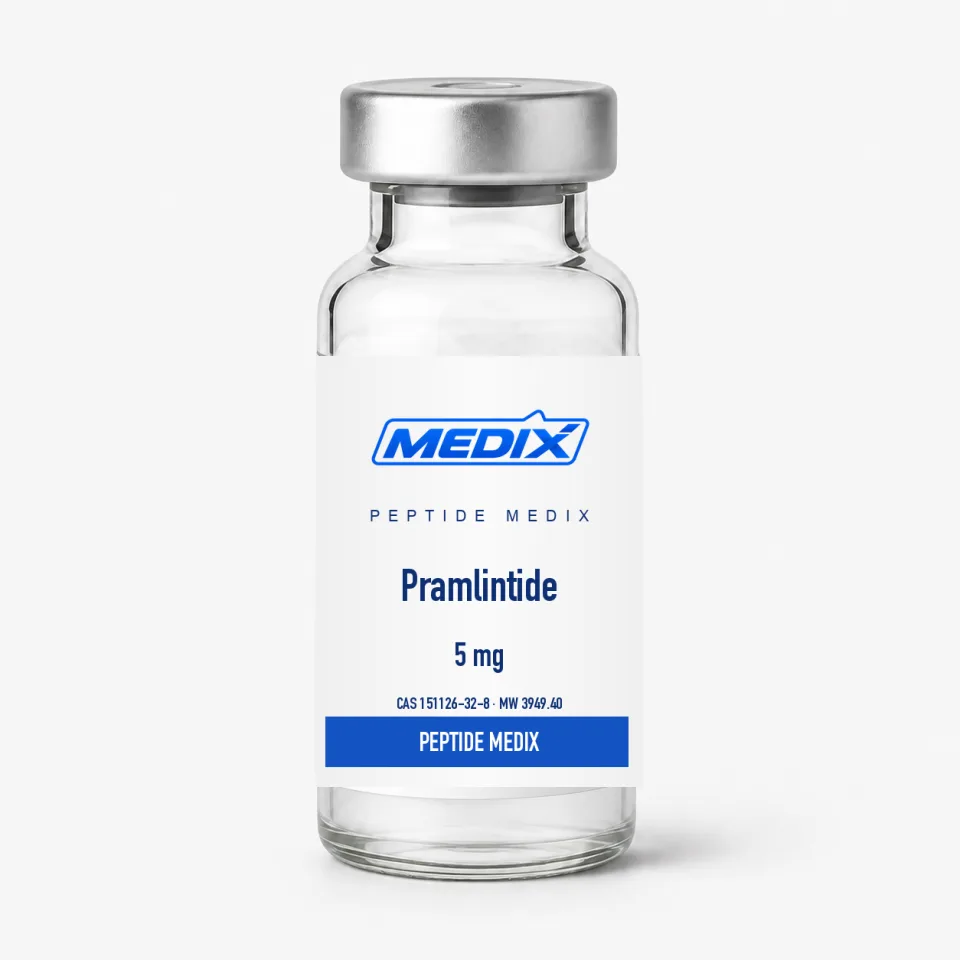
- ≥99% by HPLC
- Lot-matched certificate of analysis
- Ships next business day, tracked
Pramlintide
Synthetic 37-residue amylin analog for islet-hormone research
- FormLyophilized powder, sealed glass vial with flip-off seal
- Mol. weight3949.40 g/mol
- Research areasIslet hormone signalling, gastric emptying, glucagon regulation, satiety and food-intake models
Overview
Pramlintide is a synthetic 37-amino-acid analog of human amylin, the islet amyloid polypeptide co-secreted with insulin by pancreatic beta cells. Human amylin is awkward to work with because it aggregates readily into amyloid fibrils; pramlintide substitutes proline for the native residues at positions 25, 28 and 29 — a change borrowed from rat amylin, which does not form fibrils — giving a soluble, far more tractable molecule that retains amylin receptor activity.
Structurally the peptide keeps the features that define the amylin family: an intramolecular disulfide bridge between the two cysteine residues near the N-terminus and an amidated C-terminal tyrosine, both of which are required for receptor engagement. Its calculated mass is 3949.40 g/mol and it carries CAS number 151126-32-8. We supply it as a lyophilized powder in sealed 5 mg and 10 mg vials, synthesised by solid-phase methods and purified by reversed-phase HPLC to at least 99%, with a lot-matched certificate of analysis available.
Specifications
Identity
- CAS number
- 151126-32-8
- Molecular weight
- 3949.40 g/mol
- Amino acid sequence
- Lys-Cys-Asn-Thr-Ala-Thr-Cys-Ala-Thr-Gln-Arg-Leu-Ala-Asn-Phe-Leu-Val-His-Ser-Ser-Asn-Asn-Phe-Gly-Pro-Ile-Leu-Pro-Pro-Thr-Asn-Val-Gly-Ser-Asn-Thr-Tyr-NH2
- Chain length
- 37 amino acids, single chain
- Peptide class
- Synthetic amylin (islet amyloid polypeptide) analog
Supply & purity
- Form
- Lyophilized powder, sealed glass vial with flip-off seal
- Purity
- ≥99% by HPLC; lot-matched COA available
- Available sizes
- 5 mg, 10 mg
- Solubility
- Bacteriostatic water and mildly acidic aqueous buffers; solubility falls near neutral pH
Handling & storage
- Storage (lyophilized)
- −20 °C, sealed and protected from light and moisture
- Storage (reconstituted)
- 2–8 °C, protected from light; use within the study window
Additional detail
- Key modifications
- Pro substitutions at 25, 28 and 29; Cys2–Cys7 disulfide bridge; C-terminal amide
- Molecular target
- Amylin receptors — calcitonin receptor in complex with RAMP1, RAMP2 or RAMP3
- Research areas
- Islet hormone signalling, gastric emptying, glucagon regulation, satiety and food-intake models
Working out the concentration
Reconstitution is where the arithmetic lives. The same vial made up with 1 mL or with 3 mL of diluent gives three-fold different numbers, which is why a reconstitution volume calculator is more use here than a fixed table: enter the vial mass and your diluent volume and read the concentration back.
Where a method is written in molar terms instead, the molecular weight above — 3949.40 g/mol — is the input the molarity calculator needs.
Certificate of analysis
Every lot of Pramlintide is released against a certificate of analysis: the batch-specific laboratory data for that lot, not a generic document for the compound. The lot number on the certificate matches the lot number printed on the label you receive — the vial label itself, where the product is vialled — so the record and the material it describes can always be reconciled.
Purity: ≥99% by HPLC — the specification for this listing. The figure for the lot you receive is the one reported on that lot’s certificate.
No lot certificate is on display on this page at the moment. That is a publishing state and not a testing one: lots are released and documented as described above whether or not the document is posted here, and we will send what exists for the lot in stock, or for a lot already on your bench, by its number.
Certificates are available on request before you order as well as after, with no account and no charge. Request the certificate for this listing, read the testing and documentation policy in full, or see how to read a peptide COA.
Questions about Pramlintide
What is pramlintide?
It is a synthetic 37-residue analog of human amylin, the hormone that pancreatic beta cells release alongside insulin. Three proline substitutions taken from the rat sequence stop the peptide forming amyloid fibrils, so it stays in solution and behaves predictably in an experiment.
How does it differ from a GLP-1 analog such as semaglutide?
They act through different receptor systems. Semaglutide is an agonist at the GLP-1 receptor; pramlintide acts at amylin receptors formed from the calcitonin receptor plus a receptor activity-modifying protein. Researchers often run them side by side, or in combination, to separate the two pathways.
Why is it more stable than native human amylin?
Human amylin aggregates rapidly into amyloid fibrils, which makes concentration and activity unreliable across an assay. Substituting proline at positions 25, 28 and 29 disrupts the beta-sheet packing that drives fibril formation, mirroring rat amylin, which does not aggregate.
How is purity verified and is a COA supplied?
Every lot is analysed by reversed-phase HPLC to at least 99% purity, with mass spectrometry confirming the expected 3949.40 g/mol mass. A certificate of analysis matched to the lot number on your vial is available on request before or after purchase.
Which vial size should a laboratory choose?
The 5 mg vial suits assay development, receptor-binding work or a short pilot, while 10 mg reduces the number of vial openings in longer or multi-arm studies. Fewer openings mean fewer reconstitution steps and less variability between preparations.
How should it be stored?
Keep the lyophilized vial at −20 °C, sealed and away from light and moisture. Once reconstituted, laboratories hold the solution at 2–8 °C and use it within the planned study window, aliquoting to avoid repeated freeze–thaw cycles.
Related