- ≥99% by HPLC per vial
- Lot-matched certificate of analysis
- Ships next business day, tracked
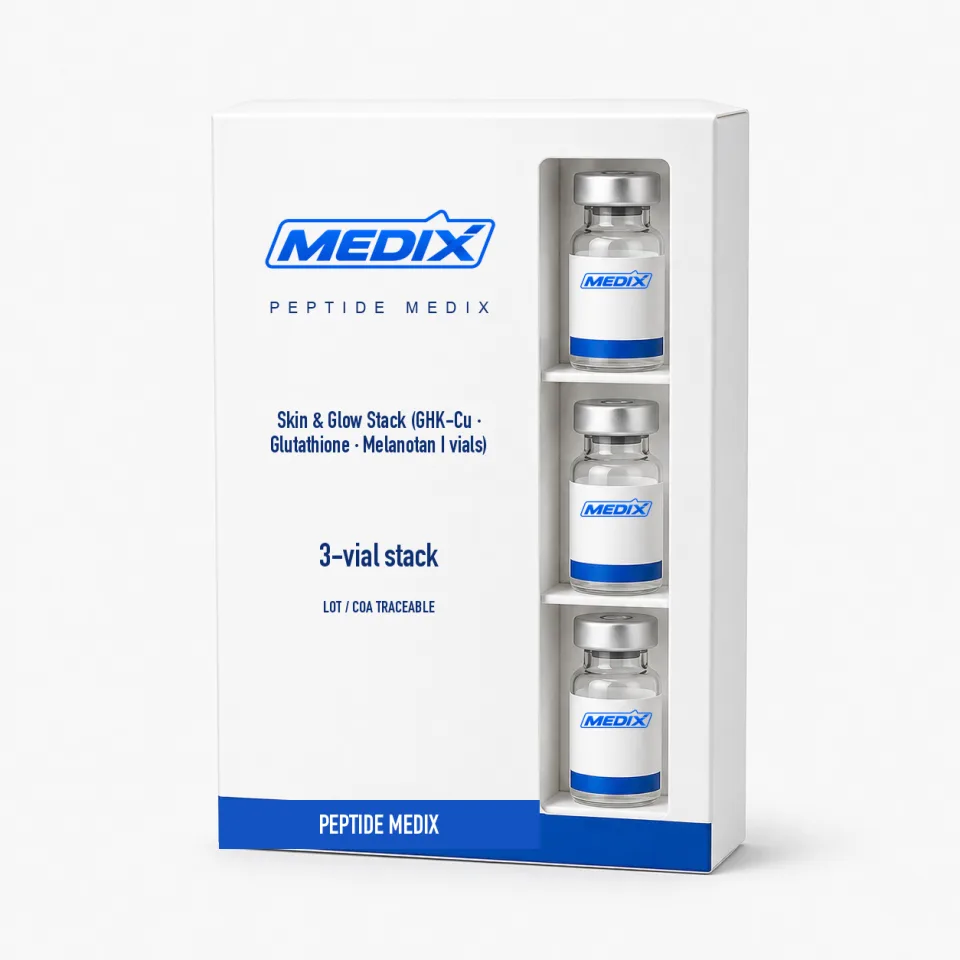
Skin & Glow Stack (GHK-Cu · Glutathione · Melanotan I vials)
Three-vial dermatology kit: GHK-Cu, L-glutathione and Melanotan I
- FormLyophilized powder in each vial, individually capped
- Research areasCollagen and matrix synthesis, redox and thiol biology, MC1R melanogenesis
Overview
The Skin & Glow Stack assembles three compounds studied in dermatological and pigment research and supplies them as separate sealed vials. What unites them is a research context — skin biology — rather than a shared mechanism, and their chemistry could hardly be more different.
GHK-Cu is a glycyl-L-histidyl-L-lysine tripeptide bound to copper(II), isolated from human plasma in the 1970s and studied since in fibroblast culture around collagen and matrix protein synthesis. L-glutathione is not a designed peptide at all: it is the endogenous tripeptide gamma-glutamyl-cysteinyl-glycine, the principal intracellular thiol antioxidant, present in nearly every cell and studied in redox biology, detoxification pathways and melanogenesis. Melanotan I, also known as afamelanotide, is a 13-residue analogue of alpha-melanocyte-stimulating hormone with substitutions at positions 4 and 7 that increase stability and receptor affinity at MC1R.
Each vial is HPLC-assayed to ≥99% purity with its own lot-matched certificate of analysis. Separate vials are the right format here because the three are used at very different milligram scales — glutathione at hundreds of milligrams, the peptides at tens. The kit is supplied as research material for laboratory use only.
Specifications
Supply & purity
- Form
- Lyophilized powder in each vial, individually capped
- Purity
- ≥99% by HPLC per vial; separate lot-matched COA for each
Handling & storage
- Storage (lyophilized)
- −20 °C, protected from light and moisture
- Storage (reconstituted)
- 2–8 °C, protected from light; glutathione oxidises readily
Additional detail
- Product type
- Multi-vial research kit — three separately sealed vials
- Kit contents
- One GHK-Cu vial, one L-glutathione vial, one Melanotan I vial
- GHK-Cu
- CAS 89030-95-5 · C14H24N6O4·Cu · 403.93 g/mol
- L-glutathione
- CAS 70-18-8 · C10H17N3O6S · 307.32 g/mol
- Melanotan I (afamelanotide)
- CAS 75921-69-6 · C78H111N21O19 · 1646.87 g/mol
- Melanotan I class
- [Nle4, D-Phe7]-alpha-MSH, 13-residue melanocortin analogue
- Glutathione class
- Endogenous tripeptide gamma-Glu-Cys-Gly; reduced form
- Research areas
- Collagen and matrix synthesis, redox and thiol biology, MC1R melanogenesis
- Reconstitution
- Each vial prepared separately; glutathione is used at far larger mass
Working out the concentration
Skin & Glow Stack (GHK-Cu · Glutathione · Melanotan I vials) ships as a lyophilized powder, so nothing on this page can state a concentration: the figure you work with is the one you create when you add diluent. Put the vial mass and the volume you intend to use into the peptide reconstitution calculator and it returns mg/mL, mcg/mL and the mass sitting at each mark on a U-100 syringe.
Certificate of analysis
Every lot of Skin & Glow Stack (GHK-Cu · Glutathione · Melanotan I vials) is released against a certificate of analysis: the batch-specific laboratory data for that lot, not a generic document for the compound. The lot number on the certificate matches the lot number printed on the label you receive — the vial label itself, where the product is vialled — so the record and the material it describes can always be reconciled.
Purity: ≥99% by HPLC per vial — the specification for this listing. The figure for the lot you receive is the one reported on that lot’s certificate.
No lot certificate is on display on this page at the moment. That is a publishing state and not a testing one: lots are released and documented as described above whether or not the document is posted here, and we will send what exists for the lot in stock, or for a lot already on your bench, by its number.
Certificates are available on request before you order as well as after, with no account and no charge. Request the certificate for this listing, read the testing and documentation policy in full, or see how to read a peptide COA.
Questions about Skin & Glow Stack (GHK-Cu · Glutathione · Melanotan I vials)
Why is glutathione supplied at a much larger mass?
Because it is used at a different scale. Glutathione vials are typically 600 mg or more, while GHK-Cu and Melanotan I are handled at tens of milligrams. That difference is exactly why this kit uses separate vials rather than a co-formulated blend.
Does each vial come with its own COA?
Yes. Each vial represents a distinct manufacturing lot and is released with its own certificate of analysis reporting HPLC identity and purity for that compound. Three separate documents accompany the kit and current lot COAs can be requested beforehand.
What is the difference between Melanotan I and Melanotan II?
Melanotan I, or afamelanotide, is a linear 13-residue alpha-MSH analogue with relative selectivity for MC1R. Melanotan II is a smaller cyclic heptapeptide with broader melanocortin receptor activity, including at MC3R and MC4R. They are distinct molecules with different research profiles.
Why does the GHK-Cu solution look blue?
The pale blue colour is intrinsic to the copper(II) ion coordinated within the tripeptide. It confirms the complex is intact and in solution. A colourless preparation, or a shift toward green or brown, would be unexpected and warrants setting the vial aside.
How stable is reconstituted glutathione?
Less stable than the peptides. Reduced glutathione oxidises to its disulfide form on exposure to air, and light and warmth accelerate that. Prepare it close to the time of use, keep it cold and dark, minimise headspace and avoid storing dilute solutions for long.
Related