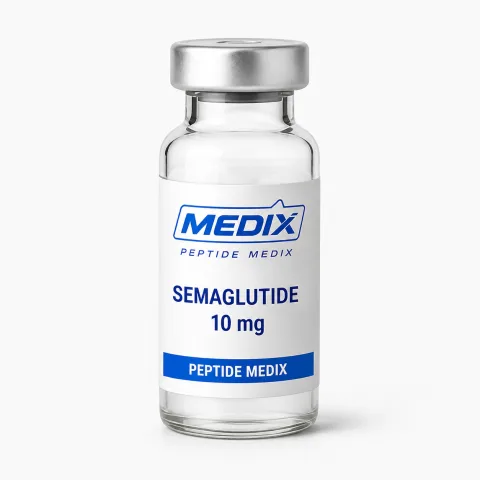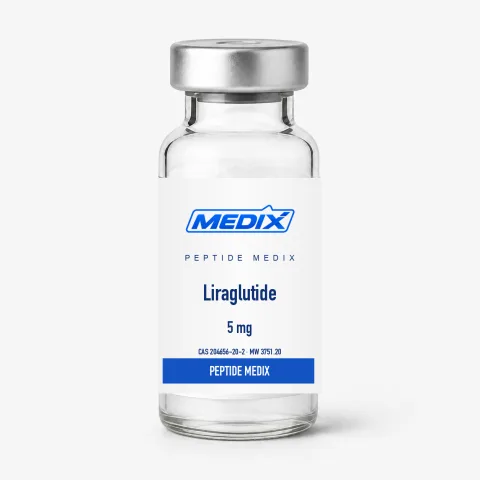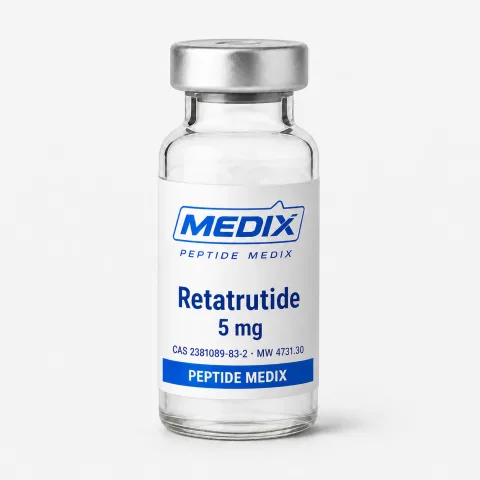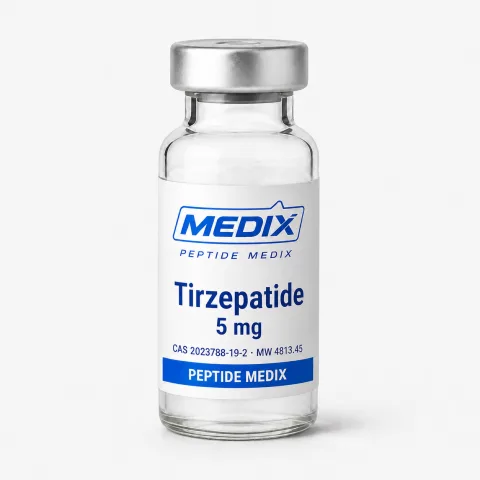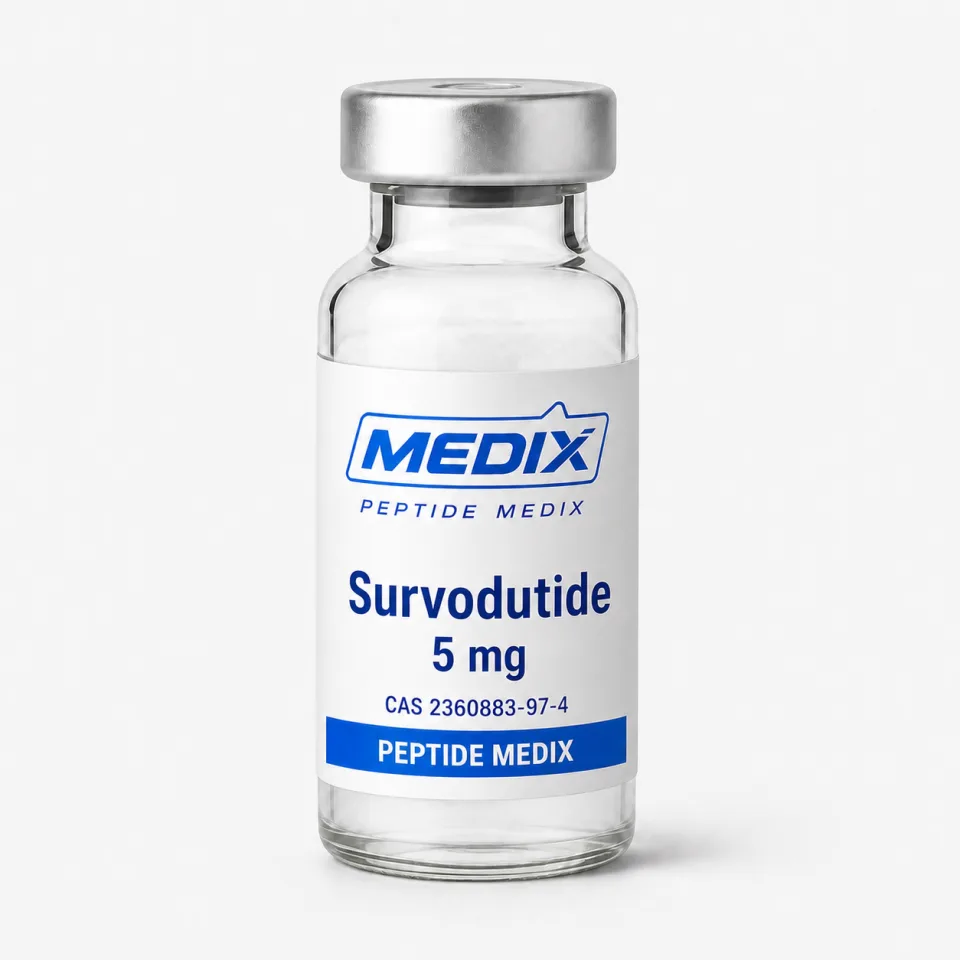
- ≥99% by HPLC
- Lot-matched certificate of analysis
- Ships next business day, tracked
Survodutide Peptide
Acylated dual glucagon and GLP-1 receptor agonist peptide for research
- FormLyophilized powder, sealed glass vial with flip-off seal
- Research areasHepatic lipid metabolism, energy expenditure, incretin-glucagon receptor crosstalk
Overview
Laboratories work with survodutide when the question is how glucagon receptor engagement modifies a GLP-1 response. Typical experiments measure cyclic-AMP potency at each receptor separately in transfected cells, then move to hepatocyte, adipocyte or whole-animal systems where glucagon-driven endpoints such as hepatic lipid content, ketone production and indirect-calorimetry measures can be separated from intake effects. It is also used as a comparator against triple agonists that add GIP activity on top of the same two receptors.
Structurally it is built on a glucagon-superfamily backbone rather than a GLP-1 one, stabilised with protease-resistant substitutions and carrying a fatty-acid side chain for reversible albumin binding — the same acylation strategy used across this class, applied to a different parent sequence. It is catalogued under CAS 2360883-97-4 and also appears in the pharmacology literature under a development code, worth searching when assembling references. No molecular formula is printed in the specification list because published structural descriptions differ between sources, and the lot certificate carries the identity data verified for the vial supplied. Three fills are stocked, 5 mg, 10 mg and 20 mg, dissolving in bacteriostatic water or in a dilute alkaline or phosphate buffer, with the sealed cake held in the freezer and solutions refrigerated.
Specifications
Identity
- CAS number
- 2360883-97-4
- Peptide class
- Acylated dual glucagon receptor / GLP-1 receptor agonist
Supply & purity
- Form
- Lyophilized powder, sealed glass vial with flip-off seal
- Purity
- ≥99% by HPLC; lot-matched COA available
- Available sizes
- 5 mg, 10 mg, 20 mg
- Solubility
- Bacteriostatic water; dilute alkaline or phosphate buffers also used
Handling & storage
- Storage (lyophilized)
- −20 °C, sealed and protected from light and moisture
- Storage (reconstituted)
- 2–8 °C, protected from light; use within the study window
Additional detail
- Structural notes
- Glucagon-superfamily backbone with protease-resistant substitutions and a fatty-acid side chain for albumin binding
- Research areas
- Hepatic lipid metabolism, energy expenditure, incretin-glucagon receptor crosstalk
Working out the concentration
Because Survodutide arrives dry, its concentration is a decision rather than a specification. Run the numbers through the reconstitution calculator — vial mass in, diluent volume in, mg/mL and mass per syringe unit out.
Certificate of analysis
Every lot of Survodutide is released against a certificate of analysis: the batch-specific laboratory data for that lot, not a generic document for the compound. The lot number on the certificate matches the lot number printed on the label you receive — the vial label itself, where the product is vialled — so the record and the material it describes can always be reconciled.
Purity: ≥99% by HPLC — the specification for this listing. The figure for the lot you receive is the one reported on that lot’s certificate.
No lot certificate is on display on this page at the moment. That is a publishing state and not a testing one: lots are released and documented as described above whether or not the document is posted here, and we will send what exists for the lot in stock, or for a lot already on your bench, by its number.
Certificates are available on request before you order as well as after, with no account and no charge. Request the certificate for this listing, read the testing and documentation policy in full, or see how to read a peptide COA.
Questions about Survodutide
How does survodutide differ from tirzepatide?
Tirzepatide pairs two incretin receptors, GIP and GLP-1. Survodutide pairs the glucagon receptor with GLP-1, so its research profile centers on hepatic substrate handling and energy expenditure rather than on incretin receptor crosstalk.
What purity and documentation do you provide?
Every lot is HPLC tested to at least 99% purity with identity confirmed by mass spectrometry. A lot-matched certificate of analysis is available and corresponds to the vial number shipped, keeping assay data traceable to the specific material used.
Why is no molecular formula listed?
We publish only specifications we can state with confidence. Reported structural descriptions for this peptide vary between sources, so we point instead to the lot certificate of analysis, which carries the identity data verified for your specific vial.
How should it be stored?
Keep the sealed lyophilized vial at −20 °C, away from light and moisture. After reconstitution, refrigerate at 2–8 °C, protect from light and use within your documented study window. Aliquot to avoid repeated freeze-thaw cycling.
Related